

How does the blasting process impact the overall quality of the powder coating?
Blasting improves powder coating quality by removing rust, mill scale, old coatings and other contaminants while creating a consistent surface profile for the powder to grip. Correctly controlled blasting supports stronger adhesion, more even coverage and better long-term durability; unsuitable media, pressure or technique can instead damage the metal or leave residues that cause coating defects.
Blasting influences powder coating quality by determining how consistently the metal is prepared for every stage that follows. Its effect is seen not only in adhesion, but also in the coating’s appearance, film uniformity, resistance to handling and corrosion protection. A controlled blasting process gives the coating team a predictable surface; inconsistent preparation makes later coating defects more likely and harder to diagnose.
Surface texture and coating film behaviour
The texture created by blasting affects how the powder film settles across the component. A surface that is too smooth can provide insufficient mechanical keying, while an excessively aggressive profile can leave pronounced peaks and valleys. These variations may influence local film thickness, especially on broad faces, corners and exposed edges. If the profile is not appropriate for the component and coating system, the finished surface may look uneven or provide less consistent protection.
Profile control is therefore a balance rather than a matter of using the highest possible blasting force. The blasting method, abrasive characteristics, air pressure, nozzle distance and operator technique all need to suit the substrate and the required finish. Softer metals may require more controlled treatment than robust steelwork, particularly where preserving dimensions or a smooth visual appearance is important.
Component geometry and difficult areas
Blasting quality can vary across a component if its geometry is not considered. Recesses, holes, internal corners, folded sections and areas behind brackets may receive less direct abrasive action than exposed faces. Conversely, edges and thin sections can receive disproportionate treatment. This can create differences in texture across one part, which may later show as variation in coating appearance or performance.
Welds also require careful attention. Weld spatter, sharp transitions and heat-affected areas can remain visible through the final finish if they are not properly prepared before coating. Blasting cannot correct poor fabrication, excessive sharpness or unsuitable weld profiles, so preparation and fabrication quality need to work together. Where a component has tight tolerances, masking or controlled treatment may also be needed to prevent unnecessary alteration of mating surfaces, threads or precision features.
Cleanliness and process contamination
The condition of the blasting equipment and abrasive has a direct bearing on the finished coating. Reused or poorly managed media can carry unwanted particles into the process. Dust, oil from equipment, moisture and residues on the component can interfere with subsequent powder application. Even when a surface appears visually clean, contamination can contribute to craters, pinholes, fisheyes or localised coating failure.
For this reason, preparation includes more than directing abrasive at the metal. Components should be assessed before treatment, blasting equipment should be kept in suitable condition, and the prepared surface should be protected from handling contamination. Clean gloves, suitable lifting methods and controlled movement between preparation and coating areas help prevent a good blasted surface from being compromised afterwards.
Impact on appearance and consistency
Uniform preparation is particularly important when several parts are being coated as a batch. Differences in blasting angle, exposure or surface condition can produce variations in gloss, texture and visual uniformity after powder application. The effect may be more noticeable on large flat panels, parts viewed side by side, or assemblies where adjacent components need to match.
Blasting can also reveal defects that were not obvious on an untreated surface, such as pitting, laminations, deep scratches or irregular weld preparation. Identifying these issues before powder coating allows them to be assessed rather than concealed beneath the finish. Powder coating follows the shape of the substrate; it is not a filler for significant surface defects.
Relationship with application and curing
Blasting establishes the condition of the substrate, but the final result also depends on applying the correct powder quantity and curing it according to the coating manufacturer’s requirements. A well-prepared component can still develop defects if powder is applied unevenly, if difficult areas are not adequately covered, or if the cure is unsuitable for the metal and powder system.
Equally, a correctly applied and cured coating cannot fully compensate for inconsistent preparation underneath. This is why the blasting stage should be treated as part of an integrated finishing process rather than an isolated operation. The component’s material, geometry, intended use and required appearance should inform the preparation method from the outset.
Checks that support reliable results
Useful quality checks may include:
- examining the component for remaining scale, corrosion, previous coating and visible contamination;
- checking that the surface texture is consistent and appropriate for the specified finish;
- inspecting edges, welds, recesses, holes and other areas that are difficult to reach;
- looking for embedded abrasive, dust, moisture or handling marks before powder application;
- confirming that prepared parts have not been exposed to conditions that could cause renewed surface deterioration; and
- reviewing the finished coating for visual variation, thin areas, inclusions and other signs of uneven preparation.
In practical terms, blasting has the greatest positive effect when it is selected and controlled for the individual component, followed by careful handling and consistent powder application. Its contribution is measurable through the uniformity and condition of the finished coating, while poor control can create defects that persist throughout the service life of the part.
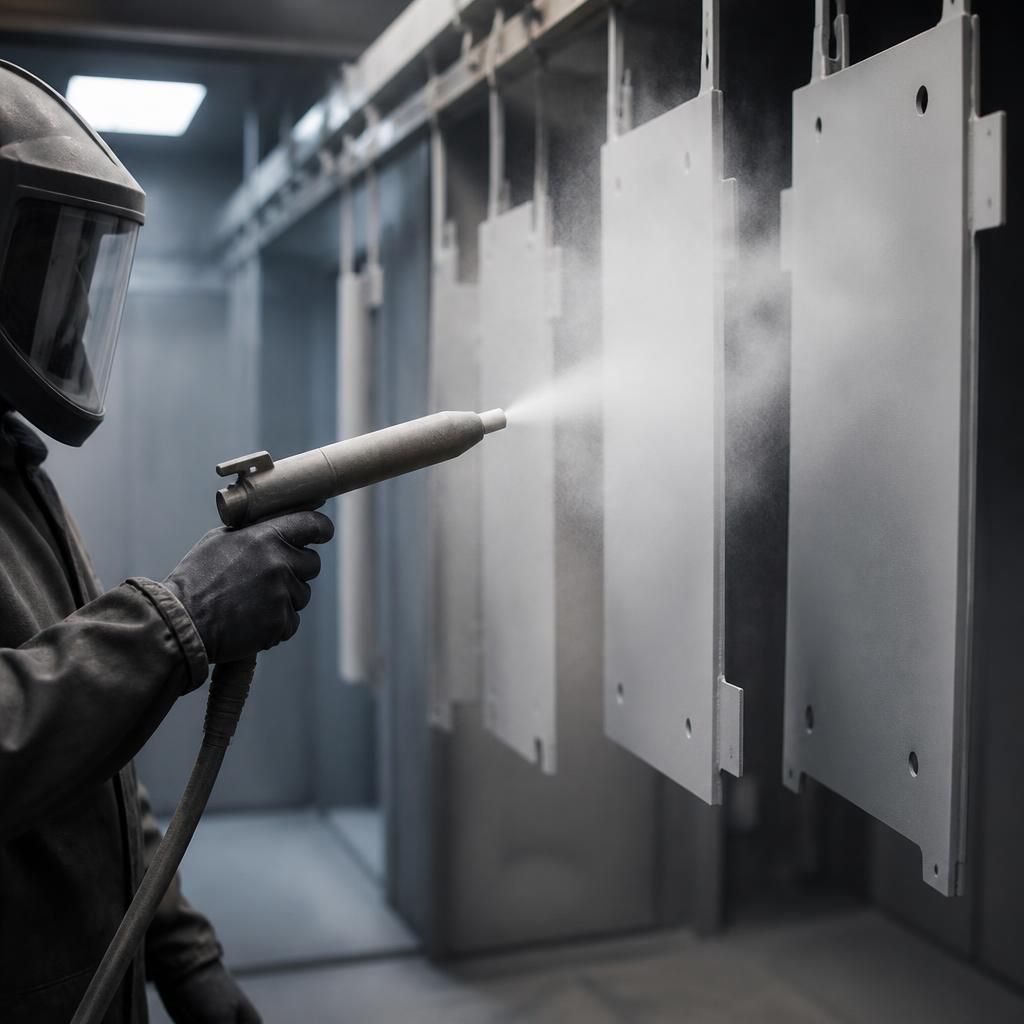
Blasting also influences how reliably powder can be deposited during electrostatic application. Removing non-conductive residues, loose oxide and remnants of previous coatings helps establish a clean substrate, while clean contact points allow the component to be grounded correctly. This supports consistent attraction of charged powder to the metal rather than uneven build caused by poor electrical contact or local surface contamination.
The blasting stage must still be matched to the substrate. Abrasive trapped in the surface, excessive oxidation after preparation or contamination from handling can interfere with powder deposition and may only become apparent as thin coverage, inclusions or adhesion problems after curing. Surface preparation, grounding and powder application therefore need to be considered as connected stages of the finishing process.
Discuss Your Blasting and Powder Coating Requirements
If you are planning a powder coating project, discuss your component material, dimensions, geometry and intended use with our team so the blasting and coating requirements can be considered together. Share your specification or batch details to explore a suitable preparation approach.