

How can the choice of sandblasting media affect the integrity and longevity of the powder coating finish?
The sandblasting media determines the surface profile, cleanliness and degree of substrate impact before powder is applied. Using a suitable abrasive for the metal and coating system helps create a consistent key for adhesion, while unsuitable media can leave contamination, distort softer substrates or produce a profile that weakens the finish over time.
The choice of sandblasting media affects powder coating longevity by controlling how the substrate is cleaned, how much material is removed and what surface texture remains for the coating to grip. The most suitable abrasive produces a stable, uniform surface without embedding unwanted particles, rounding important edges or damaging the metal. An unsuitable medium can contribute to poor adhesion, corrosion beneath the coating, premature wear and visible defects.
Surface profile and mechanical adhesion
Blasting creates microscopic peaks and valleys in the metal. Powder coating flows across this prepared surface and, once cured, forms a mechanical bond with it. Angular abrasives generally create a more pronounced profile because their edges cut into the substrate. Rounded media tend to peen or smooth the surface, making them useful where a lower-impact finish is required but potentially less suitable where a stronger key is needed.
The profile must be appropriate for the powder system and the component. If it is too shallow, there may be insufficient mechanical engagement. If it is excessively deep, the powder may not adequately cover the recesses, leaving thin areas that are more vulnerable to corrosion and wear. A coarse, irregular profile can also remain visible through a thinner decorative finish.
Media selection for different substrates
Hard carbon steel can usually tolerate more aggressive media than aluminium, zinc-coated parts or thin-gauge sheet. Abrasives such as steel grit or aluminium oxide may be appropriate for robust steel components when the process is controlled correctly. Softer substrates can be distorted, gouged or left with an unsuitable profile if the abrasive is too hard, too coarse or applied with excessive force.
Aluminium often requires a less aggressive approach because it can erode quickly and show blasting marks beneath the powder. Glass bead or a fine non-metallic abrasive may be considered where the objective is to remove contamination while limiting substrate damage. Zinc-coated surfaces require particular care because excessive blasting can remove the protective zinc layer rather than simply prepare it.
Stainless steel also needs controlled media selection. Media previously used on carbon steel can transfer ferrous contamination to the stainless surface. Those particles may later oxidise and create rust-coloured staining, even though the underlying component is stainless steel. Dedicated or suitably controlled media and clean blasting equipment help reduce this risk.
Contamination and embedded abrasive
Media can become contaminated with oil, paint residues, salts, moisture or particles from earlier work. If these contaminants are transferred to the component, the powder may fail locally or develop bubbling, pinholing or discolouration during curing. Broken-down abrasive can also produce excessive dust, making it harder to achieve a consistently clean surface.
Some media can become embedded in softer metals or remain trapped in recesses, weld details and threaded areas. This may interfere with coating adhesion or create a route for corrosion if the coating does not fully cover the affected area. Media condition, storage, separation between materials and suitable cleaning after blasting are therefore as important as the nominal type of abrasive.
Impact on component integrity
Blasting is not only a cleaning operation; it applies energy to the component. Excessive impact can round sharp edges, alter fine details, damage machined surfaces or distort thin sections. Edges are especially important because powder tends to pull away from sharp geometry during application and curing, leaving a naturally thinner coating at the edge. Removing too much material or changing the shape of the edge can make this weakness more pronounced.
Over-blasting may also create unnecessary residual stress or a roughness that the coating cannot reliably cover. The correct process uses enough energy to prepare the surface but avoids treating the component more aggressively than its design and material require.
How media choice affects long-term coating performance
A durable finish depends on the relationship between the substrate, the prepared surface and the powder system. Media that leaves a clean, compatible profile supports consistent wetting and bonding during powder application. Media that leaves dust, soluble contamination, embedded particles or an inconsistent texture creates weak points. Moisture and salts trapped in those areas can promote corrosion under the coating, while poor bonding can lead to flaking or lifting after impact, abrasion or environmental exposure.
The required preparation may also vary according to the component’s intended use. A decorative indoor part may not need the same level of abrasion resistance or corrosion protection as an external structural component, vehicle part or industrial item exposed to chemicals and repeated handling. The abrasive should therefore be selected with the final service conditions and the powder coating specification in mind, rather than chosen solely because it removes material quickly.
Process checks before powder application
- Confirm that the abrasive is compatible with the substrate and will not introduce unwanted metallic contamination.
- Check that the media is clean, dry and in suitable condition, with degraded or contaminated material removed.
- Inspect the blasted surface for remaining mill scale, rust, paint, oil, dust and embedded abrasive.
- Assess the texture across the whole component rather than relying on one easily accessible area.
- Protect prepared parts from handling contamination and moisture before powder is applied.
- Use an agreed surface preparation standard and verify the profile where the coating specification requires it.
In practice, the best media is not necessarily the hardest or fastest-cutting option. It is the abrasive that achieves the required cleanliness and surface texture while preserving the component’s dimensions, edges and material properties. Matching the media to the metal, coating system and service environment gives the powder a sound foundation and reduces the risk of adhesion failure or corrosion developing beneath the finished coating.
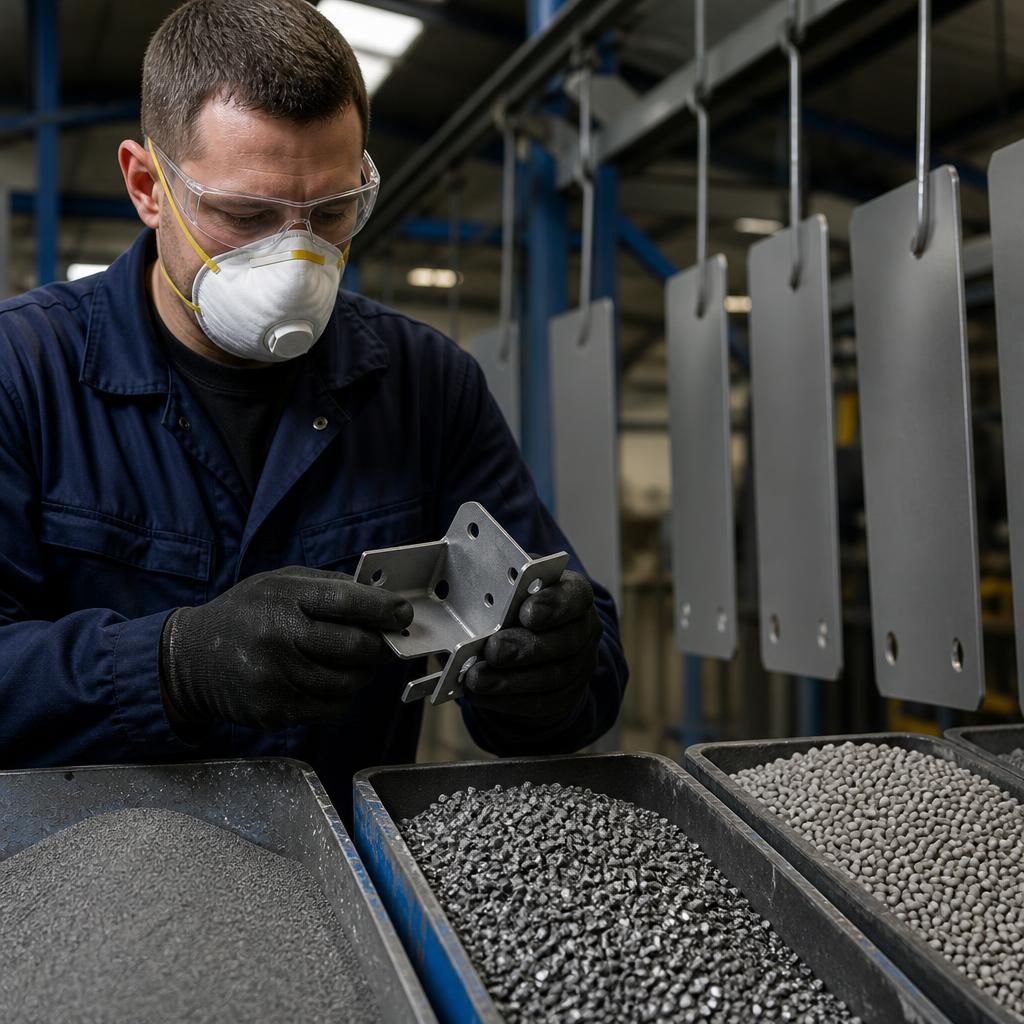
Media condition can affect the consistency of a powder coating across a production batch. As abrasive particles fracture or become rounded through use, their cutting action changes. The resulting variation in surface preparation can leave some components with a different texture from others, even when the same blasting settings are used.
For repeat work, the abrasive should be monitored throughout the process and replaced or separated when its performance changes. Checking representative parts from the beginning and end of a batch helps identify differences in cleanliness and surface texture before powder application. Consistent media condition supports a more uniform coating foundation and reduces variation in adhesion and finish quality between components.
Discuss your sandblasting media requirements
Discuss your sandblasting media requirements with the team, providing details of the component material, dimensions, existing finish and intended service environment. This information helps identify a preparation approach suited to the part and its powder coating specification.