

How can selecting the right grit size for sandblasting optimise the surface preparation for a flawless powder coating application?
Selecting the right sandblasting grit size creates the surface profile needed for powder coating to bond securely without unnecessarily damaging the metal. Match the grit to the substrate, coating or contamination being removed, and the required surface texture, using finer media for delicate surfaces and coarser media for heavier preparation.
The correct grit size is the one that produces a clean, consistently keyed surface without removing excessive substrate or creating a profile the powder cannot cover. Selection should therefore be based on the metal’s hardness and condition, the existing coating or corrosion, the powder system’s requirements and the blasting equipment, rather than on grit size alone.
Understand what the grit specification means. Abrasives may be described by mesh size, particle size, grade or a manufacturer’s own classification. These descriptions are not always directly interchangeable. A finer numerical mesh generally indicates smaller particles, but the exact range can vary between abrasive types. Before processing production parts, confirm the supplier’s particle-size range and consider how much the media has broken down through use. Worn abrasive can produce a less consistent finish and may behave more like a finer grade than the original charge.
Use the substrate as the starting point. Steel can usually tolerate more aggressive preparation than aluminium, thin sheet or delicate fabricated sections, but the condition and geometry of the part remain important. A heavy grit directed at sharp edges, corners or thin areas can cause undesirable rounding, distortion or dimensional change. Softer metals may also become embedded with unsuitable abrasive, which can affect the appearance or performance of the finished coating. For these components, a controlled finer abrasive or a less aggressive blasting approach is often more appropriate.
Consider what must be removed. Light oxidation, handling residue and a sound, lightly adhered coating may require a different abrasive grade from thick mill scale, firmly bonded corrosion or multiple layers of old paint. A coarse abrasive can remove difficult contamination more efficiently, but it also increases the risk of an overly pronounced surface texture. If the contamination is localised, it may be better to pre-clean or mechanically remove the worst deposits before blasting, allowing a more controlled grit to prepare the whole component.
Particle shape affects the result as much as particle size.
- Angular particles cut into the surface and are useful where a more pronounced mechanical key is required.
- Rounded or spherical particles tend to peen or burnish rather than cut, so they may be unsuitable where the objective is to create a defined anchor pattern for powder.
- Hard abrasives remove material quickly but can be unnecessarily aggressive on softer substrates.
- Lower-contamination media can be preferable where residue, embedment or colour transfer could affect coating appearance.
Consequently, two abrasives with a similar nominal grit size can produce different results. A trial panel or a non-critical sample is useful when the substrate, existing finish or powder specification is unfamiliar. The test should assess cleanliness, visual uniformity, edge condition and the resulting surface profile before the full batch is processed.
Control the blasting conditions. Grit selection cannot be separated from nozzle distance, angle, air pressure, abrasive flow, traverse speed and the number of passes. Increasing pressure or dwelling in one area can make a relatively fine abrasive act more aggressively. Holding the nozzle too close may produce uneven preparation, while an inconsistent travel speed can leave bands with different textures. Operators should use a repeatable method and avoid treating flat faces, edges and recesses as though they require identical exposure.
Media cleanliness and equipment condition also influence consistency. Moisture can interrupt abrasive flow, and excessive fines can reduce cutting efficiency or produce a less uniform finish. Contaminated reusable media may transfer oil, paint particles or other residues back to the workpiece. Sieving, separating or replacing media where appropriate helps maintain a predictable result. The blasting system should also be checked for worn nozzles, as changes in the nozzle opening can alter the effective delivery of the abrasive.
Inspect the prepared surface before powder coating. A suitable result should be visually clean, evenly textured and free from loose dust, abrasive residue, oil and remaining corrosion. Pay particular attention to welds, folded edges, drilled holes and recesses, where contamination is easily retained. Surface-profile comparators, replica tape or suitable electronic instruments can be used where a documented profile is required. The acceptable range should come from the coating specification or the powder manufacturer’s technical guidance; a visibly rough surface is not automatically a better surface.
Timing after blasting is also relevant. Clean bare steel can begin to oxidise if exposed to moisture or contaminated handling before powder application. Parts should therefore be protected from recontamination and handled with suitable clean equipment. If flash rusting, dust deposition or oily fingerprints are found, the surface may need further preparation rather than being sent directly to the coating stage.
For batch work, record the abrasive type and grade, equipment settings, inspection findings and any adjustments made during the run. This creates a repeatable preparation method and makes it easier to identify whether a coating defect originated in blasting, cleaning or curing. Where a project involves mixed metals, variable thicknesses or a difficult existing finish, an industrial coating specialist can review the parts and establish a blasting procedure suited to each component before processing the full order.
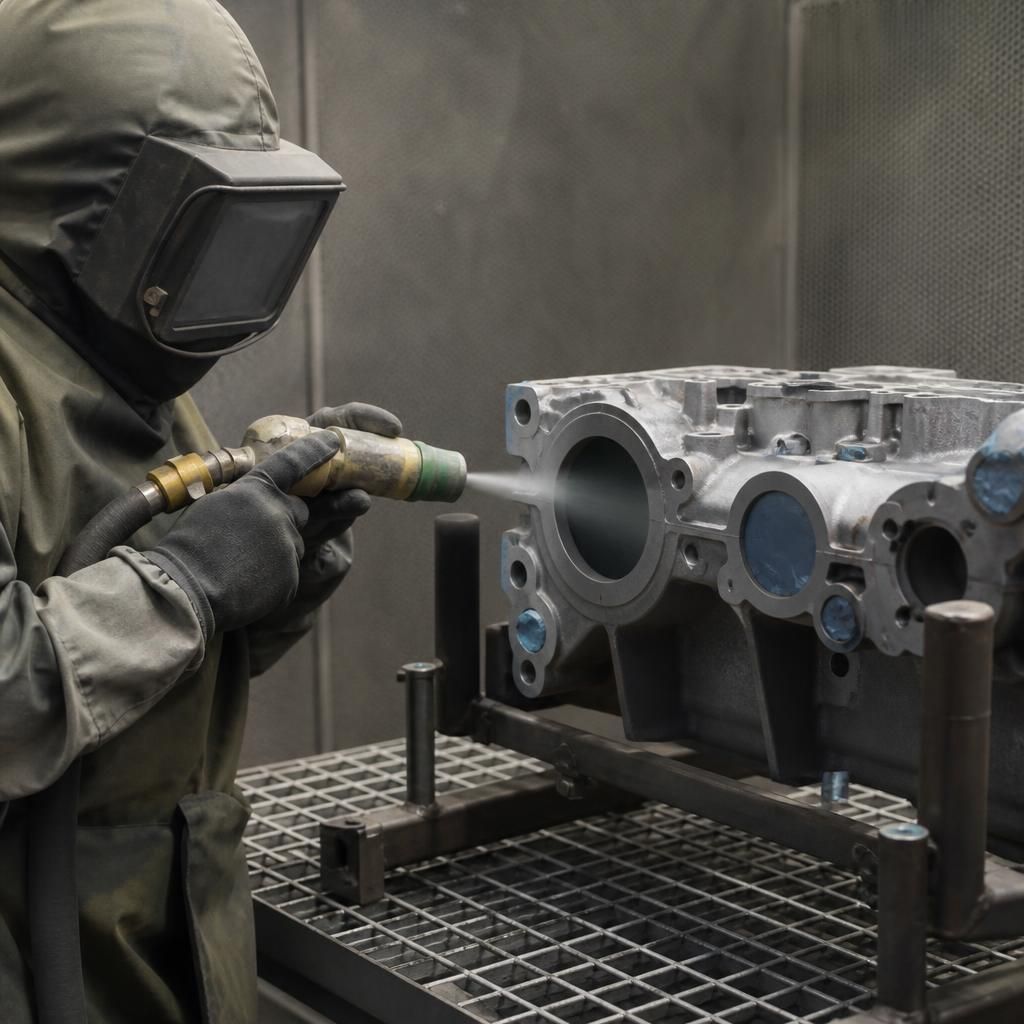
Where a component has threaded holes, bearing seats, machined faces or close-fitting mating surfaces, grit selection must also protect dimensional accuracy. Aggressive abrasive can alter an edge or contaminate a precision interface, while powder build-up in a threaded or fitted area may affect assembly after curing. These zones should be masked or plugged before blasting, with the surrounding surface prepared using a controlled abrasive grade and exposure.
After preparation, remove masking materials and check that no abrasive, dust or coating residue remains in the protected areas. This approach allows the main surfaces to receive an effective key for powder coating without compromising the component’s functional features.