

What are the essential cleaning agents used in the preparation for nylon powder coating?
The essential cleaning agents for nylon powder coating preparation are alkaline degreasers for oils and grease, suitable solvent cleaners for stubborn residues, and, where required, acidic cleaners for light oxidation or scale. The selected agent must be compatible with the substrate and followed by thorough rinsing and drying so no chemical residue remains before coating.
The essential cleaning agents for preparing metal for nylon powder coating are selected according to the contaminant being removed and the substrate being treated. Alkaline cleaners are generally used for oils, grease and workshop soils; solvent cleaners address localised organic residues; and acidic cleaners are used only where oxidation, mill scale or corrosion products require chemical removal. Each must be used under controlled conditions so the surface is chemically clean without being attacked or left with a residue.
Alkaline cleaners are the main choice for general degreasing. They usually contain alkaline builders, surfactants and water-based additives that loosen oil, grease, polishing compounds, handling marks and other process soils. The surfactant helps lift contamination from the metal, while the alkaline chemistry breaks down or emulsifies oily deposits so they can be removed by agitation, spraying or immersion. These cleaners are suitable for many steel components and can also be formulated for aluminium or other substrates where a milder action is needed.
The concentration and contact time need to match the product instructions and the condition of the component. Excessively strong alkaline chemistry, prolonged exposure or inadequate rinsing can stain or etch sensitive metals. A cleaner that has become heavily loaded with oil can also redeposit contamination, so the bath or application equipment must be kept in a condition that allows it to remove, rather than redistribute, workshop residues.
Solvent cleaners are useful for targeted removal of substances that water-based cleaners may not readily dissolve. Typical applications include removing adhesive traces, waxes, some marking residues and isolated patches of oil. They are often applied to a cloth or used for localised wiping rather than treating an entire production batch. The solvent itself must evaporate cleanly and must not contain additives that leave an oily film, plasticiser or other residue on the metal.
Solvent cleaning should not be regarded as a substitute for complete preparation where components carry widespread grease or manufacturing soil. Wiping can move contamination across the surface, and a cloth that is already saturated may leave more residue behind. On larger or heavily contaminated parts, an aqueous degreasing stage is normally more consistent, with solvent cleaning reserved for particular marks or areas that need additional attention.
Acidic cleaners and pickling products are used when the surface has light rust, oxidation, scale or other mineral deposits that alkaline products cannot remove effectively. Their action dissolves or loosens the affected layer, exposing a more suitable metal surface for subsequent treatment. Acid selection is substrate-dependent: a formulation suitable for carbon steel may be unsuitable for aluminium, galvanised material or an alloy that is vulnerable to etching.
Acid treatment requires especially careful control. Over-pickling can roughen the surface, cause staining or promote flash rusting on ferrous parts after rinsing. Acid residues can also interfere with nylon powder coating if they remain in seams, recesses or threaded features. For this reason, acid cleaning is followed by thorough rinsing and, where appropriate, a neutralising or conditioning stage specified for the process chemistry.
Neutral and mildly alkaline cleaners can be preferable for delicate substrates, mixed-metal assemblies or components with finishes that could be damaged by stronger chemistry. They may not remove severe oxidation or heavy baked-on soil as quickly, but they provide a lower-risk option for routine contamination when the substrate requires a gentler treatment. The correct choice depends on the metal, the contaminant and whether subsequent blasting or conversion treatment will be used.
Effective preparation normally uses cleaning agents in a defined sequence:
- Initial removal: loose dust, swarf and heavy deposits are removed mechanically so the cleaning solution can reach the metal.
- Degreasing: an appropriate alkaline, neutral or solvent cleaner removes oils and organic workshop contamination.
- Oxide treatment where necessary: an acid-based product is used only if oxidation, scale or corrosion products remain.
- Rinsing and inspection: the component is examined for water-breaks, streaks, stains or visible residue that may indicate incomplete cleaning.
- Drying: moisture is removed from joints, holes and recesses before the next preparation stage.
Water quality also affects the result. A final rinse containing dissolved salts can dry to form deposits that reduce coating adhesion or appear as surface marks. Where the process and substrate require it, a cleaner final rinse with suitably controlled water helps reduce this risk. Components should then be dried promptly, particularly when treating steel, because a clean damp surface can begin to oxidise before nylon powder is applied.
The cleaning agent should be compatible with the whole component, not just its main exposed face. Welds, folded edges, hollow sections, threaded holes and joints can retain cleaner, acid or contaminated rinse water. Drainage and access should therefore be considered during preparation, with particular attention paid to areas where trapped chemistry could emerge later and affect the coating.
Before nylon powder coating, the prepared surface should be free from oil, grease, dust, fingerprints, scale, cleaning residues and visible corrosion products. If contamination remains after chemical cleaning, further mechanical preparation or a revised cleaning stage may be required. The most suitable agent is therefore not simply the strongest one; it is the product that removes the identified contamination effectively while preserving the substrate and leaving a clean, dry surface for the following coating process.
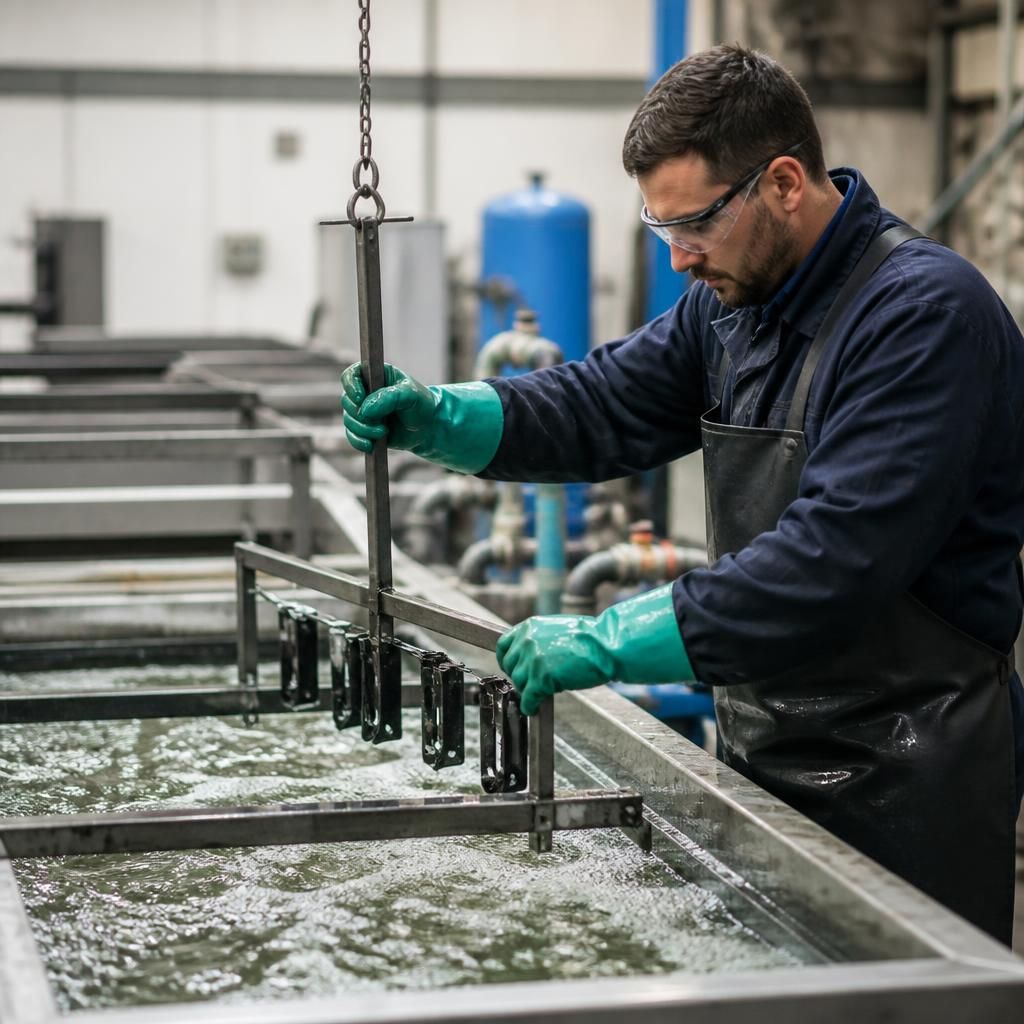
In areas with hard water, a cleaning formulation containing chelating or sequestering agents can help prevent calcium and magnesium salts from depositing on the metal during cleaning. These additives bind dissolved minerals so they remain in the solution rather than forming a dull film that could interfere with the nylon powder coating process.
Such additives support the main cleaning chemistry; they do not replace a suitable degreaser or remove heavy oil and corrosion by themselves. Their value is greatest where water quality, repeated washing or complex component geometry creates a risk of mineral deposits. The formulation should still be checked against the substrate and the subsequent preparation stages to confirm that it rinses cleanly and does not introduce a new residue.