

What role does equipment maintenance play in ensuring the quality and consistency of the powder coating process?
Equipment maintenance keeps powder coating systems operating within controlled parameters, helping maintain consistent powder application, film thickness and curing conditions. Regular inspection and servicing can identify issues such as blocked guns, worn components, inaccurate settings or uneven oven performance before they affect finish quality.
Equipment maintenance is a quality-control activity as well as a way of preventing breakdowns. In a powder coating system, the condition of the application equipment, air supply, recovery equipment, conveyor and curing oven directly affects how consistently powder is deposited, melted and cured. A planned maintenance programme therefore helps keep the process within its intended operating range from one production run to the next.
Maintenance protects process repeatability
Powder coating relies on several connected stages working together. The gun must deliver a stable powder flow and electrostatic charge; the compressed air must be clean and correctly regulated; the workpiece must be properly earthed; and the oven must provide the required thermal conditions. A fault in one area can create variations that may not be immediately obvious to the operator.
For example, a partially restricted powder path can alter the amount of material reaching the gun. Contamination in the air supply can affect application equipment and finish cleanliness, while poor earthing can reduce transfer efficiency and produce uneven deposition. Maintenance helps control these variables before they develop into recurring defects.
Key equipment areas requiring attention
- Powder guns and feed systems: Nozzles, electrodes, hoses, pumps and injectors should be checked for wear, powder build-up and damage. Their condition influences powder delivery, spray pattern and charging performance. Components that have become worn or contaminated may need cleaning, adjustment or replacement according to the equipment manufacturer’s guidance.
- Compressed-air systems: Filters, dryers, regulators and drains need inspection so that the air used for conveying and atomising powder remains suitable for the process. Moisture or oil contamination can cause poor powder flow, surface defects and unreliable equipment operation.
- Booth and recovery equipment: Booth surfaces, extraction paths, cyclones and filters should be kept free from excessive powder accumulation. This supports controlled airflow, reduces the risk of colour contamination and helps recovery systems operate consistently. Cleaning procedures are particularly important when changing between powder colours or formulations.
- Earthing and electrical connections: Earthing points, cables, clamps and connections should be checked for continuity and cleanliness. A sound earth path is essential for effective electrostatic application and for safe operation. Paint or powder build-up at contact points can interfere with this path.
- Ovens and temperature controls: Heating elements, fans, sensors, seals, controllers and air circulation paths should be inspected as part of a planned programme. The stated oven temperature is not necessarily the same as the temperature reached by the coated component, so temperature checks and process validation are important when investigating curing variation.
- Conveyors and work-handling equipment: Conveyor speed, hooks, racks and contact points should be examined for wear, contamination and alignment. Unstable movement or inconsistent spacing can affect gun-to-part distance, exposure through the oven and the ability to coat difficult areas.
Cleaning is part of maintenance
Powder residue can accumulate inside hoses, pumps, guns, booth corners, filters and handling fixtures. If it is not removed, it may restrict flow, contaminate a different colour or create deposits on the workpiece. Cleaning should follow a defined sequence and use methods appropriate to the equipment and powder type. Particular care is needed around electrodes, nozzles and sensors, where aggressive cleaning or physical damage can affect performance.
Maintenance also includes cleaning the areas that contact the components. Hooks and racks can become insulated by repeated coating, reducing earthing effectiveness. Contact surfaces should be kept sufficiently clean to maintain reliable electrical continuity without damaging the component or fixture.
Calibration and verification
Control devices should be checked rather than assumed to be accurate. This can include powder flow controls, pressure gauges, current and voltage displays, conveyor speed settings, temperature sensors and oven controllers. Where a device is used to make a quality-critical decision, its reading should be compared with a suitable reference and adjusted or replaced when it falls outside the required tolerance.
Oven verification is especially important because curing depends on the metal reaching the correct metal temperature for the required time. Mapping or profiling different oven zones can reveal cold spots, excessive heat, poor circulation or changes caused by blocked filters and failing fans. This provides more useful information than relying only on the controller display.
Planned maintenance and production records
A documented schedule should distinguish between routine operator checks, periodic servicing and condition-based inspections. Operator checks may cover visible powder accumulation, hose condition, earthing, air pressure and unusual noise. More detailed work may involve electrical testing, filter inspection, sensor verification and assessment of oven performance.
Records should identify the equipment inspected, the date, the condition found, any corrective action and the person responsible. Linking maintenance records with coating defects, rework or changes in powder batch can help identify patterns. For instance, a gradual increase in coating variation may point to progressive wear or contamination rather than an isolated application error.
Maintenance should be linked to quality checks
When equipment has been serviced, the process should be confirmed before normal production continues. Useful checks may include powder flow, spray pattern, electrical continuity, film thickness and the appearance of test-coated components. Depending on the application, adhesion and cure performance may also need verification. These checks establish whether the maintenance work has restored the intended process conditions and help prevent an unnoticed adjustment from affecting a full batch.
Ultimately, maintenance does not replace correct pre-treatment, suitable powder selection or controlled curing. It supports those stages by keeping the equipment capable of applying and processing the coating consistently. A structured approach reduces avoidable variation, makes faults easier to diagnose and provides a traceable basis for maintaining finish quality across repeated industrial production runs.
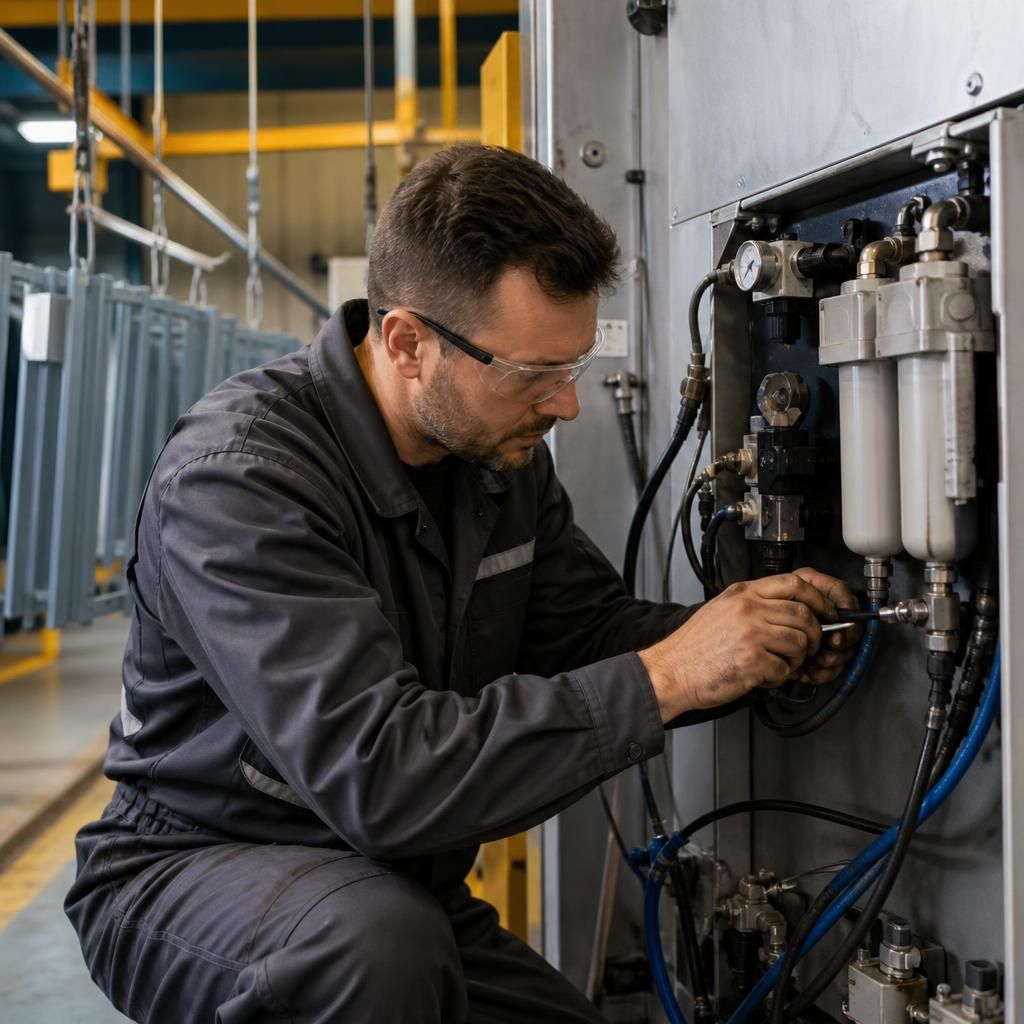
Equipment maintenance provides a controlled baseline for diagnosing coating defects. When guns, air supplies, electrical connections and curing equipment are kept in known condition, operators can investigate problems without confusing equipment faults with issues relating to powder, pre-treatment or application settings.
A structured diagnostic approach can prevent unnecessary process changes. For example, if coverage or surface appearance changes, the equipment condition can be checked against its maintenance records before altering the powder formulation or production settings. This makes corrective action more focused and helps preserve consistency between batches.