

What considerations should be taken into account when selecting a powder type for specific industrial applications?
Selecting a powder type for a specific industrial application requires assessing the substrate, expected exposure, required durability, finish, application method and curing conditions. The powder must be compatible with the metal component and provide suitable resistance to factors such as corrosion, chemicals, abrasion, heat or weathering in its intended service environment.
Choosing a powder type for an industrial application is a specification exercise that balances the component’s function, the required coating performance, production method, regulatory requirements and whole-life cost. The correct choice is not determined by colour alone: two powders with a similar appearance can behave very differently during manufacture, service and maintenance.
Start with the function of the coated component. Establish whether the coating is primarily intended to provide corrosion protection, electrical insulation, chemical resistance, low friction, impact protection, a decorative finish or a combination of these functions. A bracket used indoors may need a different formulation from a part exposed to oils, cleaning agents, road debris or repeated handling. Components that come into contact with food, drinking water or other controlled substances may also require a powder with the relevant compliance documentation.
Consider the powder family. The main options have different strengths:
- Epoxy powders generally provide strong adhesion and resistance to chemicals and corrosion, making them suitable for many interior, industrial and protective applications. Their suitability should be reviewed where prolonged direct weathering or ultraviolet exposure is expected.
- Polyester powders are commonly selected for external metalwork because they can provide good resistance to weathering and ultraviolet light. The precise formulation and specification still need to match the severity of the environment.
- Epoxy-polyester hybrids combine characteristics of both resin types and are often used for general-purpose indoor components, appliances, furniture and fabricated parts where the service conditions are controlled.
- Polyurethane and acrylic powders may be considered where appearance, smoothness, chemical resistance or particular surface properties are important. Their suitability depends on the component and the application specification.
- Thermoplastic powders, including nylon-based coatings, form a coating without the same chemical cross-linking process used by thermoset powders. They can be useful where toughness, abrasion resistance, impact protection, insulation or a thicker protective layer is required.
These categories are starting points rather than automatic recommendations. The resin, additives, pigments and intended film build all affect the final properties.
Match the powder to the component’s geometry and tolerances. Powder build can affect holes, threads, mating faces, hinges, sliding areas and locations used for electrical contact or earthing. Deep recesses, sharp corners, narrow gaps and complex fabrications may create application or coverage challenges. Where dimensional tolerances are tight, the specification should identify surfaces that must remain masked or uncoated and define the acceptable coating thickness.
Review the required film characteristics. Film thickness, hardness, flexibility, impact resistance, edge coverage, surface texture and adhesion should be considered together. A very hard coating may not be appropriate where a part flexes or experiences repeated impact. Conversely, a softer or more flexible coating may be unsuitable for severe abrasion. Textured, smooth, low-gloss and high-gloss options can also affect cleaning, appearance and the visibility of surface imperfections.
Check compatibility with the manufacturing process. The powder must suit the available application equipment, recovery arrangements, spray pattern and production volume. Parts with awkward geometry may require a formulation and application method that provide consistent coverage without excessive accumulation in corners. For batch work, colour changes, powder reclaim and contamination control should be considered before selecting a system. Reclaimed powder may not be suitable for every specification, particularly where a tightly controlled appearance or performance requirement applies.
Assess the production and curing window. The selected powder must be compatible with the component’s mass, construction and heat sensitivity, as well as the coater’s oven capacity and process controls. Large or heavily fabricated parts may heat differently from small components, while assemblies containing seals, bearings, electronics or dissimilar materials may impose restrictions. The powder supplier’s technical data should be checked against the actual metal temperature requirement rather than relying only on oven air temperature.
Factor in appearance and colour control. Colour reference, gloss level, texture, metallic effect and batch-to-batch consistency should be recorded in the coating specification. Metallic and special-effect powders can require tighter process control because application direction, film build and recovery practices may influence the visual result. If components will be assembled side by side, the same approved powder system and agreed appearance standard should be used wherever practical.
Consider future maintenance and repair. Some industrial parts may need local repairs, recoating or replacement components during their service life. The specification should state whether touch-up is acceptable, how damaged areas are to be prepared and whether a repair coating must match the original appearance or only restore protection. If recoating is likely, the compatibility of the new system with the existing coating should be confirmed rather than assumed.
Include environmental and compliance requirements. Selection may be influenced by restrictions on hazardous substances, waste handling, overspray recovery and the disposal of contaminated materials. Technical data sheets and safety data sheets should be reviewed alongside any sector-specific requirements. For safety-critical or regulated components, documented test methods and acceptance criteria are more useful than a general claim that a powder is suitable for industrial use.
A practical selection process is to prepare a written coating specification covering the component material, function, service environment, geometry, dimensional limits, required properties, appearance, application method, processing constraints, compliance needs and inspection criteria. The powder can then be shortlisted against those requirements and validated on representative parts. Testing should reflect the intended use, such as adhesion, impact, abrasion, chemical exposure, corrosion or insulation performance, rather than relying solely on a decorative sample panel.
For manufacturers and fabricators, supplying accurate drawings, part dimensions, service conditions and production requirements allows the coating system to be assessed before full batch processing. Where the application involves specialist protection, nylon coating or unusual component geometry, a technical discussion and trial on representative parts can help identify masking, thickness and processing issues at an early stage.
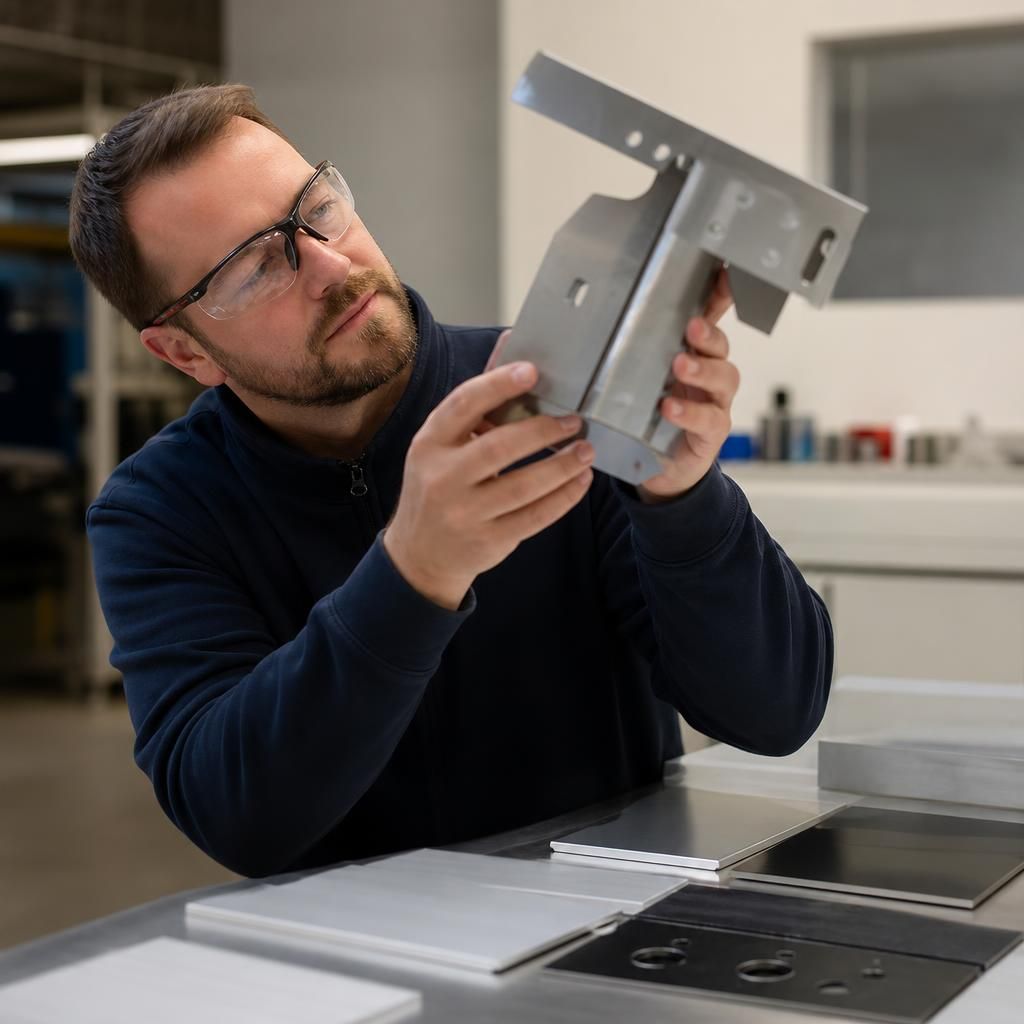
Substrate condition can influence powder selection as much as the service environment. Galvanised steel, aluminium and cast components may have different surface characteristics, including oxide layers, porosity or the potential for trapped gases. These factors can affect adhesion, appearance and the risk of pinholing during curing.
The coating specification should therefore identify the exact substrate and any existing surface treatment before a powder is approved. A trial on representative components can confirm that the proposed system produces the required finish without interfering with dimensional features or exposing defects that would not appear on a flat test panel.