

How does the powder curing process enhance the durability and performance of the final coated product?
The powder curing process heats the applied coating to a controlled temperature so the powder melts, flows and chemically bonds into a continuous film. This develops the coating’s adhesion, hardness and resistance to wear, corrosion, chemicals and environmental exposure, improving the durability and performance of the finished metal product.
Powder curing enhances the finished coating by converting the deposited powder into a stable, continuous polymer film with a controlled crosslinked structure. During this stage, heat activates the resin and curing agents, allowing the coating to flow across the metal and develop its intended physical and chemical properties. The quality of this transformation depends on the metal temperature, time at temperature, powder formulation, film thickness and consistency of the oven conditions.
Most industrial powder coatings are thermosetting materials. Unlike a coating that simply softens and hardens again, a thermoset powder undergoes an irreversible chemical reaction during curing. The resin molecules link together to form a three-dimensional network. This network determines how the coating responds to impact, abrasion, moisture, cleaning chemicals and changes in temperature. A properly developed network gives the film a balance of toughness and rigidity, rather than leaving it soft, brittle or easily marked.
The curing cycle also controls how the coating forms around the component. The powder first melts, then flows across the surface before the chemical reaction progresses sufficiently to lock the film in place. Adequate flow helps reduce dry spray, pinholes, uneven texture and visible variations in gloss. It can also improve coverage around edges, corners and formed sections, although these areas still require suitable application settings and an appropriate powder build.
Accurate temperature control is essential because the air temperature shown on an oven gauge is not necessarily the temperature reached by the metal itself. A thin bracket may heat rapidly, whereas a heavy fabricated assembly may require considerably longer to reach the coating’s specified curing condition. Industrial curing therefore has to account for the component’s mass, shape, material and loading arrangement. The relevant schedule is normally based on the part temperature and the powder manufacturer’s technical requirements, not simply on the oven’s set point.
- Undercuring: If the coating does not receive sufficient heat or time, the crosslinking reaction may remain incomplete. The film can show reduced resistance to marking, solvents, impact or outdoor exposure, even if its appearance initially seems acceptable.
- Overcuring: Excessive heat or an unnecessarily long cycle can alter colour and gloss and may reduce the coating’s intended performance. Some powders can become discoloured or lose flexibility when exposed to unsuitable conditions.
- Uneven curing: Different areas of a complex component may reach the required temperature at different times. This can produce inconsistent finish characteristics across one batch or even on one part.
Oven design and operating discipline are therefore part of coating quality. Air circulation must distribute heat consistently without disturbing uncured powder on the component. The loading pattern should allow heated air to reach all surfaces, while hooks, racks and contact points should be arranged to minimise areas that remain shielded. Monitoring representative parts and checking the curing profile helps identify cold spots, excessive thermal exposure and changes caused by different component sizes.
Curing performance is also affected by the amount of powder applied. A film that is too thin may not provide the specified coverage or visual uniformity, while excessive build can cause sagging, trapped defects, poor edge definition or an appearance outside the required specification. Consistent electrostatic application, suitable earthing and controlled gun settings help create a film that the oven can cure evenly. The powder formulation must also match the required process; a product designed for one curing range should not be treated as interchangeable with another.
After curing, controlled cooling allows the film and the metal substrate to stabilise before handling, inspection or assembly. Parts should be protected from contact damage while the finish is still hot or insufficiently stable. Inspection can include checking colour, gloss, texture, coverage, visible defects and film thickness, alongside practical tests where the specification requires them. These checks help distinguish an application defect from a curing defect and provide evidence that the process is repeatable.
For manufacturers and fabricators, the main benefit of a well-controlled cure is consistency across batches and component geometries. It helps the coating perform as a designed system rather than merely appearing finished when removed from the oven. Correct curing does not compensate for contamination, unsuitable preparation, poor application or an incompatible powder, but it ensures that the selected coating can develop the properties expected from it. This is why curing parameters, part temperature and inspection criteria should be considered together when assessing the long-term performance of powder-coated metalwork.
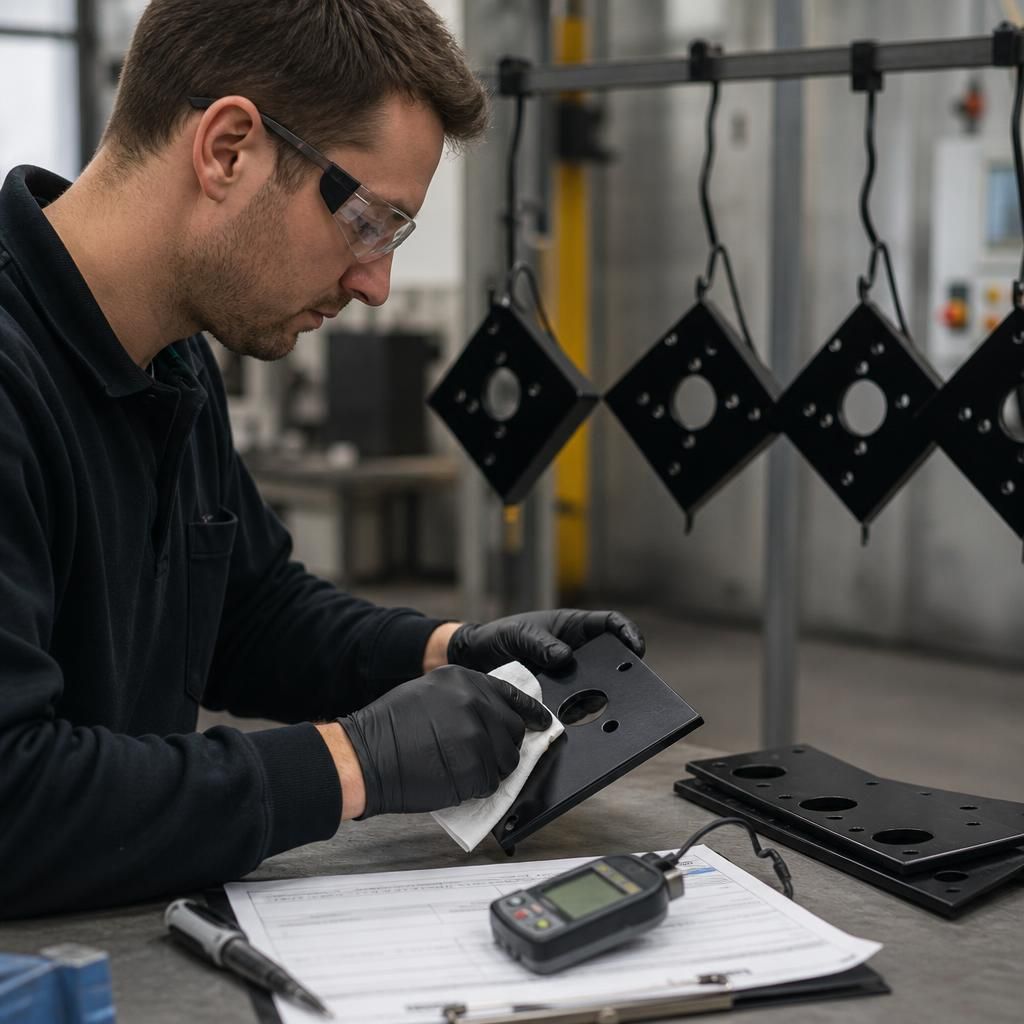
Cure verification confirms that the powder film has developed its intended chemical resistance, rather than relying on appearance alone. A coating may look smooth and evenly coloured while still having insufficiently reacted resin. Practical checks such as a solvent-resistance test can help identify incomplete curing, whereas film-thickness measurement confirms coverage but does not prove that the coating has reached its required cure state.
Using more than one inspection method gives a clearer assessment of final performance. Visual checks identify defects in the surface finish, thickness measurements assess application consistency, and a suitable performance test evaluates whether the cured film can withstand the conditions expected in service. This distinction is important for industrial components that will be exposed to cleaning agents, handling or mechanical contact after coating.