

What factors influence the selection of the correct nozzle size for aluminium powder coating applications?
The correct nozzle size for aluminium powder coating depends on the component’s geometry, the required spray pattern, powder characteristics, target film thickness and the gun’s operating settings. Select a nozzle that provides controlled, even coverage for the part without excessive powder velocity, overspray or difficulty reaching edges and recessed areas.
The correct nozzle size is selected by matching the nozzle to the powder gun, charging method, delivery system and production conditions, rather than choosing one solely because the workpiece is aluminium. The nozzle must allow the gun to charge and transport the powder consistently while maintaining a stable, controllable cloud at the required operating distance.
Gun and nozzle compatibility is the first consideration. Nozzles are designed around particular gun bodies, electrode arrangements and powder paths. The fitting, internal bore and electrode position must be compatible with the gun; otherwise, the nozzle may not seat correctly or the powder may leave the gun unevenly. Consult the gun supplier’s technical information before changing to a different nozzle style or size.
The gun’s charging technology also affects the choice. Corona systems use an electrode to charge the powder as it leaves the nozzle, while tribo systems charge it through friction within the powder path. These arrangements do not necessarily respond in the same way to an identical nozzle. A nozzle that performs well on one type of gun may produce unstable charging or inconsistent deposition on another.
The electrode arrangement deserves particular attention. The electrode should remain correctly positioned and free from accumulated powder. Its location influences the electrical field around the powder cloud, so a nozzle with a different outlet or electrode support can alter how powder deposits on conductive aluminium. Selection should therefore include the complete nozzle-and-electrode assembly, not just the visible outlet.
Powder delivery capacity is another limiting factor. A very small nozzle can restrict the volume of powder that can pass through the gun, while a large nozzle may make low-output application difficult to control. The selected size should suit the powder pump, hose length and feed arrangement. If the delivery system cannot supply powder steadily, changing the nozzle alone will not correct surging, pulsing or intermittent output.
Powder feed stability is especially important when the coating specification requires a consistent finish across a batch. Consider whether the system is being used manually, with reciprocators or in an automated line. Automated equipment may require a nozzle that provides repeatable output at a fixed gun position, whereas manual work may benefit from finer control at lower delivery rates.
Electrical conditions and earthing should be checked before interpreting nozzle performance. Aluminium is conductive, and poor earthing can affect powder attraction, wrap and deposition. If the workpiece, hanger or conveyor is contaminated, a change of nozzle may appear to improve or worsen the result without addressing the underlying fault. Confirm that the part is securely earthed and that contact points are clean before selecting a different nozzle size.
The available voltage and current controls can also influence the practical nozzle choice. A nozzle that produces a dense powder cloud may be unsuitable if the electrostatic field is causing back-ionisation, uneven deposition or excessive powder repulsion. In such cases, the solution may involve balancing the nozzle with the gun’s electrical output and application distance rather than simply increasing powder delivery.
Application distance and operator access affect how useful a nozzle will be in practice. A nozzle intended for close, controlled application may be unsuitable where the gun must be held farther away for safe access or to avoid contact with the component. Conversely, an outlet designed to distribute powder over a wider working area may be less controllable in confined application zones. The nozzle should support a comfortable, repeatable gun position without forcing the operator to compensate with excessive air or electrical adjustment.
Consider the required level of edge control as well. Aluminium parts can show visible differences at edges, corners and transitions because the substrate is conductive and the electrical field is not uniform. A nozzle that produces a highly concentrated discharge may increase local build-up, while a less concentrated outlet may make edge definition easier to manage. This is not determined by size alone; outlet shape, electrode position and the powder’s charging behaviour work together.
Powder type and changeover requirements should be included in the decision. Different powders can vary in flow, particle distribution and tendency to accumulate inside the nozzle. A narrow passage may be more prone to restriction when the powder is not fluidising correctly or when residue from a previous colour remains in the powder path. If the equipment is used for frequent colour changes, choose a nozzle that can be cleaned thoroughly and inspected easily.
Wear is also relevant. Powder moving through the nozzle can gradually enlarge or roughen internal surfaces, particularly where the system handles abrasive formulations or high output. A worn nozzle may produce a different discharge from its original specification, even if the setting has not changed. Inspect the outlet, electrode and retaining components regularly, and replace damaged or visibly worn parts rather than compensating indefinitely through air or voltage adjustments.
A practical selection process is:
- Identify the gun type, charging method and approved nozzle options.
- Check that the nozzle, electrode and retaining parts are compatible with the gun.
- Match the nozzle to the powder pump, hose arrangement and intended delivery rate.
- Verify earthing, powder fluidisation and electrical conditions before assessing the nozzle.
- Trial the selected nozzle on a representative aluminium component using controlled, repeatable application conditions.
- Inspect the finish for uniformity, edge build-up, back-ionisation and signs of unstable powder flow.
- Record the nozzle, electrode and operating combination that gives the most repeatable result, then monitor it for wear.
The best choice is therefore the smallest or largest nozzle only when the complete system supports it; size in isolation is not a reliable selection rule. Compatibility, charging behaviour, powder delivery, earthing, access, cleanability and wear resistance should all be assessed together before adopting a nozzle for regular aluminium coating work.
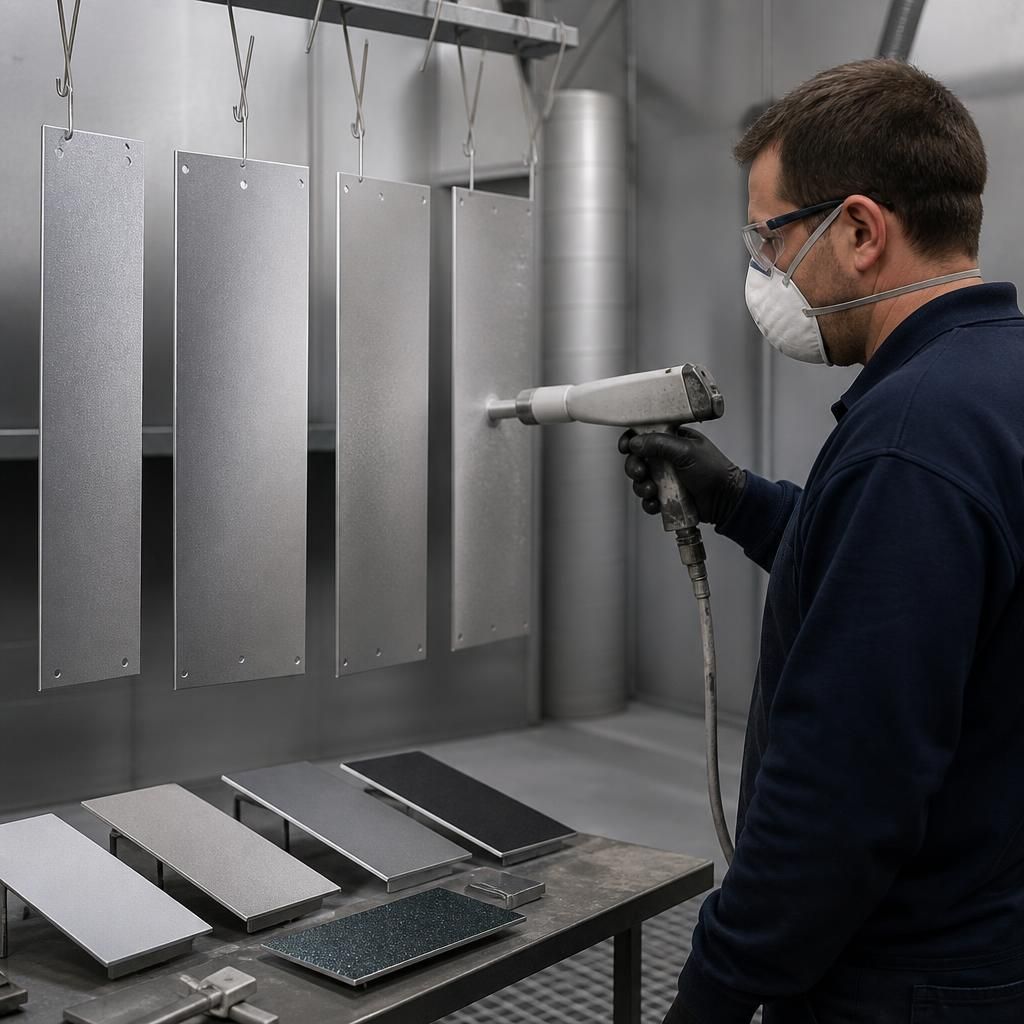
Special-effect powders can change the nozzle requirement. Metallic, mica-containing or other effect powders may produce visible differences in shade and orientation if the powder cloud is unstable. In these applications, select a nozzle that produces a smooth, repeatable discharge rather than simply choosing the largest outlet for faster coverage. Validate the nozzle using the actual powder and an aluminium test component, then compare the appearance across the face, edges and recessed areas. The nozzle, gun settings and application technique should remain consistent between test panels and production work so that any variation can be traced accurately.