

What are the common troubleshooting tips for maintaining consistent coverage during aluminium powder coating applications?
To maintain consistent coverage when powder coating aluminium, check powder flow, air pressure, gun distance, earthing and the cleanliness of both the component and equipment whenever the finish becomes uneven. Correct one variable at a time, inspect for blocked or worn feed components, and confirm that the aluminium is properly pre-treated before adjusting the application settings.
Consistent coverage in aluminium powder coating means achieving an even deposited film across flat areas, edges, recesses and joints without thin patches, heavy build, pinholes or visible shade variation. Troubleshooting is most effective when the defect is classified first, then the powder condition, spray pattern, component geometry, booth conditions and curing process are checked in a controlled order.
Begin by comparing the affected component with a correctly coated reference or test panel. Note whether the problem is localised to corners, edges, recessed sections or the whole surface. A defect confined to one area usually indicates a geometry, access or spray-pattern issue; variation across the complete component is more likely to involve powder condition, equipment settings or the curing process.
- Thin edges or exposed high points: Sharp edges can attract a greater proportion of charged powder, while nearby flat areas receive less. Reduce excessive edge build by reviewing the part orientation, gun angle and spray overlap. Where the design permits, soften unnecessarily sharp edges before coating. Avoid compensating by repeatedly spraying the same area, as this can create excessive film thickness elsewhere.
- Light coverage in recesses: Recessed sections and boxed shapes can create a Faraday-cage effect, which restricts charged particles from entering the area. Use a suitable application approach for the geometry, keeping the spray pattern controlled and avoiding excessive electrostatic loading. A lower-impact pass directed into the recess, followed by a normal coverage pass on the accessible faces, can be more effective than trying to force all the powder into the corner at once.
- Heavy build or uneven overlap: Excessive overlap between adjacent passes can produce ridges, shade differences and localised thick areas. Use a consistent travel speed and maintain a repeatable path around the component. If manual application is used, mark or mentally divide complex parts into sections so that each area receives a planned number of passes rather than repeated correction.
- Intermittent spray or surging: Inspect the powder hose for sharp bends, restrictions and areas where powder may settle. Check that connections are secure and that the hose is appropriate for the powder delivery arrangement. Surging can also occur when powder in the hopper bridges, becomes compacted or is not being aerated evenly. Emptying and conditioning the feed system may be necessary rather than continually increasing the feed setting.
- Spitting or coarse deposits: Moisture, agglomerated powder or contamination can interrupt the spray and leave isolated heavy particles. Keep unused powder sealed and allow it to reach the surrounding workshop temperature before opening the container. Sieve powder where the process requires it, and segregate material that has picked up debris or has been mixed with an incompatible colour or formulation.
- Colour variation between batches: Confirm that the same powder formulation and batch-control procedure are being used. Reclaimed powder can differ in particle distribution and colour balance from virgin material, particularly when recovery ratios are not controlled. Keep recovered powder separate until it has been assessed against the process requirements, and avoid mixing different colours or formulations in the same feed equipment.
- Good spray appearance but poor final coverage: If the uncured film appears even but the finished coating shows craters, pinholes or bare-looking areas, investigate the substrate and curing stages rather than changing the gun immediately. Residual oils, conversion-treatment variation, trapped gases in cast or porous aluminium, and incorrect oven conditions can all become visible only after curing. Compare an uncured inspection with a cured inspection to identify where the defect first appears.
- Variation across a large component: Check whether all sections receive comparable exposure to the spray and curing environment. Large aluminium parts can have different thermal masses, orientations and heat-up rates. Record the position of defects and compare it with the part’s location in the oven. A coating can appear uniform on entry but cure differently if some areas have not reached the required metal temperature.
Powder condition should be assessed before making major equipment changes. Look for clumps, colour contamination, foreign particles and signs that the material has absorbed moisture. Do not assume that increasing air or powder delivery will correct poor material condition; it may simply produce a heavier or more turbulent deposit.
Use a repeatable inspection method. Examine the coating under consistent lighting, inspect difficult areas before removing the component from the booth, and measure film thickness where the specification requires it. Take readings from flat faces, edges and recesses rather than relying on one convenient location. A pattern of low readings can reveal a coverage problem that is not obvious visually, while unusually high readings may explain runs, poor appearance or insufficient curing.
For recurring faults, record the powder batch, component orientation, operator, equipment configuration, booth conditions and cure results. Change one controlled factor during the next trial and compare it with the reference component. This creates a useful fault history and prevents several adjustments from masking the original cause.
Aluminium parts with complex geometry, cast surfaces, welded assemblies or tight coverage tolerances may need a trial application before full production. The trial should assess the complete route: preparation, powder application, inspection and curing. If consistent coverage cannot be achieved without excessive build or repeated rework, review the component design, masking plan and application sequence with the coating specialist before proceeding with the full batch.
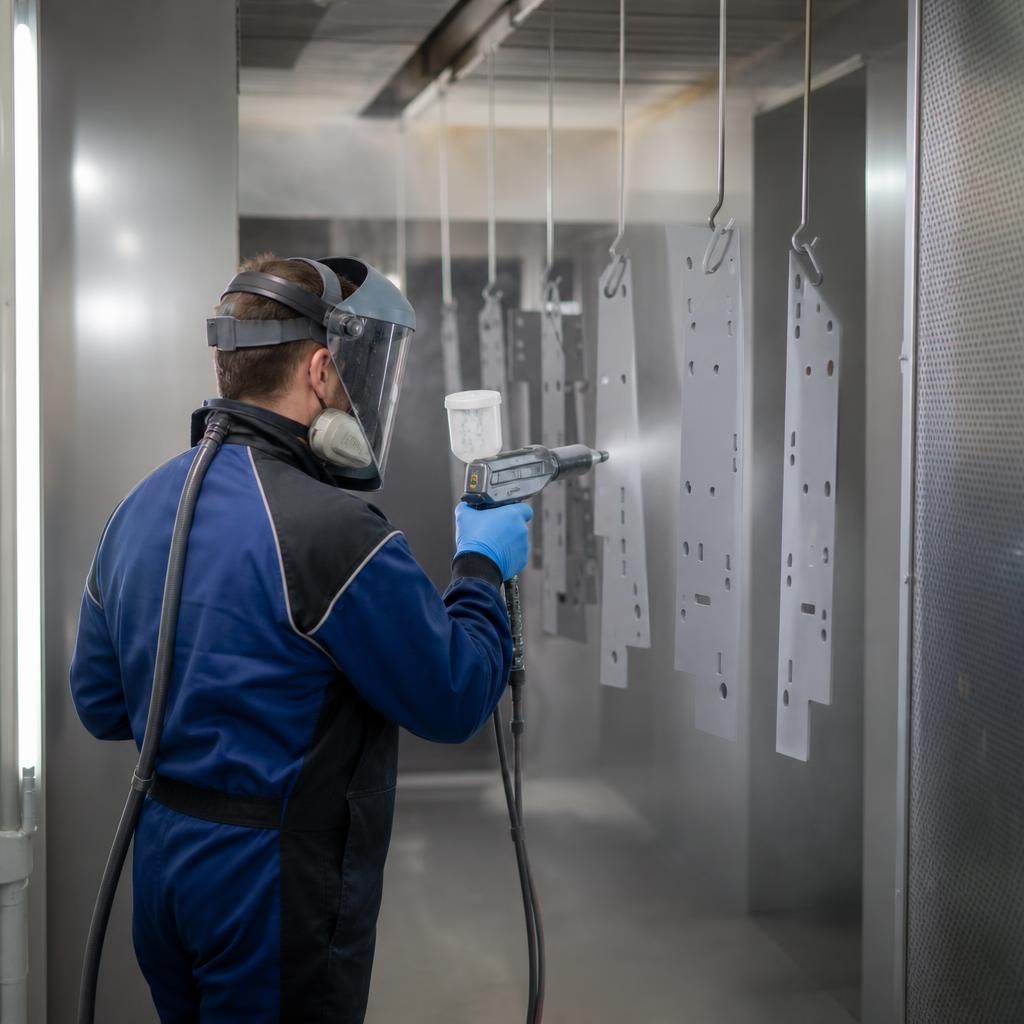
Booth airflow is a common but overlooked cause of inconsistent aluminium powder coating coverage. Excessive or uneven extraction can pull charged powder away from the component, disturb the spray cloud and leave thin areas on sheltered surfaces, while insufficient airflow can allow overspray to circulate and settle unpredictably.
When coverage changes without an adjustment to the gun, inspect extraction, filters, booth openings and nearby sources of draught. Compare the spray pattern with the gun operating normally and check whether powder is drifting away from the intended target. Correct the airflow problem before altering powder delivery or electrostatic settings, then repeat the application on a test component to confirm that the coverage has stabilised.