

What adjustments should be made to the gun feed rate for optimal coating on aluminium components?
Adjust the gun feed rate gradually, starting with a controlled, lower powder output and increasing it until the aluminium component receives an even, continuous coat without excessive powder build-up. Reduce the rate if you see heavy edges, roughness or poor transfer, and increase it slightly if coverage is thin, checking test pieces while keeping gun distance, movement and electrostatic settings consistent.
The correct gun feed rate for aluminium components is the lowest powder delivery that produces a continuous, uniform film at the required thickness without excessive overspray, back-ionisation or powder build-up. The setting should be established with the actual aluminium alloy, component geometry, powder and application equipment, because a rate that works on a flat panel may be unsuitable for a thin edge, deep recess or complex fabricated part.
Make adjustments only after the other application variables are stable. Keep the gun-to-part distance, traverse speed, spray angle, electrostatic output, carrier air and booth conditions consistent while assessing feed rate. Changing several controls together makes it difficult to identify whether a coverage problem is caused by powder delivery or by another part of the setup.
- Increase the feed rate when the coating remains visibly thin after a consistent pass, bare areas remain on broad faces, or the powder cloud does not provide continuous coverage across the component.
- Decrease the feed rate when the film becomes excessively heavy, the finish looks rough or uneven, powder accumulates on edges, or the gun begins to produce an unstable cloud.
- Hold the rate steady when coverage is even and the deposited powder looks consistent across faces, corners and profiles. Further increases do not necessarily improve the finish and can reduce transfer efficiency.
Use a representative test component or test section rather than judging the setting only in the air. Apply the powder using the intended gun movement, then inspect the component before curing. Check open faces, external corners, holes, returns and recessed areas separately. Aluminium components often have conductive surfaces and complicated geometries, so a single visual check on the largest face may conceal light coverage elsewhere.
When an aluminium part has both open areas and difficult profiles, avoid compensating for a poorly covered recess by raising the overall feed rate. Excess powder may collect on the accessible faces while the recess remains uneven. Instead, maintain a controlled general feed rate and alter the gun angle, distance or pass direction for the difficult area. A smaller, more controlled application can be more effective than delivering a large volume of powder into the same region.
Feed rate should also be matched to gun movement. A fast traverse removes powder from the application zone before enough has deposited, while a slow movement can create a heavy film even at a moderate delivery setting. If the operator changes movement speed during testing, reassess the rate rather than assuming the previous setting remains suitable. Consistent overlapping passes are particularly important on long aluminium sections and repeated batch components.
Consider the powder formulation and particle distribution when making the adjustment. Fine powder can respond differently from a coarser formulation, and a formulation intended for a specialist protective finish may require a different delivery balance from a standard architectural or industrial powder. Keep the powder condition consistent during the test, since moisture, contamination, agglomeration or segregation in the feed system can make the apparent rate fluctuate.
A stable feed system is essential. Inspect the powder hose for restrictions, check that the pickup point is not obstructed and confirm that the powder is being fluidised consistently. A partially blocked injector or hose can mimic an incorrect feed-rate setting by causing pulsing, intermittent coverage or a weak powder cloud. Clean the relevant components before making a major adjustment, particularly when changing colours or powder types.
After selecting a working setting, cure a test piece according to the powder manufacturer’s requirements and inspect the cured film. Look for thin areas, runs, excessive texture, pinholing, edge build-up and visible differences between overlapping passes. If the cured result is unacceptable, record the feed setting alongside the powder type, component design, gun position and other control settings before making one controlled change. This creates a repeatable setup rather than relying on an unrecorded operator judgement.
For production batches, verify the setting at the start of the run and whenever the component, powder, hose arrangement or application method changes. Record the final setting and the conditions under which it was established. If coverage changes without an intentional adjustment, investigate feed consistency, powder condition, grounding, gun cleanliness and part preparation before increasing output. A higher feed rate can mask the symptom temporarily while creating an unnecessarily thick or inconsistent coating.
Where aluminium components require a particularly controlled or durable finish, a specialist powder-coating provider can assess the component design, preparation requirements and application process as a complete system. Powder-coatings.co.uk serves manufacturers, fabricators, construction firms and automotive businesses across the Midlands and surrounding areas, with collection and delivery options for coated metal components.
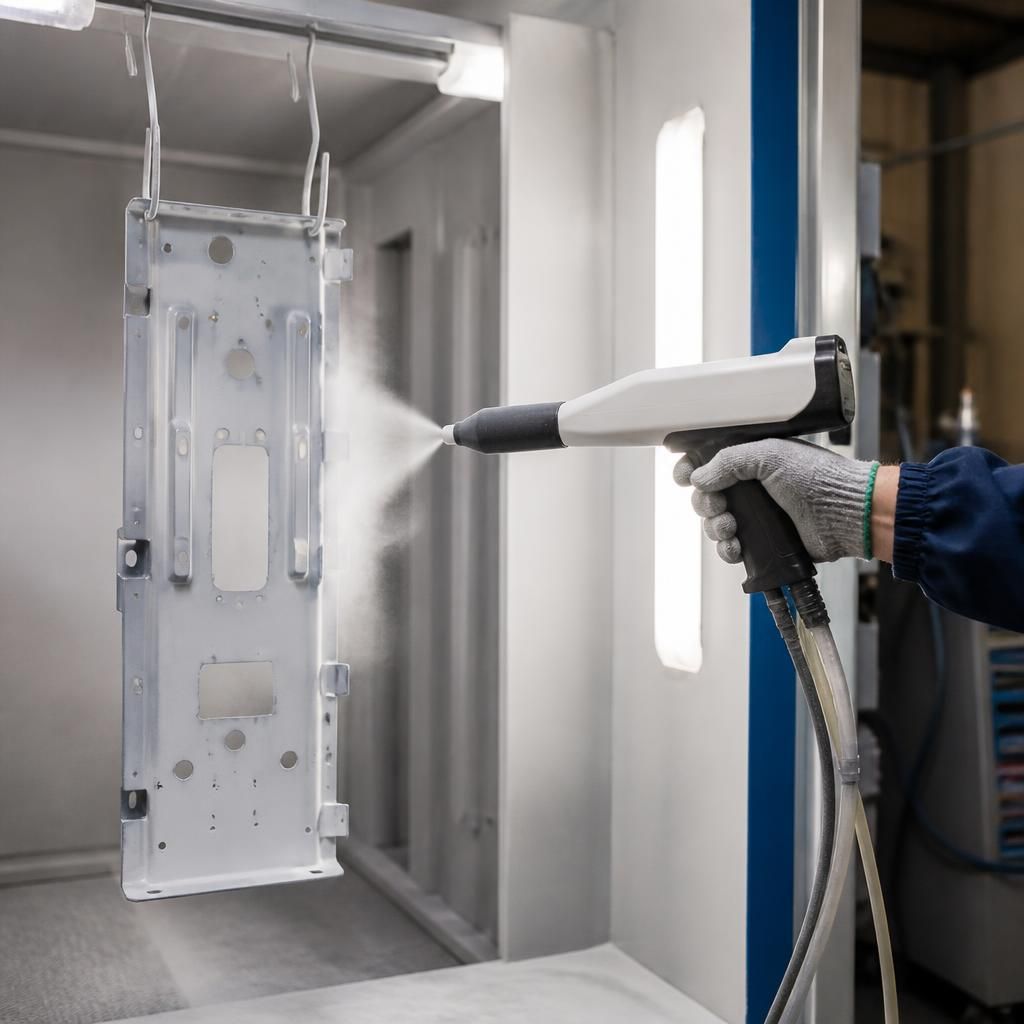
Gun feed rate should be adjusted separately from conveying air. The feed control determines how much powder enters the airstream, while the air setting transports and disperses it. Increasing air can make the powder cloud appear larger without depositing more powder on the aluminium; excessive air may create turbulence, overspray and reduced transfer to the component.
For a reliable adjustment, first establish a stable conveying-air setting suited to the powder and equipment. Then alter the powder feed in small increments while observing the deposited film on a representative aluminium part. If the cloud pulses, surges or appears uneven after the feed control is changed, investigate the injector, hose and powder supply rather than continuing to increase output. This separates a genuine feed-rate correction from an air-balance or delivery fault.
Discuss your aluminium powder coating requirements
Discuss your aluminium component geometry, powder specification and required finish with Powder-coatings.co.uk to review the appropriate gun feed-rate approach. Provide details of any recessed areas, edges or batch requirements so the coating process can be considered against the part design.