

How do I adjust the powder flow for optimal coverage on aluminium surfaces?
Adjust powder flow in small increments while keeping the spray pattern stable, using a test aluminium component to assess coverage. Increase flow only when coverage is too light; if the finish becomes uneven, heavy or prone to back-ionisation, reduce the flow and check that conveying air is not carrying excess powder.
Optimal powder flow is the lowest stable feed rate that deposits a continuous, even film on the aluminium without causing excessive overspray, impact losses or surface defects. Flow should therefore be adjusted alongside conveying air, atomising air, gun movement and the condition of the powder, rather than treated as an isolated control.
Establish a reliable baseline first. Confirm that the powder container is adequately fluidised and that the pickup tube, injector, hose and gun are clean. Moisture, compacted powder or partial restrictions can make the feed pulse, which may appear to be an incorrect flow setting. Check that the powder is free-flowing and that any reclaimed material has been blended and conditioned in line with the powder supplier’s instructions.
Set the gun to a repeatable starting condition using the equipment and powder supplier’s guidance. Keep the gun distance, angle, traverse speed and trigger technique consistent while assessing the result. If these variables change between test passes, it becomes difficult to tell whether a coverage difference is caused by powder flow or by application technique.
Balance powder feed with air. The powder feed control determines how much material enters the air stream, while conveying or pump air transports it towards the gun. Too little conveying air can cause an irregular feed, pulsing or blockage. Too much can accelerate the particles, widen the cloud unnecessarily and increase bounce-back or overspray. Make the smallest practical change to one control at a time, then observe whether the powder stream becomes more uniform before making another adjustment.
Where the equipment provides separate controls for powder feed, conveying air and atomising air, avoid using additional air to compensate for an excessive powder setting. A heavy, turbulent cloud may deposit less efficiently than a controlled cloud with a lower powder load. Conversely, reducing powder flow will not correct a restriction, poor fluidisation or an unstable injector.
Assess the coating on representative aluminium parts. Use a test component or a section of production material that includes the relevant geometry, such as broad faces, edges, recesses and apertures. Look for continuous coverage, consistent colour and texture, clean edges and the absence of thin areas after curing. Where process control requires it, verify the cured film with a suitable coating-thickness gauge rather than relying on appearance alone.
Aluminium parts often combine large conductive faces with edges and recesses that receive powder differently. A flow setting that appears suitable on a flat panel may be unsuitable for a fabricated component with corners or partially enclosed areas. If the broad faces are heavily coated while recesses remain light, changing flow alone is unlikely to solve the problem. Review gun angle, access, pass sequence, electrostatic settings and grounding, while keeping the feed setting stable during the assessment.
Use the defect pattern to identify the correct adjustment:
- Thin coverage over the whole part: check powder delivery, fluidisation and the feed path before increasing output. If the equipment is functioning correctly, raise the feed gradually and reassess the cured result.
- Heavy deposits on exposed faces: reduce the powder load or improve the application path. Excess material on open areas can make recess coverage appear worse by comparison.
- Uneven bands or intermittent coverage: inspect the hose, injector and pickup system for restrictions, moisture or unstable fluidisation. A control adjustment will not remove a mechanical feed fault.
- Powder bouncing from the aluminium: consider excessive particle velocity, a high local deposit or inadequate grounding before increasing flow. Lowering the material load and correcting the electrical or air balance may improve transfer.
- Spitting or surging: check for condensation, powder build-up and an inconsistent air supply. Clean the feed components before attempting to fine-tune the setting.
Powder flow also needs to suit the part’s production method. A slow manual pass, complex component or multi-angle application may require a different feed condition from a consistent automatic stroke. The objective is not to maximise powder output; it is to maintain a stable powder cloud that gives the operator sufficient control across the complete component.
Once the preferred condition has been found, record the powder type, equipment settings, air balance, gun position, pass sequence and inspection result. Keep separate records for different powders, colours and component geometries, because changes in particle characteristics and part design can alter the practical flow requirement. Recheck the baseline after cleaning or changing feed components, as wear, powder build-up and hose condition can affect delivery even when the displayed settings remain unchanged.
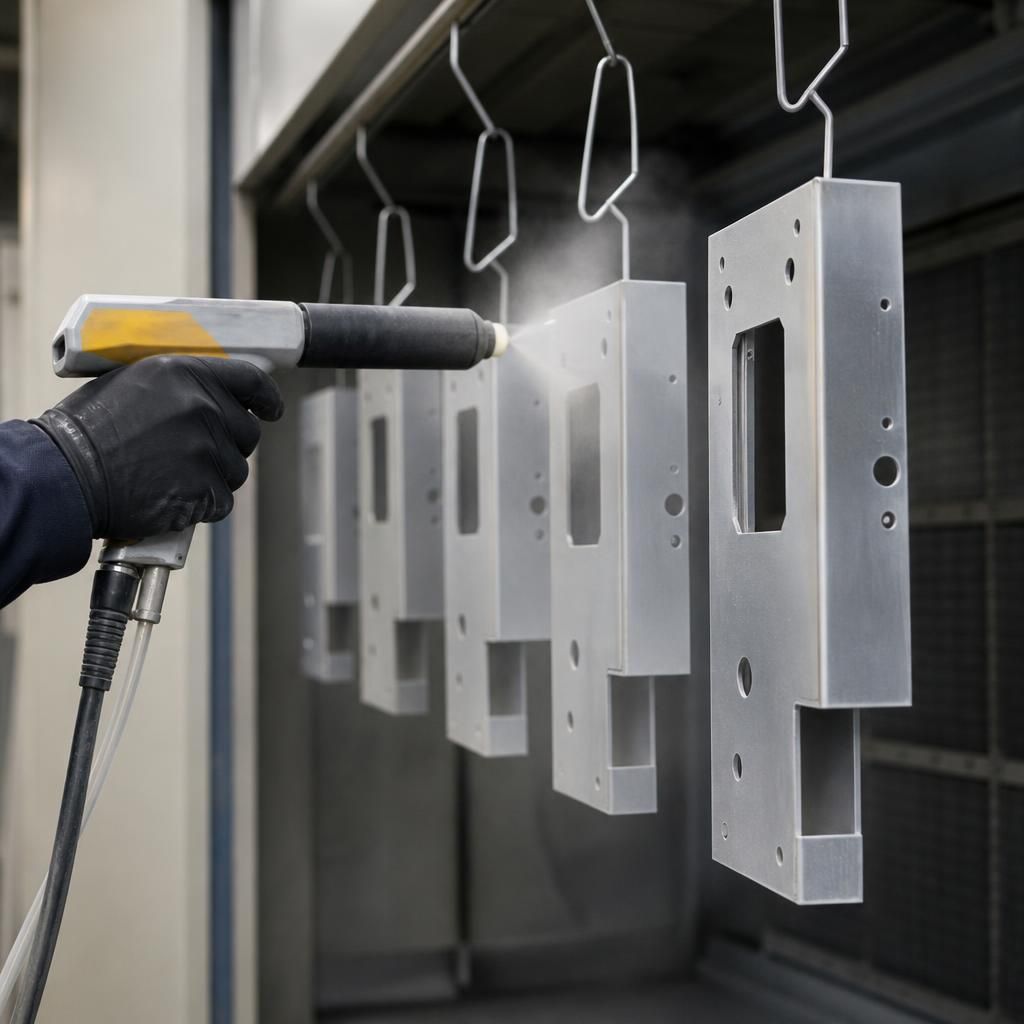
Before changing powder flow, confirm that the aluminium surface is clean, dry and correctly pretreated. Oil, dust, moisture or inconsistent pretreatment can cause poor adhesion, patchy appearance or apparent thin coverage even when powder delivery is stable. Increasing the feed rate in response to a surface problem usually adds material without correcting the defect.
Compare the finish on areas with similar preparation and geometry. If the powder deposits evenly but separates, craters or loses adhesion during curing, investigate surface preparation and the curing process rather than increasing flow. Flow adjustment is appropriate when the deposited layer is consistently too light or too heavy on a sound, properly prepared aluminium surface.