

What are the benefits of surface roughening in powder coated scaffold tube preparation?
Surface roughening creates a consistent profile that gives powder coating a stronger mechanical key to the scaffold tube. It can improve adhesion, reduce the risk of premature lifting or flaking, and support a more durable, uniform finish when combined with thorough cleaning.
Surface roughening benefits powder coated scaffold tube preparation by conditioning the metal into a clean, consistent and suitably textured surface before powder is applied. The process is not simply about making the tube look less smooth; it removes weak surface layers, controls the condition of the steel and helps the coating form an even protective film over the prepared tube.
- Removes mill scale, corrosion and unsound material: Abrasive or mechanical roughening can break down mill scale, light rust and other surface layers that may be poorly attached to the steel. Leaving these materials in place can compromise the coating system because the powder is applied to the residue rather than to a stable metal surface.
- Creates a more consistent substrate: Scaffold tube may contain variations caused by handling, storage, previous processing or local oxidation. Controlled roughening reduces these differences, giving the coater a more uniform surface to inspect and treat before powder application.
- Supports an even visual finish: A suitable surface profile helps the powder settle over the tube without being affected by loose scale, flaky corrosion or abrupt contamination-related changes. This can reduce visible inconsistencies such as localised texture differences, exposed patches or areas where the finish appears thinner.
- Helps expose defects before coating: Preparation can reveal dents, deep scratches, weld spatter, sharp projections and areas of corrosion that might otherwise be hidden beneath the powder. Identifying these issues before coating allows the tube to be assessed, repaired or separated where necessary rather than concealing a substrate problem.
- Improves process control: Surface roughening provides a preparation stage that can be checked for coverage, uniformity and remaining contamination. Operators can assess whether the tube has been prepared consistently instead of relying solely on the appearance of the finished coating.
- Reduces the risk of coating irregularities caused by contamination: Roughening is often part of a wider preparation sequence. When followed by appropriate cleaning and moisture control, it helps remove particles and residues that could otherwise cause pinholes, craters, poor coverage or local finish defects.
The degree of roughening must be controlled. Too little preparation may leave corrosion, scale or weak material in place, while excessive abrasion can create an unnecessarily coarse profile, remove too much substrate or make thin sections and edges more difficult to coat consistently. The correct approach depends on the tube’s condition, the existing surface treatment, the required finish and the powder coating system being used.
Preparation is normally assessed across the full tube rather than only on the most visibly affected areas. Particular attention is needed around welds, cut ends, joints, brackets and damaged sections, where residues and corrosion can be concentrated. Ends and recesses may also require separate inspection because they can be harder to abrade and clean evenly.
After roughening, the tube must be cleared of abrasive media, dust and loosened debris before coating. This is why roughening should not be treated as a substitute for cleaning. The two stages have different purposes: roughening conditions the metal surface, while cleaning removes the material introduced or released during preparation. Moisture and further contamination must also be avoided between preparation and powder application.
For scaffold tubes, the practical benefit is a more predictable starting condition. A properly controlled surface profile makes it easier to identify preparation defects, maintain consistent coating coverage and prevent the powder finish from masking problems in the underlying steel. Surface roughening therefore contributes to finish quality as part of a complete preparation process, rather than functioning as an isolated treatment.
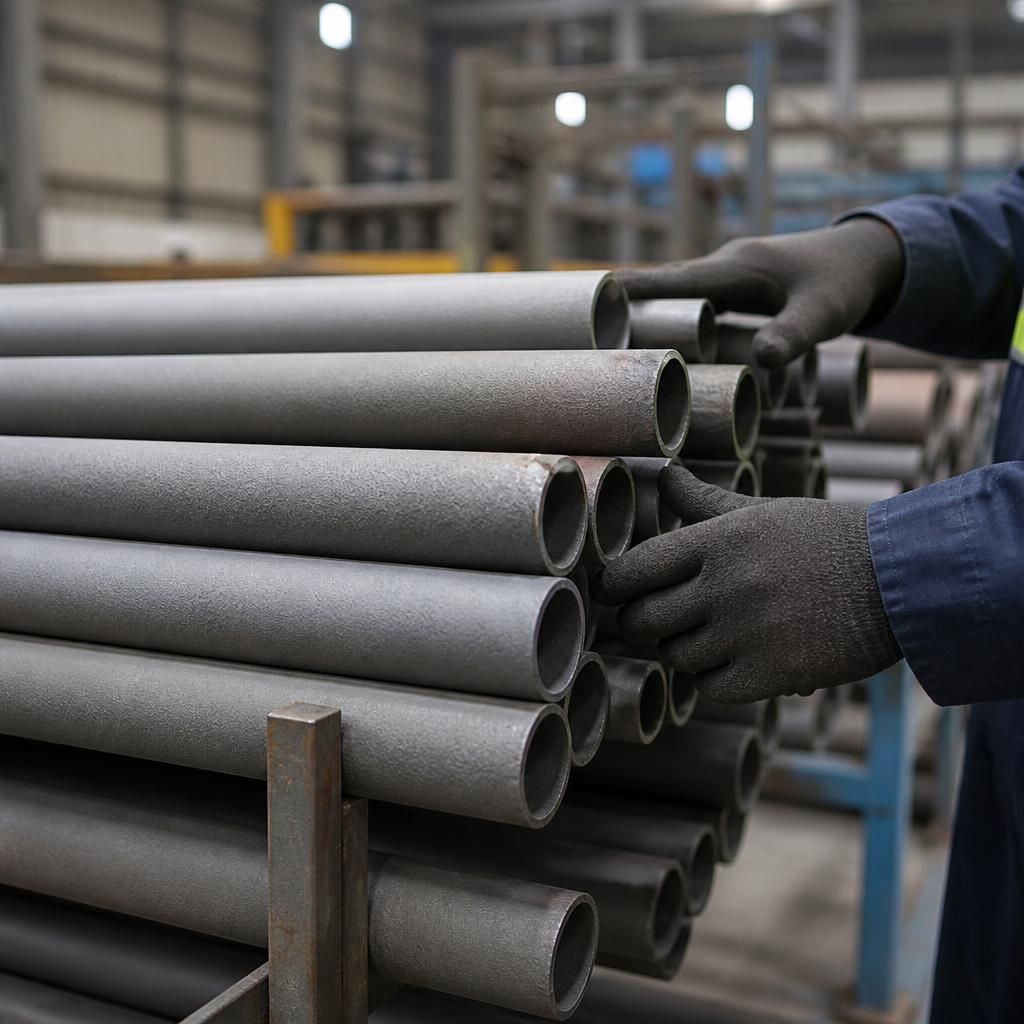
A further benefit of controlled surface roughening is that it helps match the steel surface to the intended powder coating system. The aim is not to produce the deepest possible texture, but an even profile that the powder can cover during curing. If the profile is too pronounced for the planned film build, raised areas may receive less protection while depressions can retain residue or moisture. A suitably moderated profile therefore supports a more reliable protective layer across the tube.
This is particularly important when scaffold tubes have different steel conditions or areas of previous treatment within the same batch. Assessing the roughened surface against the specified coating system helps determine whether preparation is appropriate before powder application, rather than relying on a uniform blasting or abrasion setting for every tube.