

How does the abrasion process enhance the adhesion of powder coatings on scaffold tubes?
Abrasion enhances powder coating adhesion on scaffold tubes by creating a clean, microscopically rough surface that gives the powder coating more area to grip. It also removes loose surface material and weak oxide layers, helping the applied coating form a stronger, more durable bond with the steel.
The abrasion stage enhances powder coating adhesion by preparing the scaffold tube’s surface to provide a sound, stable foundation for the coating system. Rather than relying on a weak outer layer of rust, mill scale, old coating or surface residue, the powder is applied to steel that has been mechanically prepared and checked for suitability.
The effectiveness of abrasion depends on using a method appropriate to the tube’s condition and geometry. Abrasive blasting is often suitable for larger batches because it can treat the external surface consistently, including around welds, joints and other irregular areas. Mechanical abrasion using suitable tools may be more appropriate for localised preparation, edges or sections that need controlled treatment. The objective is not simply to make the surface look dull; it is to remove unsound material without damaging the tube or creating an inconsistent finish.
Uniformity is particularly important for scaffold tubes because their shape includes curved surfaces, ends, seams, weld zones and sometimes areas that are difficult to reach. If one section is prepared thoroughly while another retains loose scale or a weak previous coating, the powder coating may bond differently across the same component. Variations in preparation can later appear as localised lifting, flaking or premature breakdown, even when the powder has been applied correctly elsewhere.
A controlled abrasion process also helps expose defects that may be hidden beneath surface contamination. Pitting, corrosion, sharp edges, weld spatter and remnants of an existing finish become easier to identify once the outer material has been removed. These areas can then be assessed before coating rather than being concealed beneath the new finish. Sharp projections and loose material are especially important because they can interfere with coating coverage and create points where damage begins during handling or use.
The abrasive medium and equipment settings must be selected carefully. Excessive force can round edges, alter the appearance of the steel, embed abrasive particles or damage a thin-walled section. Insufficient treatment may leave weak material in place. A suitable process therefore balances removal with control, producing a consistent prepared surface while preserving the dimensions and profile of the scaffold tube.
After abrasion, the prepared tubes need to be handled in a way that protects the result. Abrasive dust and detached particles must be removed using an appropriate cleaning step, and the surface should not be contaminated by oily gloves, workshop residue or unclean handling equipment. Any remaining dust can form a barrier between the steel and powder, while moisture on freshly prepared steel can contribute to surface corrosion before coating. This is why abrasion should be treated as one stage within a coordinated preparation sequence rather than as a standalone operation.
Inspection after abrasion should cover the whole tube, not only an easily accessible section. Useful checks include:
- Whether rust, scale, old coating and other weak material have been removed from all required areas.
- Whether welds, tube ends, corners, seams and recessed sections have received comparable preparation.
- Whether the surface has been left free from visible dust, oil and abrasive residue.
- Whether excessive blasting or mechanical action has caused distortion, sharp damage or an uneven appearance.
- Whether the prepared steel remains in a suitable condition for the next coating stage.
For powder coating, this consistency supports more reliable coverage during application and curing. The powder must be able to contact a suitably prepared substrate across the full component, including areas that are often overlooked. Abrasion cannot compensate for unsuitable curing, contamination introduced later or poor powder application, but it removes one of the main causes of adhesion failure: a coating being applied over an unstable or poorly prepared surface.
For scaffold tubes used in construction environments, this preparation is important because the finished coating may be exposed to repeated handling, contact with fittings and general mechanical wear. A carefully controlled abrasion process does not make the coating immune to damage, but it gives the coating system a more dependable substrate and reduces the likelihood that failure will begin at a poorly prepared area.
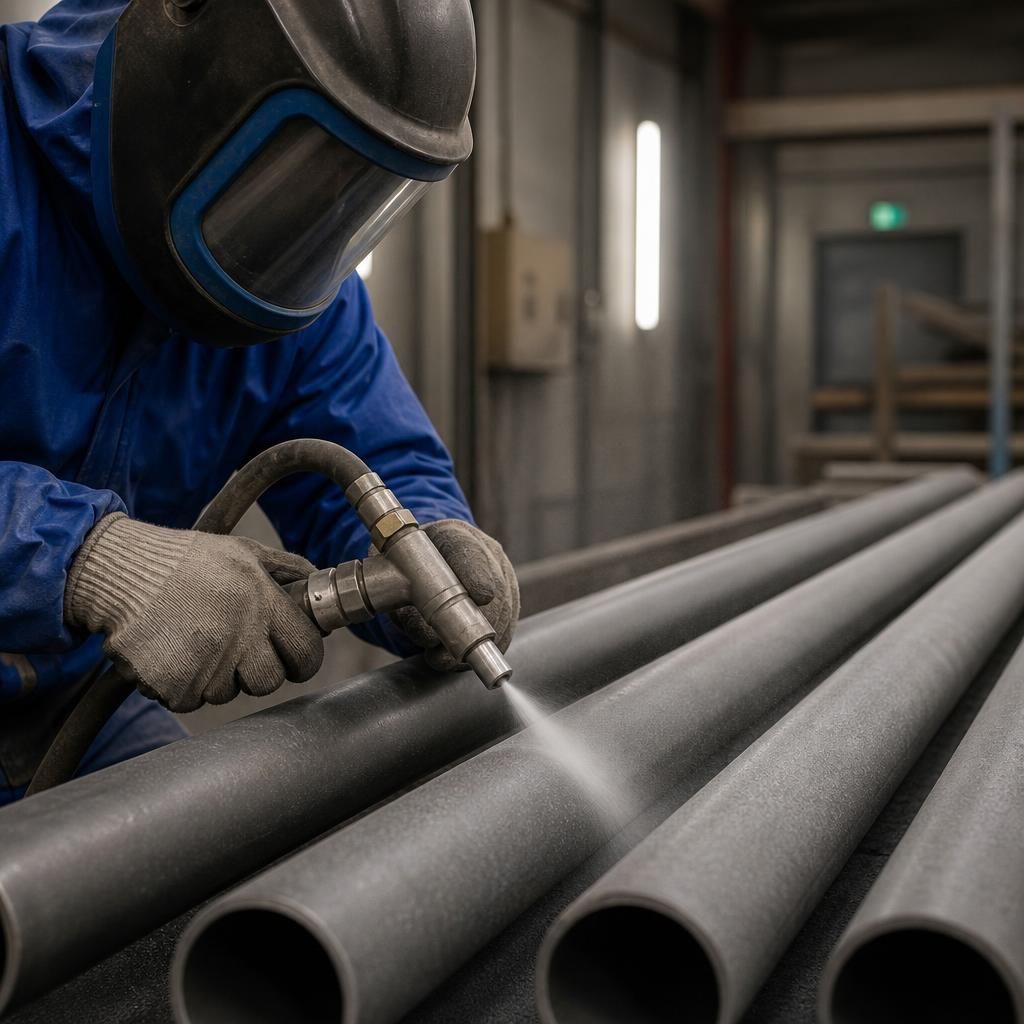
Abrasion improves adhesion by giving the powder coating a surface profile that it can flow into during curing. As the powder melts, it conforms to the prepared steel rather than remaining on a smooth, weak boundary layer. Once cured, this interlocking effect helps the coating resist separation when the scaffold tube is handled, fitted or exposed to routine mechanical contact.
The prepared profile must remain controlled. A surface that is too smooth provides limited opportunity for mechanical keying, while excessive abrasion can create an irregular finish that affects coating coverage. The most effective preparation produces a consistent profile suited to the tube and the powder-coating system, allowing the coating to form a continuous film across the steel.