

How do cleaning methods impact the quality of powder coated scaffold tubes?
Cleaning methods directly affect the adhesion, appearance and durability of powder coating on scaffold tubes by removing oil, grease, dirt, rust and other contaminants. An inadequate or overly aggressive process can leave residues, damage the metal surface or cause defects such as poor coverage, blistering and premature coating failure.
Cleaning affects powder-coated scaffold tubes by determining whether the metal surface is chemically and physically suitable for subsequent treatment. The most reliable results come from matching the cleaning process to the contaminants present, controlling residues and rinse water, and verifying that the tubes are completely dry before coating.
Different contaminants require different treatments. Oils, cutting fluids, grease and handling residues are generally removed with an alkaline or solvent-based degreaser selected for the metal and coating process. Loose dust, soil and scale may require washing or mechanical removal first, while corrosion products need a controlled treatment that does not leave the steel chemically active or contaminated. A single cleaning stage is therefore not always sufficient, particularly where scaffold tubes have passed through fabrication, storage and site handling.
- Degreasing: breaks down oils and grease that can repel pretreatment chemicals and prevent uniform coating.
- Aqueous washing: removes soluble dirt, cleaning residues and loose particles, provided the rinse stage is properly controlled.
- Solvent cleaning: can be useful for localised contamination, but the solvent must evaporate cleanly and must not leave an oily film.
- Rust and scale treatment: prepares affected areas for further surface preparation, with the method chosen according to the extent and type of corrosion.
- Final rinsing: removes residues from earlier stages that could otherwise remain beneath the powder coating.
The condition of the tubes also determines how intensive the process needs to be. New tube may carry mill oils, protective films or packaging residue, whereas reclaimed or site-used tube can contain cement dust, salts, paint, grease and embedded soil. Welded areas may hold spatter, heat tint or fabrication residues, and ends or recesses can retain water and cleaning solution. These areas need particular attention because contamination left in a joint, seam or tube end can affect the finish even when the main surface appears clean.
Cleaning chemistry must be compatible with the substrate. Excessively strong alkaline or acidic products can attack the metal, alter the surface or remain trapped in difficult-to-rinse areas. They can also create problems if different metals or existing finishes are present on the same component. The process should therefore specify the chemical type, concentration, contact time, application method and temperature rather than relying on an unspecified general-purpose cleaner.
Rinsing is as important as the initial cleaning stage. Cleaner residue, dissolved salts and loosened contamination must be carried away rather than redistributed across the tube. Poor-quality rinse water can leave mineral deposits or conductive residues, which may contribute to surface staining, uneven pretreatment or local coating defects. Rinse stages should be assessed for cleanliness, and the tube should not be allowed to dry with concentrated chemical residue on its surface.
After washing, drying must take place before powder application. Water can remain inside tube ends, around welds, beneath overlapping parts or in surface irregularities after the outside appears dry. Trapped moisture may produce steam-related defects during curing, interfere with pretreatment and contribute to corrosion beneath the coating. Drainage, air movement and suitable drying equipment help remove water from these areas, but the tubes still need inspection rather than being assumed dry.
Inspection confirms whether cleaning has achieved its purpose. Useful checks include looking for visible oil, fingerprints, dust, water marks, flash rust, streaking and residues around welds and ends. A clean surface should have a consistent appearance appropriate to the chosen pretreatment, without patches that indicate uneven chemical action. Where required by the coating specification, additional checks can assess surface cleanliness, remaining salts or water-break behaviour. These checks are particularly valuable when tube condition varies between batches.
Timing between cleaning and coating also matters. A cleaned steel surface can collect airborne dust, absorb handling contamination or develop light corrosion if it is stored in unsuitable conditions. Tubes should be protected from unnecessary contact and handled with clean equipment after preparation. If contamination or corrosion occurs after cleaning, the affected area should be reassessed rather than simply coated over.
Cleaning should be considered part of a connected preparation sequence rather than an isolated wash. The typical order is inspection, removal of heavy contamination, degreasing, rinsing, treatment of corrosion or scale where necessary, further rinsing, drying and final inspection before powder coating. Surface roughening or other preparation may follow or be integrated with this sequence, but it cannot compensate for grease, salts or chemical residue left on the metal.
For batch-coated scaffold tubes, consistency is as important as the choice of cleaner. The same process should be applied in a controlled manner, while heavily contaminated items are identified for additional treatment instead of being processed as though all tubes have identical histories. This reduces variation between tubes and makes it easier to trace the cause of any isolated coating problem.
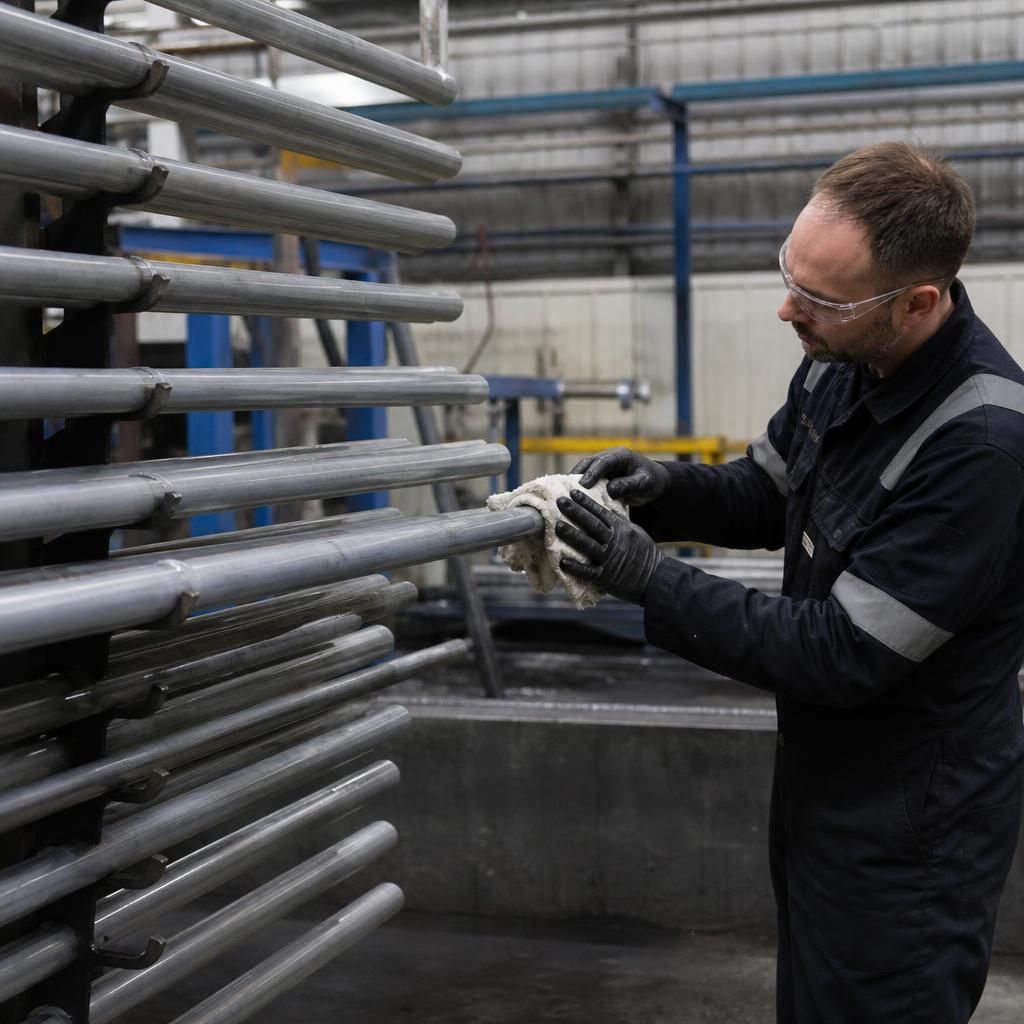
Cleaning also affects how powder is deposited onto scaffold tubes. Powder coating relies on an electrostatic charge attracting particles to the earthed metal surface. An invisible film of oil, detergent residue or other contamination can reduce consistent contact and contribute to uneven powder coverage, particularly around welds, joints and recessed areas.
This means a tube may look clean while still producing variable application results. Removing residues thoroughly and confirming that the surface is clean, dry and electrically suitable helps the powder form a more even film before curing. The cleaning method should therefore be assessed not only by visible appearance, but by its effect on the complete coating process.