

What are the best practices for masking to prevent overspray in nylon powder coating preparation?
Use clean, heat-resistant masking materials that fit tightly over threads, bores, mating faces and other areas that must remain uncoated, securing all edges to prevent powder ingress. Check the masking before coating, keep exposed boundaries clear and remove it carefully after curing to leave a defined edge without damaging the nylon finish.
Effective masking for nylon powder coating is a controlled method of shielding areas that must remain free from powder while allowing the coating to be applied evenly to the specified surfaces. The best practice is to design the masking around the component’s geometry, coating process and curing conditions, then verify its fit and condition before the part enters the spray area.
Start with the coating drawing and part function. Identify every surface where nylon could interfere with assembly, electrical contact, movement, drainage or dimensional fit. This may include bearing seats, earth points, threaded features, hinge faces, inspection points and close-tolerance locations. Mark these areas on the job documentation rather than relying only on visual judgement during preparation. A clear masking plan helps operators distinguish between surfaces that require complete protection and areas where a small coating overlap is acceptable.
Select masking by feature rather than using one material for everything. Reusable silicone caps and plugs are useful for repeated cylindrical features, while purpose-made inserts or shaped covers can protect irregular openings. High-temperature masking tape is more suitable for broad flat boundaries, temporary covers and edges that cannot accept a plug. For larger components, rigid shields or hanging masks can reduce powder deposition on adjacent areas without touching the prepared surface. The chosen material should tolerate the process temperature, remain stable during handling and leave no residue on the metal.
Masking components should also be compatible with the size and shape of the feature. A plug that is too small may allow powder into a bore, whereas excessive interference can damage the prepared surface or make removal difficult. For blind holes, consider how the mask will be retrieved after coating. A small handle, pull tab or accessible edge can prevent tools being forced against the finished coating. On deep or narrow features, confirm that the mask reaches far enough to create the required uncoated depth without becoming trapped.
Control the coating boundary deliberately. A straight boundary is usually achieved by using a firm, well-defined mask edge rather than stretching flexible tape around corners. Where the design permits, position the boundary on a non-critical face or in a recess. This reduces the visual impact of minor transition marks and helps protect the functional surface. On radiused edges, avoid forcing a flat mask across a curve, as this can create a channel through which powder settles. A shaped mask or a planned overlap is more reliable for these profiles.
Parts should be masked only after preparation has produced a clean, suitable surface. Handle the component with clean gloves or other contamination controls once the final preparation stage is complete. Oils, dust, moisture and fibres transferred from hands, damaged tape or dirty reusable plugs can create defects close to the masked boundary. Reusable masking should therefore be inspected and cleaned according to a controlled procedure, with damaged or powder-encrusted pieces removed from use.
Keep masking stable during movement and spraying. The part may be rotated, hung, transferred or exposed to compressed air before the powder is applied. Secure the masking in a way that does not obstruct the spray path or create loose edges. Avoid fixing methods that can shed debris onto the surface. Where a component has a complicated orientation, test its handling route before production so that the mask does not shift when the part is lifted or repositioned.
Overspray control also depends on how the operator approaches the component. Spray direction, gun angle and the distance from the masked boundary should be planned so that the powder cloud is not driven directly into an opening or underneath a cover. Apply particular care around cavities, downward-facing ledges and areas where electrostatic attraction may draw powder beyond the intended edge. If a feature is especially sensitive, a secondary temporary shield can be used during spraying, provided it does not touch or contaminate the prepared coating surface.
Use a first-off inspection to validate the masking method. After coating and removal of the mask from an initial component, inspect the protected areas for powder ingress, unwanted edge build-up, residue, surface damage and difficulty of removal. Check the dimensions and fit of critical features where coating exclusion is required for assembly. If the result is inconsistent, adjust the mask design, contact pressure, boundary position or spray approach before processing the rest of the batch.
Document the approved arrangement with a component photograph, drawing mark-up or work instruction. Record the type and location of each mask, the order in which it is fitted and the safe removal method. This is particularly important where several similar parts have different holes, threads or functional faces. A documented arrangement reduces the risk of a mask being omitted, fitted to the wrong feature or left in place after the process.
Finally, remove masking in a controlled sequence once the coating has reached the appropriate condition for safe handling. Pull masks in the direction that places least stress on the coating edge, and use suitable non-damaging tools where access is limited. Do not prise against a newly coated face or allow removed plugs and tape to drag debris across the finish. The protected area should then be checked against the drawing or masking plan, with any overspray, edge defect or coating damage recorded for assessment rather than concealed during assembly.
For industrial nylon powder coating, the most dependable approach combines feature-specific masks, a planned coating boundary, contamination control, stable handling, controlled spraying and documented inspection. Masking is therefore not an isolated preparation step: it should be treated as part of the complete component and process design.
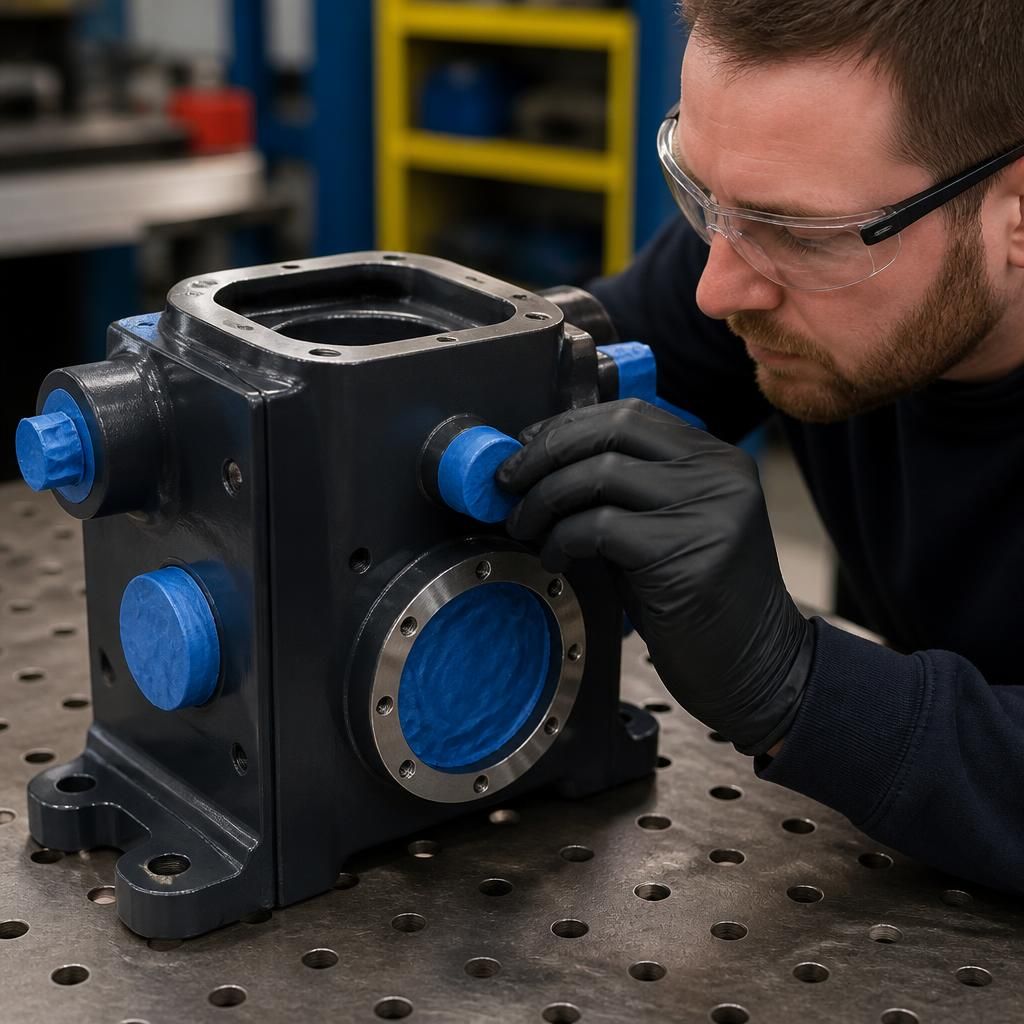
Check enclosed features for trapped air and moisture before fitting a mask. A tightly sealed plug or cap can shift as air expands during heating, allowing powder beneath the edge or leaving an inconsistent coating boundary. Moisture trapped in a bore, recess or under a cover can also produce contamination during the coating cycle.
Dry the component and masking materials before use, and consider whether a blind cavity needs a vented or pressure-relieving masking arrangement. The mask must still prevent powder entry, but it should not be forced into a feature so tightly that removal damages the prepared surface. This is particularly important for deep bores, narrow recesses and hollow sections where pressure cannot equalise easily.