

How does selecting the right nylon powder type affect the coating process and finished product quality?
Selecting the correct nylon powder type affects its melting and flow behaviour, the coating method and the conditions needed to form a consistent film. Matching the powder to the metal substrate, service environment and required finish helps achieve the intended appearance, adhesion, wear resistance and durability.
The nylon powder type determines how the material melts, flows, bonds to the substrate and forms the final film. Choosing an unsuitable grade can lead to poor coverage, inconsistent thickness, weak adhesion, surface defects or premature wear, even when the application equipment and preparation are otherwise correctly controlled.
Start with the service requirements. The finished component should be assessed for its exposure to abrasion, impact, chemicals, moisture, temperature changes, weathering and repeated flexing. A coating intended for sliding contact requires different performance from one used mainly for corrosion protection or electrical insulation. The correct nylon grade is therefore selected by balancing the required mechanical and environmental properties rather than choosing solely by colour or appearance.
- PA11 is commonly considered where flexibility, impact resistance and resistance to mechanical damage are important.
- PA12 is often selected where dimensional stability, moisture resistance and a consistent finished surface are priorities.
- PA6 and nylon copolymers can provide useful combinations of hardness, wear resistance and toughness, but their moisture sensitivity and processing behaviour need careful consideration.
These are broad material tendencies, not substitutes for the technical data for a particular coating grade. Formulations can contain modifiers, pigments, stabilisers, lubricants or adhesion-promoting additives that significantly alter their behaviour. A coating powder designed for industrial application should be used in preference to a general-purpose nylon powder intended for another manufacturing process.
Powder particle size affects application and appearance. Finer powders can produce a smoother film and may be suitable for spray application, but they can be more sensitive to fluidisation, recovery and electrostatic control. Coarser particles may be advantageous for building film thickness or use in a fluidised-bed process, although they can produce a more textured surface and may require different heating conditions. An unsuitable particle-size distribution can cause poor transfer, uneven deposition, dusting or variations between accessible and recessed areas.
The powder type also sets the processing window. Nylon grades differ in softening behaviour, melt viscosity and the temperature range over which they flow adequately. During application, the metal and powder must reach conditions that allow the particles to fuse into a continuous film without excessive flow, sagging, degradation or loss of detail. A grade that melts readily may not be appropriate if it flows away from edges or forms runs, while a high-viscosity grade may leave pinholes, incomplete coverage or visible texture if the component does not reach the necessary temperature.
This is particularly important when selecting between application methods. Fluidised-bed coating generally relies on the heated component passing through suspended powder, whereas electrostatic spray deposits charged particles before the part is heated or subjected to a combined heating cycle. Hot flocking and other specialist methods have their own requirements. Powder intended for one method may not give reliable transfer or film formation in another, so the grade, equipment settings and heating cycle should be treated as a linked system.
Film thickness is another important consideration. Nylon coatings are often chosen for their protective, wear-resistant and insulating properties, but increasing thickness does not automatically improve performance. Excessive build can obscure edges, interfere with mating parts, trap defects and produce uneven cooling. Insufficient build may leave the substrate vulnerable at corners, edges or high-wear areas. The selected powder should be capable of producing the required film consistently at the specified thickness and across the full geometry of the component.
Surface finish is influenced by more than the colour formulation. Powder flow, particle size, substrate temperature, heating uniformity and cooling behaviour all affect whether the result is smooth, textured, glossy, matt or prone to orange peel. A grade formulated for a textured finish should not be assessed against the same visual standard as a smooth grade. Conversely, visible texture that is not intended may indicate poor melting, contamination, unsuitable powder storage or an incompatible application cycle.
Moisture control is essential for nylon powders. Nylon can absorb moisture from the atmosphere, and moisture in the powder may affect fluidisation, charging, melt behaviour and surface quality. It can contribute to bubbling, pinholing or inconsistent deposition. Powder should therefore be stored and handled in accordance with the supplier’s instructions, with opened material protected from humidity and contamination. Reclaimed powder also needs controlled management because repeated heating, mixing with different grades or contamination can change its application and finished-film properties.
The substrate and component design should be considered alongside the powder choice. Different metals conduct and retain heat differently, while welds, sharp edges, recesses and changes in section thickness can create variations in melt and fusion conditions. A nylon grade that performs well on a simple, uniform component may need a different application approach on a complex fabrication. The selected system must provide adequate adhesion after the chosen preparation method and remain compatible with any required masking, assembly or post-coating operations.
Quality should be confirmed through a controlled trial before full production. A practical assessment should examine powder condition, application efficiency, film thickness, coverage of difficult areas, surface appearance, adhesion and the properties most relevant to service, such as abrasion, impact or chemical resistance. It should also check whether the coating remains stable after handling and assembly. This process helps separate a problem caused by powder selection from one caused by cleaning, surface profile, pre-heating, gun settings or oven control.
For industrial components, the most reliable selection process is to define the service environment, identify the required finish and film build, confirm compatibility with the application method, then compare the technical data for suitable nylon grades. The powder supplier or coating specialist can use the component material, dimensions and intended duty to establish an appropriate trial cycle. Selecting the grade in this way improves process control and gives the finished coating a better chance of delivering the required adhesion, appearance and long-term durability.
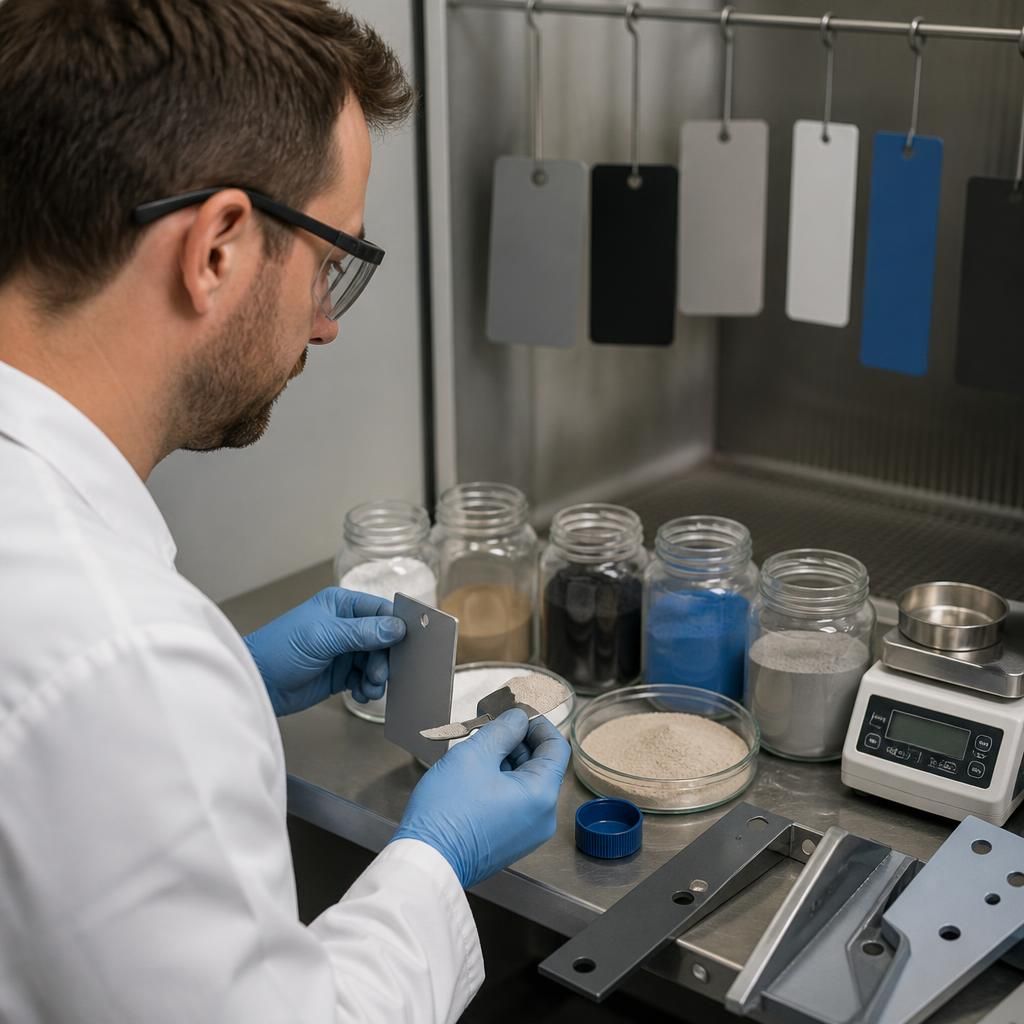
Technical data should be compared on a like-for-like basis when selecting a nylon powder. Abrasion resistance, impact performance, chemical resistance and adhesion results can vary according to the test method, substrate preparation and film thickness used. A higher value in one data sheet does not automatically mean that grade will perform better on a particular component.
Check that the published results relate to the intended application method and coating build, then confirm any limits for temperature, moisture exposure and chemical contact. This makes the powder choice more relevant to the finished product and helps prevent a grade being selected solely because of a single headline property.
Discuss the Right Nylon Powder Type for Your Components
Discuss your component material, geometry, service conditions and preferred application method with a coating specialist to identify suitable nylon powder options. A controlled trial can then confirm the chosen grade and process before production coating.