

What are the specific abrasion techniques required for optimal powder coating adhesion on different metals?
Optimal powder coating adhesion depends on matching the abrasion method to the metal: steel commonly requires shotblasting or abrasive blasting to remove scale and create a suitable profile, while aluminium and other softer metals need a gentler, controlled abrasive to prevent distortion or excessive roughness. Stainless steel requires dedicated, contamination-free abrasive equipment, followed by thorough cleaning before coating.
Abrasion for powder coating is the controlled removal or roughening of the metal surface to provide a consistent key for the coating. The correct technique depends on the substrate’s hardness, thickness, existing condition and sensitivity to heat or deformation. Effective preparation therefore involves selecting suitable abrasive media, controlling the blasting action and checking the resulting surface rather than treating every metal in the same way.
Match the abrasive to the substrate
- Mild and carbon steel: Angular abrasive media are useful where mill scale, corrosion products, weld residues or old coatings need to be removed while leaving a defined surface texture. Steel grit can provide an efficient cut on robust components, while steel shot is more suitable where a less aggressive action is sufficient. The choice should reflect the component’s thickness and geometry; excessive impact can damage thin sections, sharp edges or precision-machined areas.
- Stainless steel: Stainless components should be processed with abrasive and equipment that cannot transfer free iron or other contaminants. Non-metallic media such as aluminium oxide may be appropriate for producing a controlled key. Separate blasting systems, clean handling and careful dust removal help prevent embedded contamination that could later cause staining or coating defects.
- Aluminium: Aluminium needs a lighter, closely controlled treatment because it is relatively soft and can lose dimensional accuracy or develop an unnecessarily coarse finish. Fine non-metallic abrasive, reduced blasting force and constant nozzle movement help avoid gouging, warping and excessive material removal. Glass bead can clean and lightly texture some surfaces, although the final profile must be suitable for the powder system rather than simply appearing clean.
- Galvanised and zinc-coated steel: These surfaces generally require sweep blasting rather than aggressive removal. The aim is to key the surface and eliminate weak contamination without stripping away more protective zinc than necessary. Particular care is needed around corners, welds and exposed steel, where the coating thickness may already vary.
- Cast iron: Castings can contain pores, mould residues, graphite and absorbed oils. Abrasion should be combined with appropriate degreasing and inspection so that contaminants are not merely exposed or spread across the surface. Recesses, casting lines and internal corners require attention because retained debris can interfere with powder coverage and adhesion.
- Copper, brass and other soft alloys: These materials can be marked or distorted by forceful blasting. A fine, clean non-metallic abrasive and short, even passes are normally more appropriate than a high-impact process. The surface should be checked for embedded media and residual dust before coating.
Control the blasting technique
Media selection alone does not determine the result. Air pressure, nozzle size, stand-off distance, impact angle, traverse speed and overlap all affect the surface profile. Holding the nozzle too close or moving too slowly can produce a rough, uneven finish; moving too quickly can leave untreated areas. Flat faces, edges, holes and welded sections may need different passes, but blending between areas is important so the coating does not encounter abrupt changes in texture.
Angular grit cuts into a surface and is generally selected when a stronger mechanical key is required. Rounded shot is less cutting and can close or smooth previously roughened areas if used incorrectly. Bead media may clean or gently texture a surface, but it should not be assumed to provide the same profile as a sharper abrasive. Reclaimed media also needs monitoring, as worn particles, mixed media or accumulated contaminants can change the cleaning and profiling action.
Prepare edges, welds and difficult areas
Weld spatter, sharp burrs, slag, grinding dust and fabrication residues should be dealt with before or during abrasion. Abrasive blasting will not reliably correct poor fabrication or remove substantial weld defects. Edges may receive less coverage than broad faces, while recesses can retain abrasive and dust, so these areas need visual inspection and suitable cleaning. Any masking required for threaded holes, bearing seats or machined faces should be compatible with the preparation and coating process.
Prevent recontamination after abrasion
A freshly abraded surface is vulnerable to fingerprints, moisture, oil and airborne dust. Use clean, dry compressed air and suitable extraction to remove loose abrasive and fines. The air supply should not introduce oil or water. Operators should avoid handling prepared faces with bare hands, and components should move into the next preparation or coating stage without unnecessary exposure. If visible rust bloom, dust or handling marks appear, the surface may need further treatment rather than being coated over.
Verify the finished profile
Inspection should confirm that the surface is uniformly clean, free from loose residue and textured consistently for the powder coating system. A surface-profile comparator or suitable measuring method can help identify areas that are too smooth or excessively rough. Visual checks should be supported by attention to edges, welds, recesses and transitions between different metals or fabrication areas. Where a component combines substrates, the gentlest method may not be sufficient for the harder metal, while the most aggressive method may damage the softer one; separate passes or masking may therefore be necessary.
The optimal abrasion method is consequently a controlled, substrate-specific process: use enough cutting action to remove weak material and establish a suitable key, but not so much that the metal is distorted, contaminated or given an uneven profile. Cleaning, inspection and careful handling after abrasion are integral to adhesion and should be treated as part of the preparation process rather than as optional final steps.
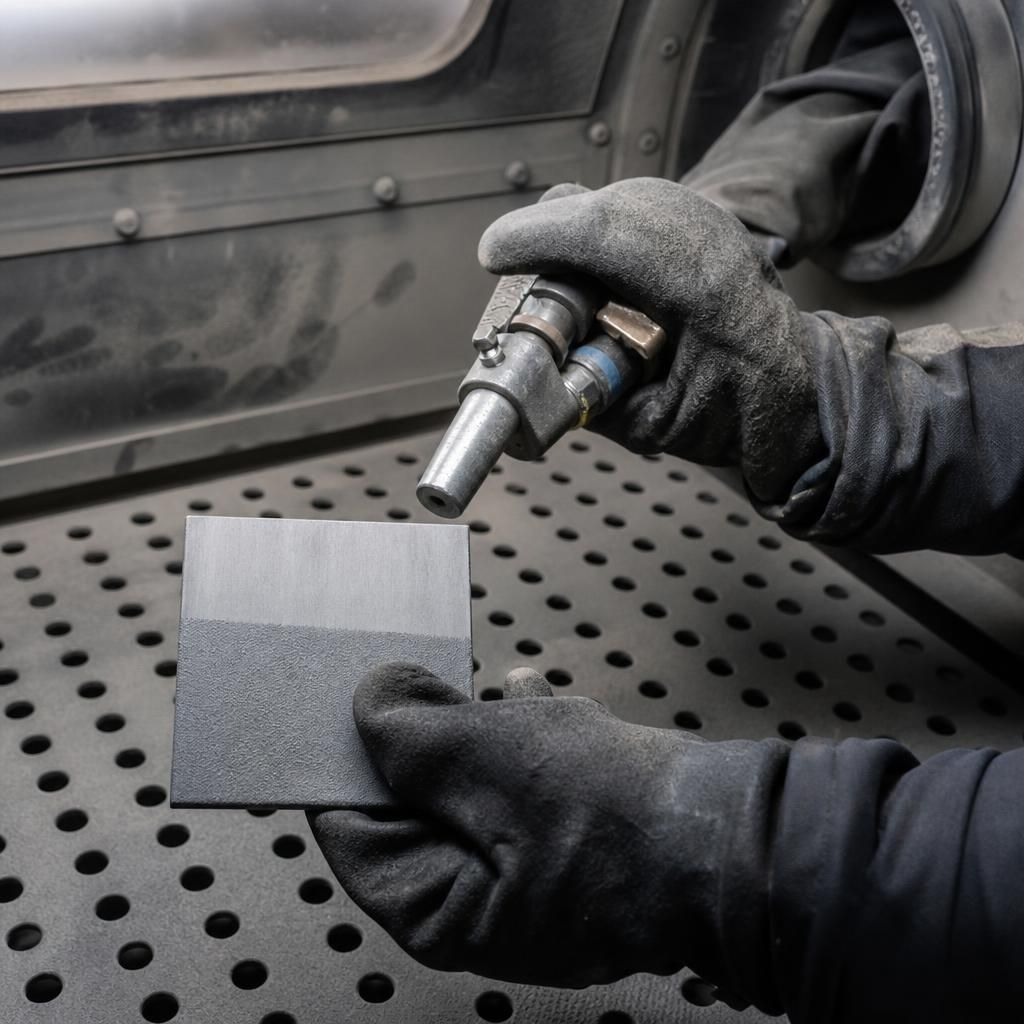
Validate the abrasion method on a representative test piece. For unfamiliar alloys, mixed-metal assemblies or components with an unusual existing finish, a small trial area can confirm that the selected abrasive produces a suitable key without damaging the substrate. This is particularly useful where the same component includes both hard and soft metal sections.
The trial should be prepared using the intended media and blasting settings, then cleaned and coated through the normal process. After curing, inspect the finish for visible defects and assess whether the coating remains firmly attached when subjected to an appropriate adhesion check. If the result shows excessive roughness, exposed substrate, embedded abrasive or poor bonding, adjust the abrasive type or blasting intensity before processing the full batch.
Discuss the right abrasion technique for your metal components
Discuss your metal components with Powder-coatings.co.uk to identify a suitable abrasion approach for the substrate, existing finish and required powder coating system. Share details of the material and component condition so the preparation process can be assessed before coating.