

Why is consistent powder coating thickness crucial for maintaining steel structural integrity?
Consistent powder coating thickness protects steel’s structural integrity by providing uniform coverage, reducing thin areas where moisture and corrosion could begin. It also avoids excessive build-up, which can impair adhesion, cause cracking or affect the fit of assembled components.
Consistent powder coating thickness is crucial because it gives every part of a steel component a predictable protective performance without changing the component’s designed dimensions or interfering with its connections. The coating does not strengthen steel or carry structural loads; its role is to protect the steel so that corrosion, dimensional changes and surface deterioration do not undermine the component during service.
Steel structural integrity depends on the material retaining its intended cross-section and mechanical properties. If corrosion progressively removes steel, particularly around joints, fixings, welds or exposed edges, the affected area may no longer perform as designed. A controlled coating thickness helps create a reliable barrier between the steel and the surrounding environment, supporting the long-term condition of the substrate.
Thickness consistency also matters because structural components are designed with defined dimensions and tolerances. Excess coating on mating faces, threaded areas, holes or locating points can alter clearances and prevent components from assembling correctly. In fabricated assemblies, this may place unintended loads on fixings or connections. A controlled finish reduces the risk that the coating itself becomes a dimensional variable.
Uneven thickness can produce different levels of flexibility and surface protection across the same component. Areas with a heavier deposit may behave differently during handling, forming or service movement, while areas with a lighter deposit have less protective material available. The result is less predictable performance, especially where a part experiences vibration, impact, abrasion or repeated changes in temperature.
The specified thickness must therefore be considered alongside the steel grade, component geometry, preparation method, powder chemistry, intended environment and curing conditions. A suitable specification normally establishes:
- the required dry-film thickness range for the component and service conditions;
- where measurements should be taken, including representative flat areas and geometrically difficult locations;
- which surfaces, edges, recesses and interfaces must remain within dimensional tolerances;
- the preparation and curing requirements needed to achieve a sound, properly bonded film; and
- the inspection records needed to demonstrate that the finished coating meets the agreed requirement.
Measurement is an important part of controlling consistency, but readings should be interpreted in context. A small number of measurements on an accessible face may not represent the coating on brackets, corners, weld zones or recessed features. Inspection planning should reflect the component’s geometry and the locations most relevant to its structural and assembly function. Where the coating is applied in batches, consistent checks also help identify process drift before it affects a larger quantity of parts.
Preparation and application control have a direct effect on the result. Contamination, unsuitable surface preparation, incorrect powder application or inadequate curing can reduce coating performance even where a thickness reading appears acceptable. Conversely, applying more powder is not a substitute for correct preparation or cure. The objective is a uniform, properly cured film that meets the specification across the surfaces that matter.
For manufacturers, fabricators and construction-related businesses, defining the thickness requirement at the design and quotation stage helps avoid conflicting expectations. Drawings and coating specifications should identify critical interfaces, masking requirements and inspection criteria rather than relying on a general instruction to apply a heavy coating. Components with complex geometry or tight assembly tolerances may need particular attention before coating.
In practice, consistent thickness protects structural integrity by making the coating’s contribution predictable: it helps preserve the steel substrate, maintains designed dimensions and supports reliable assembly and service performance. For specialist or batch work, a coating provider should be able to work to the agreed specification and use suitable inspection controls, with collection and delivery options available to businesses across the Midlands and surrounding areas.
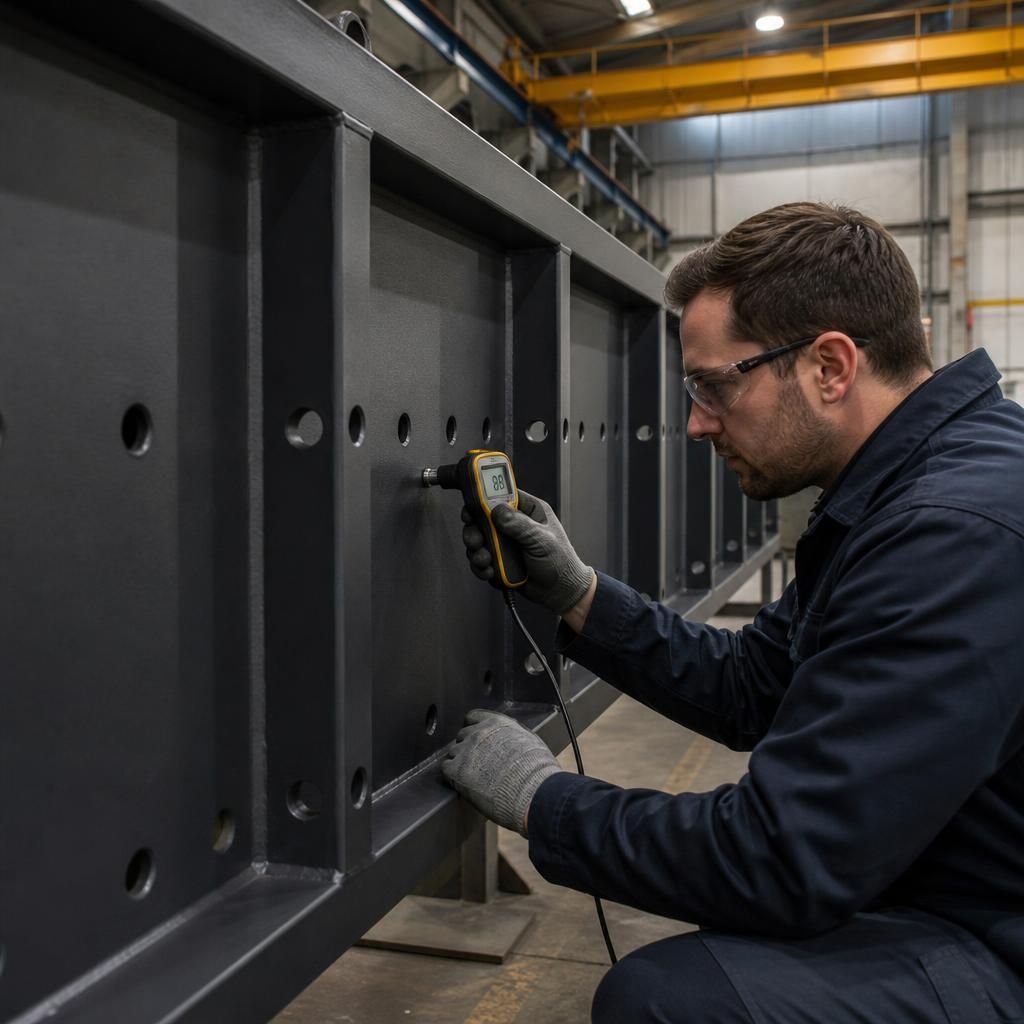
Consistent powder coating thickness also makes the steel component easier to inspect and maintain throughout its service life. When the original finish is within a controlled range, visible wear, chips or isolated defects can be assessed against a reliable baseline rather than being confused with normal variation in the coating.
This supports more targeted maintenance:
- localised damage can be distinguished from areas that were under-coated during manufacture;
- repairs can be focused on locations where the protective barrier has been breached;
- repeated inspection can identify whether deterioration is confined to the coating or has reached the steel substrate; and
- records from different batches or components can be compared more meaningfully.
For structural steel, this distinction is important because coating damage does not automatically mean loss of structural capacity, but it can expose the substrate to conditions that promote corrosion. A consistent original film therefore provides a clearer reference for deciding when remedial preparation and recoating are needed, helping prevent minor coating defects from being overlooked until they affect the steel itself.
Discuss Your Steel Coating Thickness Requirements
If you are specifying a steel component for powder coating, discuss the required finish, application conditions and inspection criteria before production begins. Powder-coatings.co.uk can review your coating thickness requirements and help establish a practical specification for the work.