

How does the thickness of powder coating affect the durability and corrosion resistance of steel components?
Powder coating thickness affects steel durability by determining how effectively the cured film forms a continuous barrier against moisture, chemicals, impact and abrasion. A coating that is too thin may provide inadequate corrosion protection, while excessive thickness can cause defects, poor adhesion or incomplete curing, so the correct and consistent thickness is essential for reliable performance.
Powder coating thickness affects steel durability by controlling the distance moisture, oxygen, salts and other contaminants must travel before reaching the metal. The most durable result comes from a correctly specified and evenly applied film that suits the steel component, coating system and service environment; maximum thickness alone does not provide maximum protection.
On a sound, properly prepared surface, the cured coating acts as an insulating barrier between the steel and its surroundings. Increasing the film build within the coating system’s suitable range can improve resistance to routine handling, abrasion and minor surface damage. It can also provide more material to withstand exposure before the steel becomes accessible. This is particularly relevant where components face outdoor moisture, industrial contaminants, road salts or repeated contact.
Corrosion protection is also influenced by how continuous the film remains during service. Local thin spots, missed areas, sharp edges and poor coverage around welds or recesses can become the first points at which corrosion develops. Corrosion may then spread beneath the surrounding coating, reducing adhesion and lifting the finish away from the steel. Consistent coverage across the whole component is therefore more important than a high reading in one accessible area.
Excessive film build can reduce performance rather than improve it. A heavy layer may have greater internal stress and can be more vulnerable to cracking, sagging, impact-related damage or other application defects. If the powder is not correctly melted and cured through its full depth, the finish may not achieve the intended hardness, adhesion or chemical resistance. Thickness must therefore be considered alongside the powder formulation and the specified curing schedule.
The condition of the steel has a direct effect on the value of the coating thickness. Oil, mill scale, rust, moisture, welding residue and other contaminants can interfere with adhesion, leaving a weak interface beneath an otherwise substantial film. Surface preparation, suitable pretreatment and correct handling before coating are essential because a thicker layer cannot reliably compensate for contamination or an unstable substrate.
Component design also affects the thickness needed for dependable protection. Corners, edges, holes, folded sections, threaded features and deep recesses can attract or shed powder differently from broad flat surfaces. Electric-field effects during application may produce heavier deposits in some locations and lighter coverage in others. These areas should be considered when defining the specification and inspection method, rather than relying on a single measurement from a flat face.
In practical terms, the appropriate thickness is selected according to the intended environment and the risks the steel will face:
- For sheltered components with limited exposure, the coating specification may focus on uniform appearance, adhesion and resistance to handling.
- For external or high-humidity service, continuity and coverage at edges, joints and fabricated details become particularly important.
- For components exposed to abrasion, impact or industrial contamination, the coating system must balance film build with toughness and reliable curing.
- For aggressive conditions, a compatible multi-layer system or specialist protective coating may be more suitable than simply applying a thicker single layer.
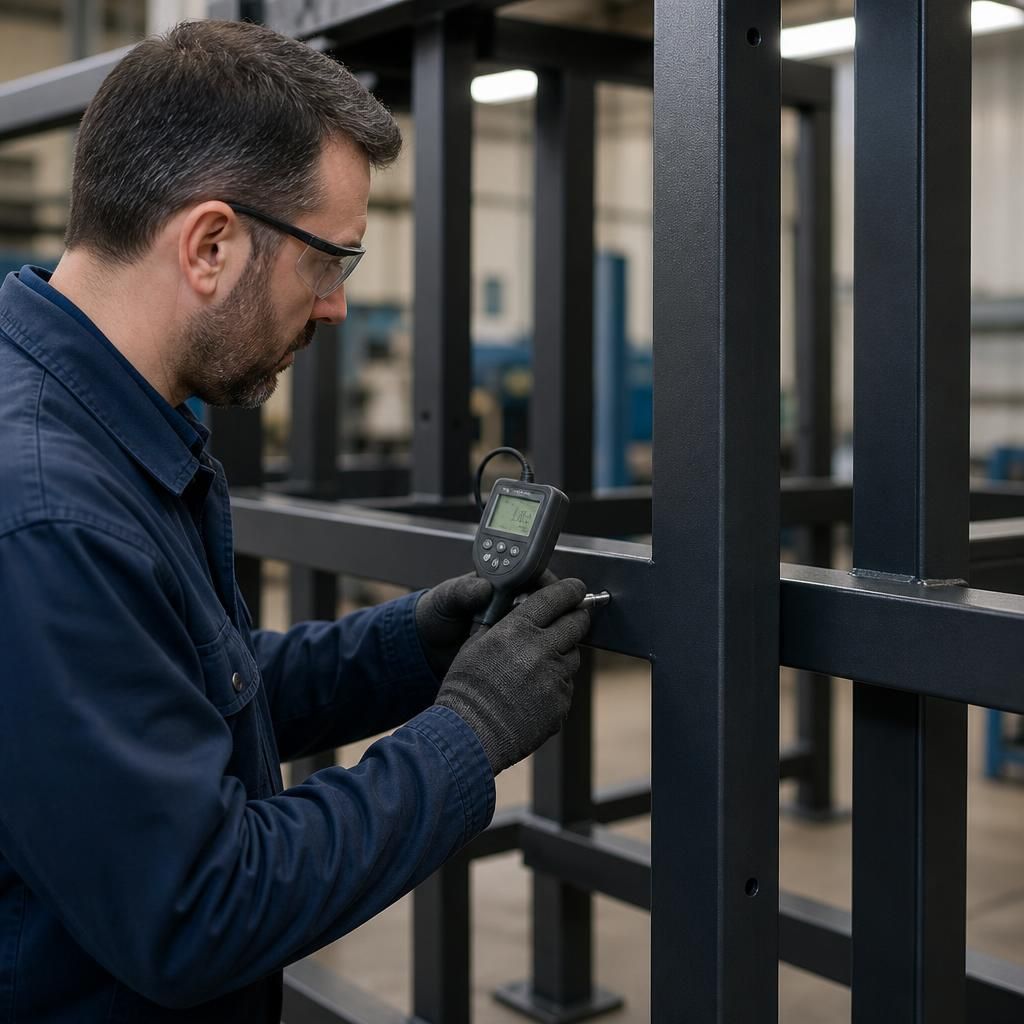
Dry film thickness measurements help confirm whether the applied coating is within the agreed specification. Measurements should be taken at representative locations, including areas likely to receive less powder, and assessed against the coating manufacturer’s technical requirements or the project specification. Where readings vary significantly, the cause may be part geometry, grounding, application settings, powder delivery or curing conditions rather than thickness alone.
Inspection should also consider visual continuity, adhesion, cure and surface condition. A coating can meet a nominal thickness requirement yet perform poorly if it contains pinholes, contamination, weakly coated edges or areas affected by handling before full cure. Conversely, a small local variation does not necessarily indicate failure if the complete system has been specified, applied and assessed appropriately.
For steel components used in demanding industrial applications, the thickness requirement should therefore be agreed before production. The specification should identify the steel preparation, coating type, target film-build range, critical areas, environmental exposure and inspection method. Maintaining those controls through batch production helps ensure that corrosion resistance and mechanical durability come from a coherent coating system rather than from film thickness in isolation.
Powder coating thickness is only one part of the protection system. The powder formulation determines properties such as flexibility, chemical resistance, weathering performance and resistance to ultraviolet exposure, while film thickness determines how much of that cured material separates the steel from its surroundings. A thicker film cannot make an unsuitable coating chemistry perform reliably in an environment it was not designed to withstand.
For this reason, durability should be assessed by matching the coating type to the service conditions before setting the film-build requirement. A coating selected for indoor use may not provide the same long-term protection on externally exposed steel, even if both applications achieve a similar measured thickness. The correct combination of formulation, surface preparation, application and curing provides more dependable corrosion resistance than thickness considered on its own.