

How does powder coating thickness influence the thermal and chemical resistance properties of steel components in industrial environments?
Powder coating thickness affects thermal and chemical resistance by determining the continuity and barrier strength of the cured film, but the coating’s resin chemistry and curing conditions usually have greater influence on maximum service temperature and chemical compatibility. A correctly specified, uniform thickness helps protect steel from chemical attack and thermal cycling, while excessive or uneven thickness can increase curing stresses, reduce adhesion and create performance weaknesses.
Powder coating thickness influences thermal and chemical resistance by changing the distance that heat, moisture and chemicals must travel through the protective film. A thicker, continuous coating can improve barrier protection and reduce the likelihood that minor surface imperfections expose the steel, but additional thickness does not automatically provide better performance. If the film is outside the coating system’s specified range, it may cure unevenly, retain stresses or respond poorly to temperature changes and chemical exposure.
Thermal resistance and heat transfer
Powder coating is a polymer film, so it behaves differently from the steel beneath it when heated. Increasing film thickness can slightly increase the thermal resistance between the steel and its surroundings. This may slow heat transfer and create a modest delay before the metal reaches the surrounding temperature. The practical effect depends on the coating formulation, the component’s mass and geometry, the heat source, and whether the part is being heated, cooled or exposed to repeated temperature changes.
Thickness also affects the way thermal expansion is accommodated. Steel and the cured coating expand at different rates. A correctly applied film can tolerate this movement, but an excessively thick layer may develop higher internal stresses as the component heats and cools. Those stresses can contribute to cracking, loss of adhesion, blistering or edge breakdown, particularly where the part has sharp corners, welds, recesses or abrupt changes in section.
Temperature resistance should therefore be assessed against the complete coating system rather than thickness alone. The resin type, pigmentation, curing profile and intended service temperature determine whether the film remains hard, flexible and adherent. A coating that is physically thick but inadequately cured may soften, discolour, embrittle or lose adhesion under heat. Conversely, reducing thickness does not make an unsuitable coating suitable for a high-temperature application.
Chemical resistance and barrier performance
For chemical exposure, thickness primarily affects the time required for liquids, vapours and dissolved chemicals to permeate the film. A uniform film with adequate dry film thickness gives the steel a longer and more reliable barrier path. It can also reduce the risk that small pores, thin areas or lightly covered edges become early routes for attack. This is particularly relevant where components encounter cleaning agents, oils, fuels, salts, acids, alkalis or industrial process chemicals.
Thickness cannot, however, compensate for chemical incompatibility. Some chemicals can diffuse through a coating, soften the binder, extract components from it or cause swelling. Increased thickness may delay these effects without preventing them. The result depends on the chemical’s concentration, temperature, contact time, pressure and whether exposure is occasional splash contact, repeated cleaning or continuous immersion.
Film continuity is often more important than simply specifying a high nominal thickness. Pinholes, missed areas, craters, inclusions, poor edge coverage and damage during handling can expose the steel regardless of the average reading taken on broad, accessible faces. Corners, holes, welds and recessed sections deserve particular attention because powder deposition and curing can be less consistent in these locations.
Why excessive thickness can reduce resistance
- Too much powder can trap air or contaminants at the interface, reducing adhesion.
- Heavy deposits may cure differently from the surrounding film, producing variation in hardness and flexibility.
- Excess material on edges and corners can chip or crack when the component is handled or subjected to thermal movement.
- A thick, poorly fused layer may conceal surface defects while remaining vulnerable to impact, solvents or moisture penetration.
- Uneven build can create local stress concentrations rather than a consistently protective barrier.
These risks are separate from the question of whether a coating has enough material to cover the substrate. Very low thickness can leave the film more vulnerable to pinholes, abrasion and chemical permeation, while excessive thickness can impair flexibility and adhesion. The correct target is the range established for the particular powder system, substrate preparation and service environment.
How performance is assessed
Specification should begin with the operating conditions. Identify the highest and lowest temperatures, the rate of temperature change, likely chemicals, concentration and contact duration, cleaning methods, abrasion, impact and any immersion requirement. The coating system can then be selected and its recommended thickness range confirmed from the relevant technical information.
After application, dry film thickness should be checked at representative locations rather than relying on a single reading. Measurements should include broad faces, edges, welds, corners, recesses and other areas likely to receive a different powder deposit. Visual inspection for missed coverage, runs, pinholes, inclusions and surface damage is also necessary. Where the application is critical, additional checks such as adhesion, cure or chemical-resistance testing may be appropriate for the specified system.
For steel components used in industrial environments, the most dependable approach is therefore to control thickness within the coating manufacturer’s stated range, verify coverage across the complete part and match the powder chemistry to the actual thermal and chemical conditions. Thickness supports resistance, but it works alongside preparation, curing, film uniformity and service-specific coating selection rather than replacing them.
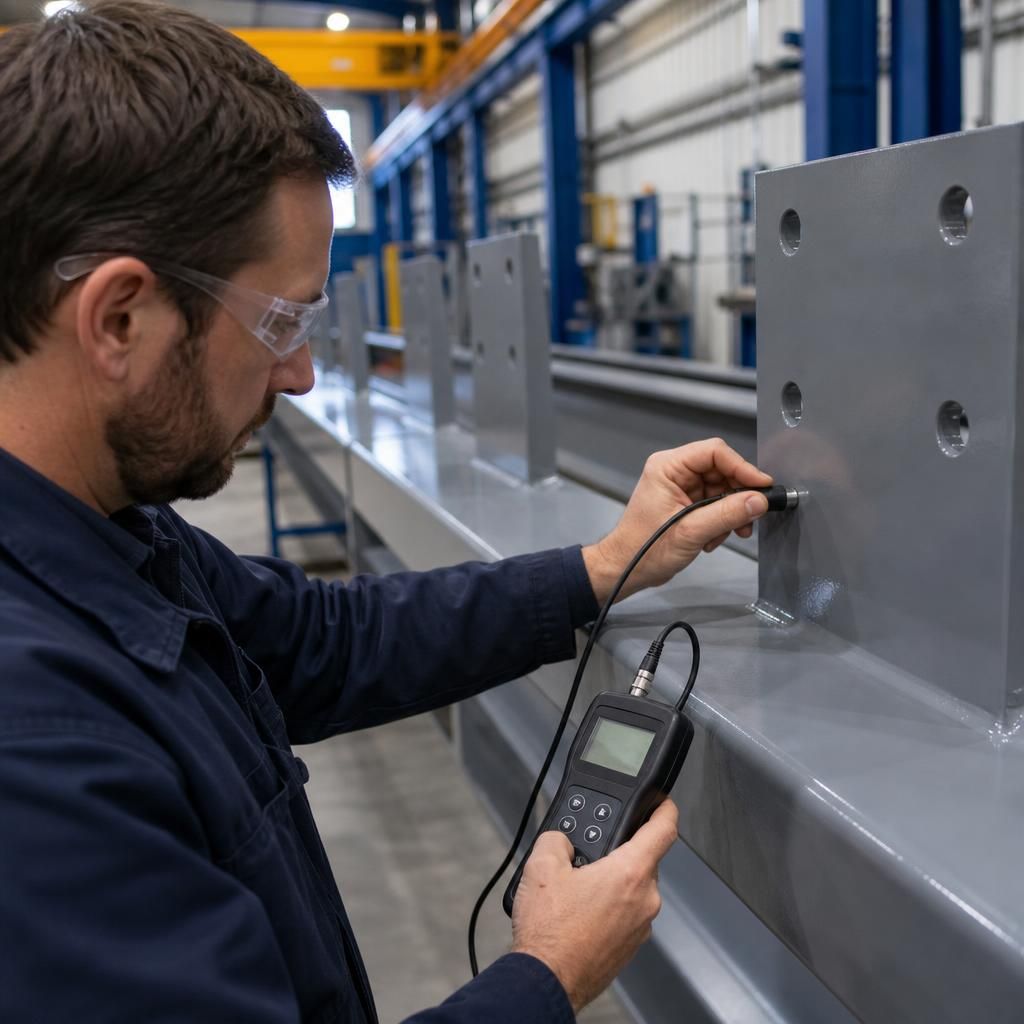
For thermal and chemical resistance, the relevant measurement is the cured dry film thickness, not the amount of powder initially applied. Powder melts and flows during curing, so the final film can differ between broad faces, edges and complex sections. Performance should therefore be judged from representative post-cure readings taken across the component.
This distinction matters because a nominal coating specification can appear satisfactory while local areas remain under-coated or heavily built up. Thin spots may provide an early route for chemical penetration, whereas excessive deposits can alter flexibility and thermal-stress behaviour. Dry film thickness checks are most useful when interpreted alongside visual coverage, adhesion and cure assessment.
Discuss Your Steel Component’s Resistance Requirements
Discuss your steel components’ operating temperatures, chemical exposure and coating requirements with our team to identify a suitable powder coating specification. We can advise on the information needed for an appropriate industrial coating assessment.