

What specific advantages does shotblasting provide over other surface preparation techniques for powder coating?
Shotblasting provides a controlled mechanical preparation method that removes rust, mill scale, old coatings and surface contaminants while creating a uniform profile for powder coating adhesion. Compared with manual abrasion or chemical cleaning, it can prepare complex metal surfaces more consistently and without relying on chemical stripping agents.
Shotblasting’s main advantage over other preparation methods is that it combines controlled mechanical cleaning with a repeatable treatment of the whole accessible metal surface. For powder coating, this gives the coater a more predictable starting condition than methods that depend heavily on manual effort, solvent action or the operator’s ability to reach every part of the component.
More consistent than manual abrasion: Wire brushing, hand sanding and mechanical grinding can be useful for local repairs, but their results may vary across a large component or batch. The operator has to maintain suitable pressure, contact and movement, and recessed areas can be difficult to reach. Shotblasting directs abrasive media across the workpiece, making it better suited to treating fabricated parts with welds, edges, brackets, holes and changes in profile. This consistency is particularly valuable where several components need to receive the same coating system.
Better suited to heavy contamination and tightly bonded residues: Light sanding or solvent wiping may deal with loose dirt or a small area of oxidation, but they are less effective when metal carries mill scale, firmly attached rust, aged coating remnants or fabrication residue. Shotblasting applies sufficient impact to break down and detach these layers, provided the equipment, abrasive and settings are appropriate for the substrate. It can therefore reduce the amount of preliminary scraping or local grinding needed before coating.
Fewer chemical residues than chemical preparation: Chemical stripping and conversion treatments can be effective in the right application, but they require careful control of concentration, contact time, rinsing and drying. Any remaining chemical, moisture or cleaning residue can interfere with subsequent powder coating. Shotblasting is a dry mechanical process, so it avoids introducing a chemical stripping solution into the preparation stage. The component still needs inspection and, where necessary, degreasing because abrasive treatment does not remove every form of oil or grease.
Useful control over the prepared surface: Shotblasting can be adjusted through factors such as abrasive type, particle size, blasting pressure or wheel speed, distance and exposure time. These variables allow the process to be matched to the metal and the condition of the workpiece. A robust steel fabrication may tolerate more aggressive treatment than a thin section or a softer alloy. By contrast, hand preparation often relies more on individual technique, while chemical methods are controlled mainly through solution conditions rather than mechanical impact.
Efficient treatment of larger or irregular fabrications: Large frames, brackets, structural components and batches of small parts can require substantial labour if prepared individually by sanding or grinding. Shotblasting is capable of treating many accessible faces within a controlled process, reducing the need for repeated manual passes. Its practical advantage is greatest where the component geometry and production volume justify the selected blasting equipment. Parts may need to be positioned, rotated or processed in stages so that sheltered areas are not overlooked.
Less risk of creating isolated deep scratches than aggressive grinding: Grinding is valuable for removing weld spatter, burrs and local defects, but it can leave visible directional marks, flatten edges or remove more parent metal than intended. Shotblasting distributes the abrasive action more broadly. It is not a substitute for correcting significant weld irregularities or dimensional defects, but it can prepare the surrounding metal without making the finish dependent on individual grinding patterns.
Improved process repeatability for powder coating: Powder coating performance depends on more than the powder itself. The condition of the substrate, the cleanliness of the surface and the compatibility of the preparation with the specified coating system all matter. A controlled blasting specification can be recorded and repeated across batches, helping the coating process start from comparable conditions. This is easier to monitor than relying solely on visual checks after inconsistent hand preparation.
Shotblasting is not automatically the best option for every component. Thin sheet, delicate edges and some non-ferrous materials may require reduced impact or a different preparation method to avoid distortion, excessive roughening or substrate damage. Masking may also be needed for threads, precision faces, bearings, electrical contact points and other areas that must remain protected. Oil, grease and some contaminants should be removed before blasting, since impact can spread contamination rather than provide a complete degreasing treatment.
The process also requires suitable containment, dust extraction, abrasive recovery and inspection. These controls help manage airborne dust, spent media and the risk of abrasive remaining in cavities. After treatment, the part should be checked for missed areas, embedded contamination, damage and the condition required by the powder coating specification. In practice, shotblasting provides its strongest advantage where the component is compatible with abrasive impact and the process is matched carefully to the metal, geometry and coating requirements.
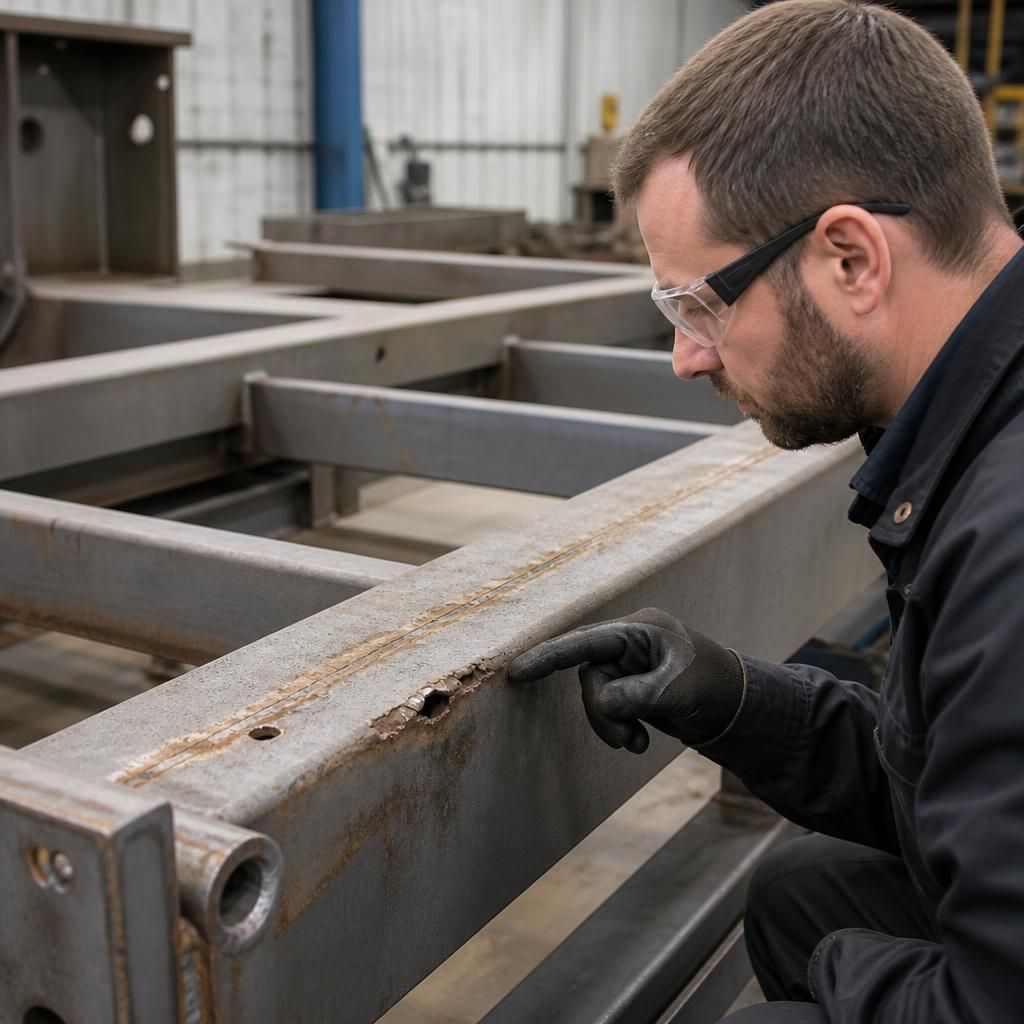
One practical advantage of shotblasting is that it can reveal defects that may be hidden beneath rust, scale or remnants of an old coating. Once these layers are removed, pits, weld imperfections, sharp edges and surface discontinuities are easier to identify before powder coating begins.
This allows the component to be inspected and corrected at the appropriate stage. Welds can be repaired, edges treated and damaged areas assessed before the finish conceals them. Manual cleaning may remove visible contamination without exposing the full condition of the underlying metal, whereas shotblasting can provide a clearer basis for deciding whether further fabrication work is needed.
Discuss Your Shotblasting Requirements
Discuss your shotblasting requirements with the team, including the metal type, component geometry, existing surface condition and powder coating specification. This will help establish whether shotblasting is suitable and how the preparation should be controlled.