

What safety protocols should be in place during the shotblasting process to protect both operators and surrounding equipment?
Shotblasting safety protocols should combine a documented risk assessment, trained operators, suitable personal protective equipment, controlled access and effective dust extraction. Equipment must be inspected before use, with guards and interlocks maintained, machinery isolated before cleaning or adjustments, and surrounding components protected from abrasive impact, dust and vibration.
Effective shotblasting safety protocols use several control layers: safe preparation of the workpiece and abrasive, controlled operation of the blasting equipment, management of dust and noise exposure, emergency arrangements, and documented checks after the work. The aim is to prevent abrasive injection injuries, respiratory exposure, eye and hearing damage, entanglement, uncontrolled movement of components and contamination of nearby production areas.
Confirm the job before blasting. The operator should have clear information about the workpiece, its mass, lifting points, surface condition and any coatings or residues that may be removed. Components should be stable and adequately supported so that blasting cannot make them shift, roll or fall. Hollow sections, vessels and enclosed fabrications require particular care because trapped pressure, residue or abrasive can be released unexpectedly. Any item containing oil, fuel, chemicals or other hazardous contamination should be assessed and made safe before it enters the blast area.
Control the abrasive itself. The selected media should be suitable for the substrate, the finish required and the blasting equipment. Its safety information should be available, particularly where the material may generate hazardous dust. Abrasives that can produce respirable crystalline silica require strict control under the relevant UK COSHH assessment; substitution with a less hazardous medium should be considered where technically practicable. Media should be stored in a dry, contained manner, and spills should be removed using a method that does not create an airborne dust cloud.
Use safe nozzle and hose practices. Blast hoses, couplings, nozzles and deadman controls need to be appropriate for the operating pressure and checked for wear, damage or insecure connections. Couplings should have suitable retention arrangements, and hoses should be routed to avoid sharp bends, vehicle routes and trip hazards. The nozzle must never be directed towards a person, an open access point or an unprotected item. The operator should release the control before repositioning, clearing a blockage or changing grip.
Keep the process enclosed and controlled. Doors, curtains, seals and viewing arrangements should be in a condition that prevents abrasive and dust escaping during blasting. Operators should not enter an enclosure while the equipment is capable of operating. Where entry is unavoidable, the blast system should be fully shut down, depressurised and subject to an appropriate entry procedure. A separate check should confirm that no stored abrasive, suspended load or moving part can create a hazard before access is permitted.
Manage dust after blasting, not just during it. Residual dust can remain on ledges, clothing, components and floors after the visible blast has stopped. Cleaning should use suitable industrial vacuum equipment or another controlled method; sweeping with a dry brush or using compressed air can redistribute fine particles. Waste abrasive, removed coating and filter residues should be contained, labelled where necessary and disposed of in accordance with their material and contamination status. If the removed coating may contain lead, chromates or other hazardous substances, the waste route must reflect that risk.
Control noise and exposure time. Shotblasting can create high noise levels from the air supply, impact and media recovery system. The workplace assessment should identify who may be exposed, including people outside the immediate blasting position, and should consider zoning, remote operation, maintenance of noisy equipment and exposure monitoring where appropriate. Hearing protection is only one part of the control strategy; reducing unnecessary time near operating equipment and restricting access to the affected area are also important.
Provide a clear emergency response. Operators should know how to stop the process, summon assistance and report an incident without placing themselves in further danger. Procedures should cover hose failure, loss of containment, entrapment, component movement, fire, power failure, eye contamination and suspected air-injection injury. An air-injection injury can appear minor while causing serious internal damage, so it requires urgent medical assessment. First-aid arrangements, emergency contact details and access routes should remain available rather than being obstructed by components, media or extraction equipment.
Separate blasting from incompatible activities. Hot work, painting, solvent use and other processes that may react with dust, residues or vapours should not take place in a way that creates an additional fire, explosion or contamination risk. Electrical equipment in or near the blast area should be suitable for the environment, with sensitive controls and instrumentation assessed for dust ingress. Any temporary covering or protection used around adjacent machinery should not obstruct ventilation, emergency stops or inspection points.
Maintain and verify the system. In addition to routine pre-use checks, the business should schedule examination of pressure systems, blast pots, hoses, nozzles, liners, recovery equipment, filters and electrical controls at intervals based on manufacturer guidance, usage and risk. Worn liners or nozzles can alter performance and increase the chance of failure. Filter condition, airflow and pressure readings should be checked against expected operating conditions so that a gradual loss of control is identified before it becomes a safety problem.
Record and review the controls. Useful records include abrasive type, equipment checks, maintenance, filter or waste handling, exposure assessments, incidents, near misses and corrective actions. The risk assessment should be revisited when the abrasive, coating being removed, component size, equipment or work method changes. Reviewing near misses is particularly valuable because unsecured components, hose movement, unexpected dust release and access-control failures often provide an early warning before a serious incident occurs.
For industrial metal coating work, these measures should form part of a written safe system of work rather than relying on operator judgement alone. The safest process is one where the workpiece, abrasive, equipment, enclosure, surrounding activities and emergency arrangements have all been considered before blasting begins, then checked again when the task or conditions change.
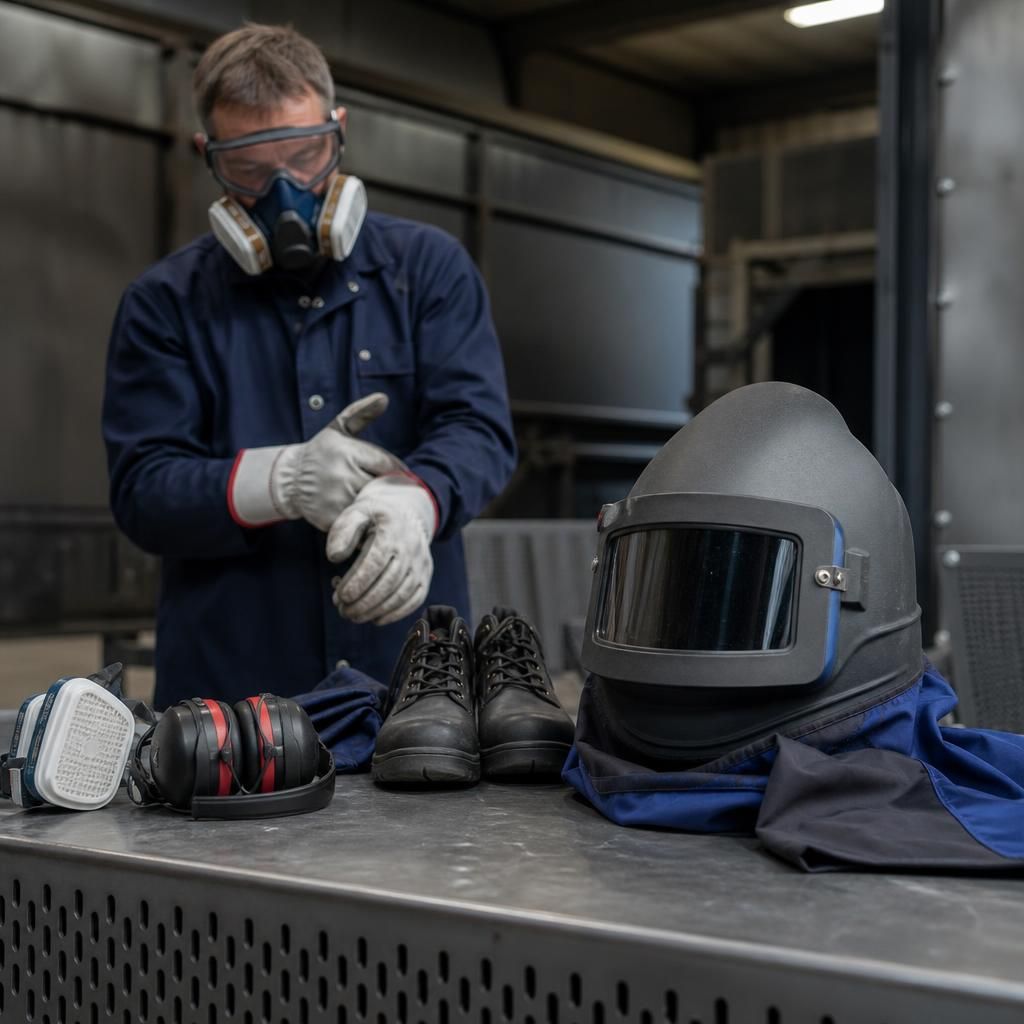
Personal protective equipment (PPE) for shotblasting must be selected for the abrasive, operating pressure and exposure assessment rather than treated as a standard uniform. Operators may require an approved blast helmet or hood, suitable respiratory protection, hearing protection, gloves, protective clothing and safety footwear. The equipment should be inspected before use for damaged seals, visors, air lines, fasteners and worn fabric, with defective items removed from service.
PPE does not replace enclosure, extraction or restricted access, but it provides an additional barrier against rebound abrasive, dust and noise. After blasting, contaminated clothing and equipment should be handled so that dust is not carried into clean areas. Operators should follow the established removal and cleaning procedure, and never use compressed air to blow abrasive or dust from clothing or PPE.