

What potential challenges should be anticipated during the shotblasting process, and how can they be effectively managed?
Shotblasting challenges can include inconsistent surface preparation, residual oil or rust, distortion of thin sections, unsuitable blast media and equipment wear. They are managed through thorough cleaning and inspection, appropriate media and pressure selection, controlled blasting parameters, secure component handling, and regular checks of the blast equipment and finished surface.
Shotblasting challenges arise when the blasting method, component design, surface condition or subsequent coating steps are not properly matched. Effective management depends on defining the required finish before work begins, controlling contamination and moisture, protecting critical features, confirming that all surfaces have been treated and preventing the prepared metal from deteriorating before coating.
1. Complex shapes and inaccessible areas
Recesses, internal corners, folded sections, narrow gaps and assemblies with overlapping parts can create shadowed areas that receive less abrasive impact. These untreated zones may retain scale or provide a weaker key for the coating, even when the more exposed faces appear satisfactory. The issue is managed by assessing the component drawings or sample parts in advance, selecting suitable racking or rotation arrangements and determining whether certain parts should be separated before blasting. Where a feature cannot be reached reliably, it should be identified before processing rather than assumed to be clean.
2. Damage to threads, mating faces and dimensional features
Shotblasting can affect precision areas that are not intended to receive the same treatment as the main surface. Threads, bearing seats, machined faces, holes and close-fitting joints may become contaminated with abrasive or receive an unsuitable surface texture. Appropriate masking, plugs, temporary covers or dedicated fixtures can protect these features. Masking must itself be secure and compatible with the blasting method; a loose cover can allow abrasive ingress or create an untreated edge that is difficult to coat consistently.
3. Abrasive entrapment and incomplete removal
Small particles can collect in cavities, folded edges, drain holes and enclosed sections. If they remain on the component, they may interfere with powder application, contaminate handling equipment or become trapped beneath the coating. Parts should therefore be positioned so that loose abrasive can escape, then cleared using an appropriate clean-air or mechanical method. Enclosed sections also need suitable drainage and access. The objective is not simply to blast the visible face, but to leave the complete component free from loose debris before it enters the coating stage.
4. Moisture, soluble salts and flash corrosion
Dry abrasive blasting does not remove every form of contamination. Soluble salts can remain on a metal surface and attract moisture beneath a coating, while condensation after blasting can produce rapid surface corrosion. These risks are greater when cold components are moved into a warmer or humid environment. Control measures include keeping prepared parts dry, avoiding contact with damp surfaces, allowing components to reach a suitable temperature before processing and carrying out checks for salt or moisture where the service environment makes this important. The interval between blasting and powder coating should also be controlled so that the prepared surface is not left exposed unnecessarily.
5. Compressed-air contamination
Air used to clear abrasive or blow down a component can introduce oil, water or compressor residue. This creates a new contamination problem immediately after blasting and may lead to poor coating wetting or surface defects. Air lines and separators should be suitable for the task, with condensate managed and the air supply checked where cleanliness is critical. A clean wipe or other approved verification method can help establish whether the surface is free from visible residue before coating proceeds.
6. Excessive or insufficient surface profile
The roughness created by blasting must suit the metal, coating system and required appearance. A profile that is too shallow may provide limited mechanical keying, while an excessive profile can increase coating consumption, remain visible through the finish or leave high points with less coating coverage. Profile should be assessed using a suitable comparison or measurement method rather than judged only by appearance. Trial processing on a representative piece can help establish the appropriate abrasive condition and treatment parameters before a full batch is released.
7. Variation between batches or component orientations
Differences in part loading, presentation and exposure can produce variation even when nominally identical components use the same process. Parts packed too closely together may shield one another, while inconsistent spacing can change the angle and duration of abrasive impact. A repeatable loading arrangement, documented process instructions and reference samples help reduce this variation. For batch work, recording the component orientation and treatment sequence also makes it easier to investigate any difference found during coating inspection.
8. Residual stress or movement in fabricated components
Welded or fabricated assemblies can contain residual stress, unsupported panels or loosely secured sections. Mechanical impact may reveal movement, vibration or weak attachments that were not apparent during fabrication. Components should be reviewed for secure welds, removable items and vulnerable sections before blasting. Suitable supports can prevent movement without blocking the surfaces that need treatment. If a part changes shape or exposes a fabrication defect, it should be assessed before coating rather than concealed by the finish.
9. Poor process sequencing
Handling, marking, masking and inspection can undo a correctly prepared surface. Touching blasted metal with contaminated gloves, placing it on dirty supports or returning it to an unclean storage area can reintroduce oils and debris. The process should define a clear route from blasting to inspection and coating, using clean contact points and appropriate identification methods. Traceability is particularly useful for batches because it links each group of components to its preparation instructions, inspection findings and coating requirements.
10. Unclear acceptance criteria
Disputes often arise when “clean” or “ready for coating” has not been defined. The required degree of scale removal, acceptable visual appearance, surface profile, masking standard and allowable handling marks should be agreed before work starts. Inspection should consider the whole component, including edges, welds, recesses and protected areas. Where the finish or substrate is especially sensitive, a representative trial part or agreed reference panel provides a more useful standard than a general description.
For a reliable result, shotblasting should be treated as one controlled stage within the coating process rather than an isolated cleaning operation. Clear preparation requirements, suitable protection of critical features, contamination control, documented loading methods and defined inspection criteria allow problems to be identified before powder is applied. A specialist coating provider can use these points when reviewing drawings, samples and batch requirements, particularly where components combine fabricated surfaces with machined or precision areas.
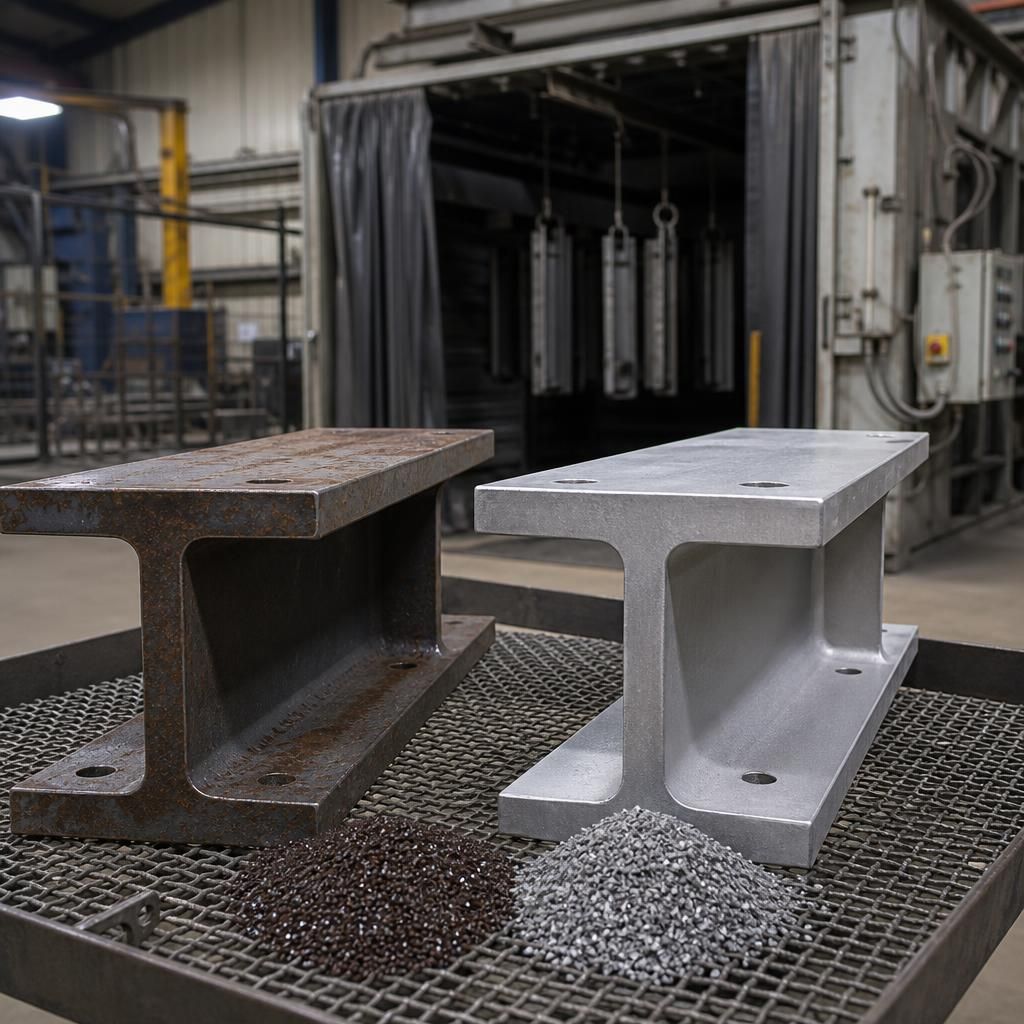
Abrasive cross-contamination is a specific shotblasting risk when ferrous and non-ferrous components are processed using the same equipment. Steel particles or residues can become embedded in aluminium, stainless steel or other sensitive substrates, causing staining, localised corrosion or an unsuitable surface for powder coating.
This is managed by matching the abrasive to the substrate, segregating media and components where necessary, and cleaning the blast chamber, recovery system and work supports between incompatible materials. A trial piece can confirm that the selected process does not leave visible contamination or an unsuitable profile before the main batch is treated.