

What are the key considerations when selecting a shotblasting service provider for powder coating preparation?
When selecting a shotblasting service provider for powder coating preparation, assess their ability to match the blasting media, pressure and surface profile to the metal, coating specification and component geometry. Also check their quality controls, handling capacity, inspection process, protection against recontamination and arrangements for transporting parts safely to the coating stage.
Selecting a shotblasting service provider for powder coating preparation involves checking more than whether the provider can remove visible rust, mill scale or old coating. The right provider should be able to assess the component, produce a clean and suitably keyed surface, preserve critical features and move the prepared parts into powder coating without compromising the result.
Consider the provider’s experience with the type of component. Shotblasting requirements vary between fabricated frames, brackets, enclosures, castings, vehicle parts and small batch components. Ask whether the provider has handled similar shapes, weights, weldments and surface conditions. Complex items may contain recesses, internal corners or areas that are difficult to reach consistently. A suitable process should address these areas without unnecessarily eroding edges, distorting thin sections or damaging machined faces.
Check how the initial condition will be assessed. A provider should identify contaminants and defects that could affect powder coating, including oil, grease, welding residue, rust, scale, previous finishes and embedded debris. Shotblasting is not a substitute for correcting every underlying defect. Deep pitting, weld spatter, sharp burrs and poor fabrication may remain visible after blasting or affect the final coating. Establishing what the process can and cannot correct helps prevent disputes over the finished appearance.
Confirm how sensitive areas will be protected. Components may include threads, bearing seats, precision-machined surfaces, apertures, electrical contact points or faces that must remain free from abrasive impact. Ask how these features will be identified and protected, and whether masking or suitable handling arrangements are included in the process. This is particularly important where the blasted part has to return to an assembly or meet a defined dimensional requirement.
Ask how consistency is maintained between batches. For repeat work, the provider should be able to work from agreed job instructions, drawings, photographs or samples. Consistency includes the appearance of the prepared surface, the treatment of welds and edges, the cleanliness of difficult areas and the protection of features. A clear method for identifying individual batches and recording any agreed variations makes it easier to compare results over time.
Review the provider’s technical communication. Before work starts, useful information includes the base material, component dimensions and weight, previous coating, areas requiring protection, intended powder coating system and any appearance or performance requirements. The provider should raise practical issues rather than making assumptions—for example, where a coating may conceal a feature, where an item cannot be safely suspended, or where the existing condition calls for additional preparation.
Examine the route from blasting to powder coating. Surface preparation is only one part of the finishing sequence. Find out how blasted components are identified, stored and protected before the next operation, and whether unnecessary handling is avoided. The interval and conditions between preparation and coating should be controlled so that moisture, dust, fingerprints or workshop contamination do not undermine the prepared surface. If blasting and powder coating are supplied as connected stages, clarify where responsibility passes between them.
Consider capacity in practical terms. Capacity is not simply the size of the blast equipment. It also includes the provider’s ability to accept the component dimensions, accommodate the batch quantity, handle awkward fabrications and maintain repeatability when several parts are processed together. Confirm whether the proposed method suits both prototype or one-off work and recurring production, where applicable. A process that is appropriate for a small bracket may not be suitable for a long fabricated assembly or a heavy welded frame.
Look for clear documentation and traceability. A written quotation or job specification should identify the items covered, preparation requirements, exclusions, protection requirements and any assumptions about the existing finish. Records linking prepared parts to a batch or order can be valuable where components are used in regulated, safety-critical or quality-controlled production. They also provide a useful basis for investigating defects if the powder coating reveals contamination or an area that was not adequately prepared.
Assess safety and environmental controls. Shotblasting produces abrasive dust, noise and used media, so the provider should operate suitable extraction, containment, personal protective equipment and equipment-maintenance procedures. Ask how spent abrasive and removed coatings are collected and disposed of, particularly where the old finish may contain hazardous substances. Proper controls protect workers, surrounding equipment and the condition of the components being processed.
Finally, compare providers on the suitability of their process rather than price alone. A realistic assessment should account for preparation requirements, masking, handling, batch identification, any additional cleaning and the route into powder coating. For businesses in the Midlands and surrounding areas, a provider offering collection and delivery can also simplify the movement of metal components between sites, provided the packaging and handling arrangements protect the prepared surfaces.
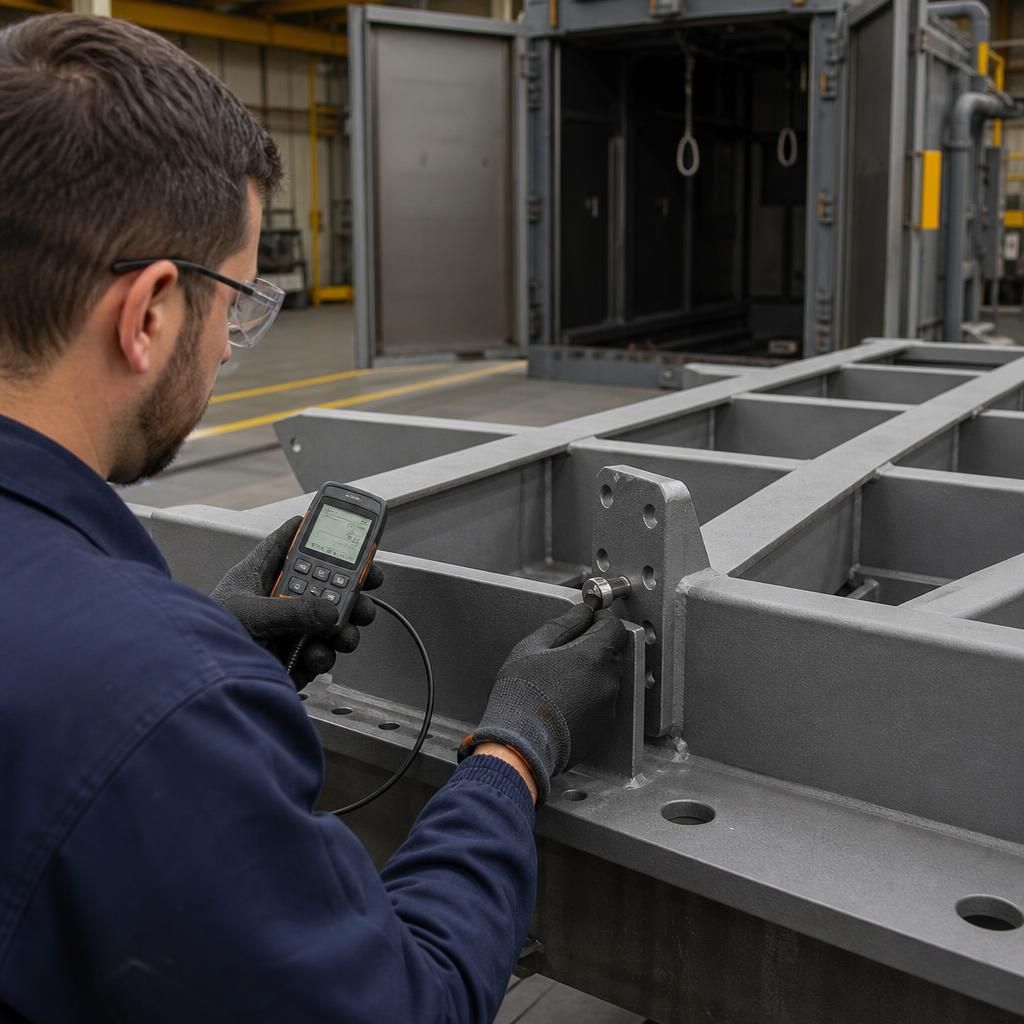
A shotblasting provider should be able to demonstrate that preparation has been checked, not simply that the component looks clean. Visual inspection can identify remaining rust, scale or missed areas, but it cannot confirm whether the surface profile is suitable for the specified powder coating.
Before processing, agree how cleanliness, surface texture, dust and any visible defects will be assessed. Where the application requires documented quality control, ask whether inspection findings can be linked to the relevant batch and reported before the parts move to coating. This gives both parties an objective basis for accepting the preparation and helps identify whether any problem originated during blasting or earlier in the fabrication process.