

How does shotblasting improve adhesion in powder coating applications?
Shotblasting improves powder coating adhesion by removing rust, mill scale, old coatings and surface contaminants that could prevent the powder from bonding to the metal. It also creates a controlled, lightly textured profile, giving the cured coating more surface area and a mechanical key for stronger, more consistent adhesion.
Shotblasting improves powder coating adhesion by producing a consistent substrate condition that allows the applied powder to form a sound, continuous bond during curing. Its value is not limited to making the surface appear clean: the blasting process controls the condition of the metal so that coating performance is less dependent on isolated defects, handling marks or uneven preparation.
Adhesion can fail when the interface between the metal and the cured coating contains weak material. Residues, embedded dirt, loosely bonded oxidation and remnants of previous finishes can separate from the substrate under impact, moisture or temperature changes. The powder may then remain attached to the residue rather than to the metal itself. Shotblasting removes or dislodges these weak layers, reducing the risk of adhesive failure at the coating-to-substrate boundary.
The process also helps create a more uniform surface across complex components. Without controlled preparation, flat areas, welds, edges, recesses and areas around fixings may present different conditions to the powder coating line. These variations can lead to inconsistent wetting or different coating behaviour during curing. Correctly specified blasting media, pressure and processing time help bring the accessible surfaces into a more consistent state.
Surface profile control is particularly important. A profile that is too shallow may provide insufficient mechanical support, while excessive blasting can roughen the substrate unnecessarily, alter fine details or create areas that are difficult to coat evenly. The objective is therefore not maximum roughness, but a profile appropriate to the metal, component design and powder coating system. Preparation should be strong enough to support adhesion without compromising dimensional detail or surface appearance.
Shotblasting supports adhesion through several stages of the coating process:
- Substrate exposure: the process reveals sound metal beneath weak surface layers, giving the coating a more reliable foundation.
- Surface uniformity: consistent preparation reduces differences between areas that would otherwise receive or cure the powder differently.
- Mechanical interlocking: the prepared surface allows the coating to key into microscopic surface variations as it flows and cures.
- Defect reduction: removing poorly bonded material helps limit lifting, flaking and local delamination that can begin at a contaminated area.
Good adhesion also depends on what happens immediately after blasting. Prepared metal should be protected from renewed contamination during handling, storage and transfer to the coating stage. Finger marks, workshop dust, moisture and contact with unsuitable surfaces can undermine the condition achieved by blasting. Components should therefore be handled using appropriate practices and checked before powder application, particularly where the parts have complex geometry or will be transported between processes.
The blasting specification should reflect the component rather than being applied as a standard setting to every job. Important considerations include the base metal, existing surface condition, welds, thin sections, threaded features, sharp edges, recesses and any areas that must remain dimensionally precise. Excessive treatment can distort delicate parts or make edge coverage more difficult, whereas insufficient treatment may leave localised weak areas that affect the finished coating.
Inspection provides a practical check that the surface is suitable for powder coating. Depending on the job, this may include visual examination for remaining scale or coating, checking for visible contamination, assessing the consistency of the blasted finish and confirming that critical features have not been damaged. The prepared parts should also be reviewed for residues from the blasting process before they proceed to coating.
Shotblasting is therefore one part of an adhesion-focused preparation sequence, not a substitute for correct powder selection, application or curing. The powder must be applied at the specified film thickness and cured in accordance with the coating system’s requirements. When the substrate is properly prepared and the later coating stages are controlled, the finished layer has a more dependable interface with the metal and is better positioned to withstand normal handling and service conditions.
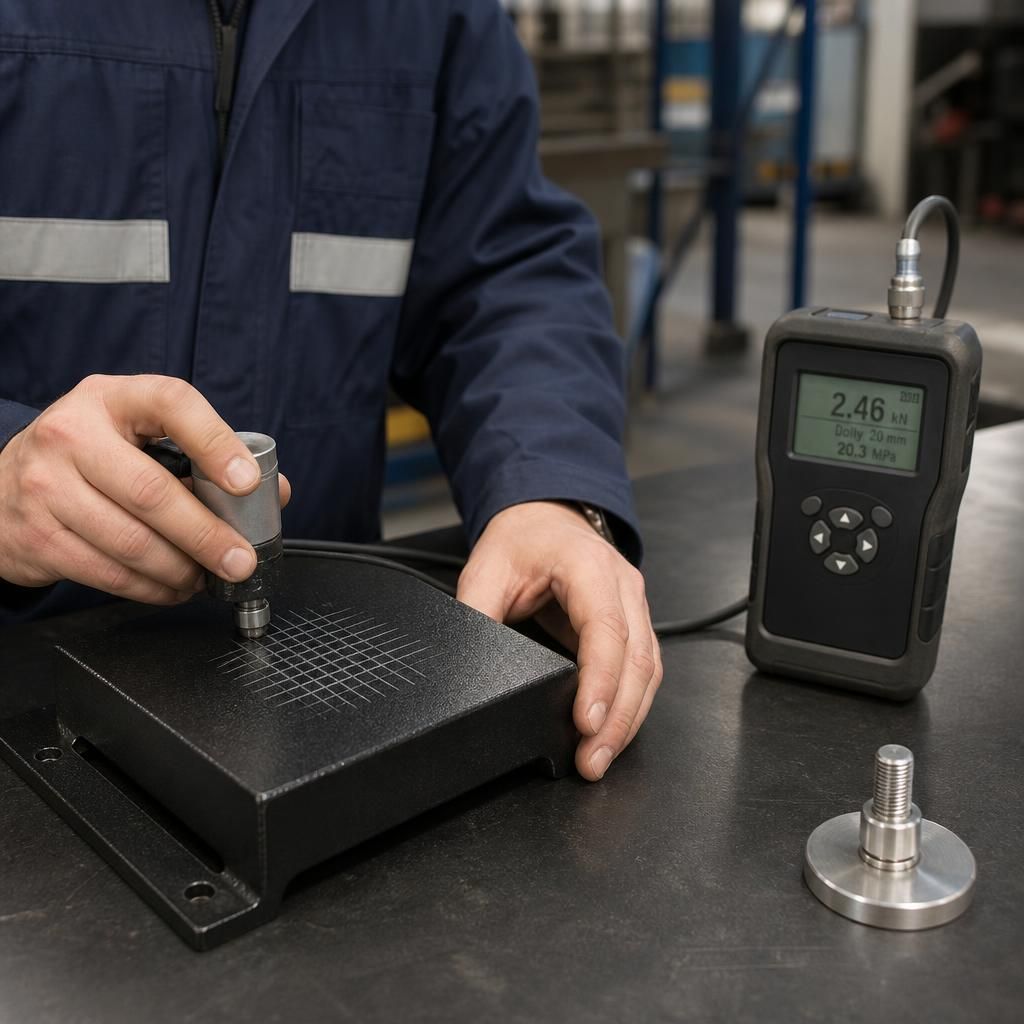
Shotblasting improves adhesion by making the preparation result measurable rather than relying on appearance alone. After powder coating and curing, adhesion can be assessed using a suitable method such as a cross-cut test or pull-off test, depending on the coating system, substrate and component design.
These checks help identify whether the coating has formed a sufficiently strong bond with the prepared metal. If adhesion is poor, the findings can help distinguish a preparation issue from problems with application or curing. For production work, agreeing the inspection method and acceptance requirements before processing provides a clearer link between the shotblasting specification and the finished coating performance.