

What role does pretreatment play in the powder coating preparation process?
Pretreatment is the preparation stage that cleans and conditions metal before powder is applied. It removes contaminants, helps the coating bond to the surface and improves resistance to corrosion, supporting a more consistent and durable finish.
Pretreatment determines whether a powder coating has a properly conditioned surface on which to form a reliable finish. It is not a single operation, but a controlled sequence selected according to the metal, its previous condition, the contaminants present and the performance required from the finished component.
The preparation process commonly includes several linked stages:
- Initial assessment: The component is examined for mill scale, rust, welding residue, oils, grease, fingerprints, old coatings and other substances that could interfere with subsequent treatment. Its material and construction are also considered, including areas such as joints, recesses and hollow sections where residues may collect.
- Removal of heavy contamination: Loose dirt, corrosion products, weld spatter and firmly attached deposits may require abrasion, blasting or another suitable mechanical method before chemical treatment. This stage is particularly important where a surface has uneven oxidation or a previous coating that cannot remain beneath the new system.
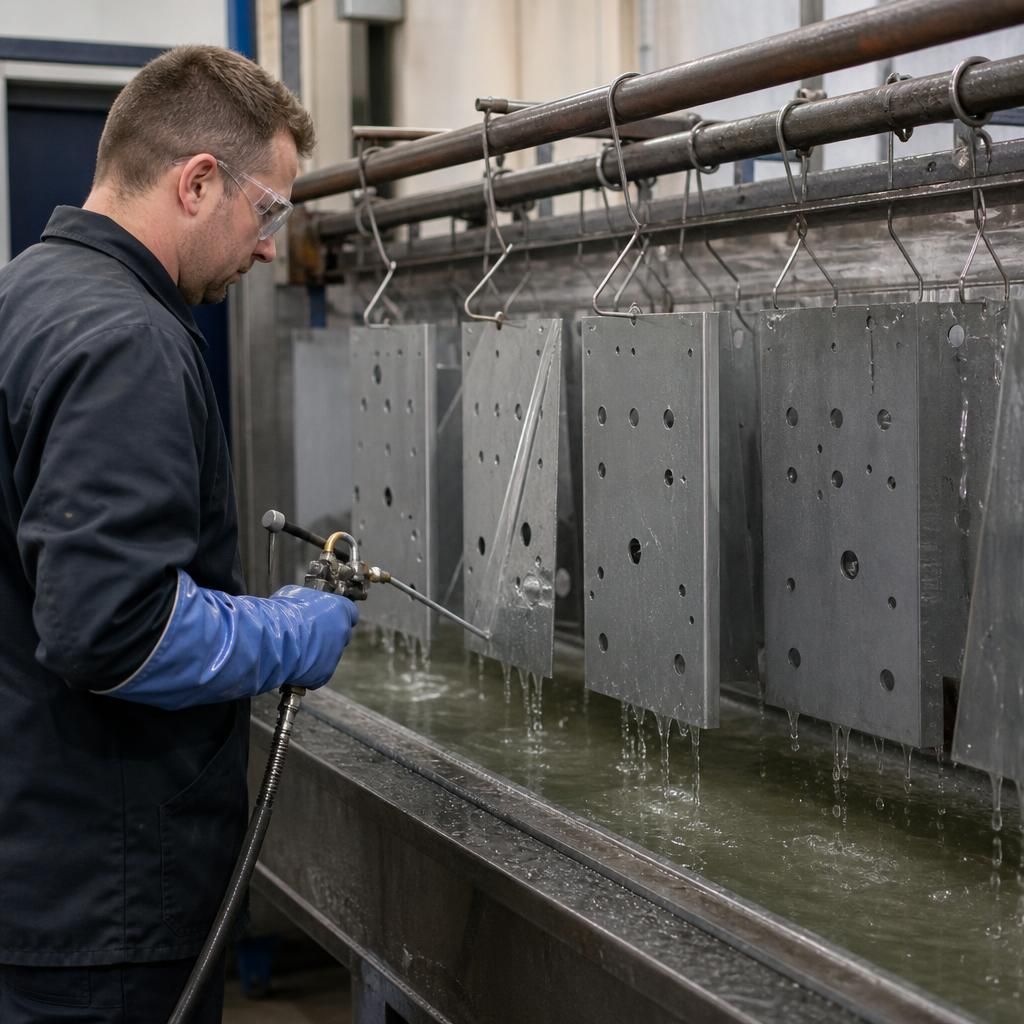
- Chemical conditioning: A suitable conversion treatment can alter the surface chemically, creating a more receptive base for the powder coating and helping to limit corrosion developing beneath the film. The treatment must be compatible with the metal; a process suitable for steel may not be appropriate for aluminium or galvanised components.
- Rinsing: Treatment residues and loosened contamination must be removed thoroughly. Poor rinsing can leave salts or chemicals on the part, which may affect coating adhesion or contribute to defects later.
- Drying and inspection: Components need to be dry before powder application. Moisture trapped in seams, folds, threaded sections or cavities can cause problems during curing. The prepared surface is checked for remaining contamination, flash rusting, damage and areas that may need further work.
The principal role of pretreatment is to control the interface between the metal and the coating. Powder does not bond consistently to a surface covered with oil, dust, corrosion or treatment residue. Even when contamination is not immediately visible, it can create weak areas, pinholes, blistering or localised lifting. A suitably conditioned surface gives the applied powder a more uniform foundation and helps the coating perform as a continuous protective layer.
Pretreatment also affects corrosion resistance. Powder coating protects metal most effectively when the film remains intact and well bonded. If moisture reaches the substrate through a defect or damaged edge, inadequate preparation can allow corrosion to spread beneath the coating. A correctly selected pretreatment system helps reduce this risk, particularly on components exposed to handling, condensation, outdoor conditions or industrial environments.
Preparation is not identical for every part. Bare mild steel may need a different sequence from aluminium, stainless steel or zinc-coated material. Galvanised surfaces can require careful handling to avoid damaging the zinc layer, while aluminium may need treatment that addresses its naturally occurring oxide layer. The condition of the component is equally important: newly fabricated parts, reclaimed items and parts with an existing finish present different preparation requirements.
Component design can influence the result as well. Welded joints, sharp edges, overlapping sections and enclosed areas may retain cleaning solution or moisture. Drainage, access for preparation equipment and the condition of edges should therefore be considered before coating. Where a component cannot be cleaned or dried consistently throughout, the risk of premature coating failure is increased.
Process control matters throughout pretreatment. The cleaning method, chemical strength, contact time, water quality, rinsing and drying conditions all need to be appropriate for the substrate and the coating specification. Excessive treatment can attack or roughen a surface unnecessarily, while insufficient treatment may leave contamination behind. The aim is a clean, stable and suitably receptive surface rather than simply making the metal appear visually clean.
After pretreatment, parts should be handled in a way that avoids recontamination. Contact with bare hands, dirty supports, workshop dust or unsuitable packaging can introduce substances that undermine the preparation work. Inspection before powder application is therefore a practical quality-control step, not an optional cosmetic check.
For industrial components, the pretreatment specification should be agreed alongside the service conditions and the required finish. Factors such as indoor or outdoor use, exposure to moisture or chemicals, the base metal, component geometry and any masking or assembly requirements all influence the appropriate preparation route. When these factors are assessed together, pretreatment becomes a defined part of the coating system rather than a preliminary cleaning task.
Pretreatment conditions the metal surface; it does not repair physical defects in the component. Scratches, pits, sharp burrs, weld irregularities and poorly prepared joints remain beneath the powder coating unless they are corrected separately before treatment.
This distinction matters because conversion treatments are extremely thin and are intended to improve the coating interface, not to level or fill the substrate. Surface repairs, edge preparation or additional finishing may therefore be needed before pretreatment begins. Separating these tasks helps ensure that the final coating reflects a properly prepared component rather than concealing defects that could affect its appearance or performance.