

What materials are suitable for powder coating preparation?
Powder coating preparation is suitable for most clean, heat-resistant metal substrates, including mild steel, stainless steel, aluminium, galvanised steel and cast iron. Specialist metals may also be coated, but their surface condition, contamination, conductivity and response to curing temperatures must be assessed before preparation begins.
The most suitable materials for powder coating preparation are sound, electrically conductive substrates that can withstand the coating system’s curing conditions and accept a properly prepared surface. Suitability depends not only on the material name, but also on its alloy, surface condition, thickness, geometry, previous finish and exposure requirements.
Material selection affects every stage of preparation. A coating system must be able to form a consistent bond with the substrate, while the preparation process must remove contamination without damaging the surface or leaving residues that interfere with adhesion.
- Iron-based substrates: These are generally straightforward to prepare when free from heavy corrosion, scale, oil and old coatings. Abrasive preparation can remove oxidation and create a suitable surface profile, although thin sections need care to prevent distortion.
- Non-ferrous alloys: Lightweight alloys often require controlled cleaning and chemical pretreatment because their natural oxide layer can affect adhesion. Abrasive treatment must be selected carefully, as an overly aggressive process may alter dimensions or leave embedded media.
- Zinc-coated surfaces: These can be coated, but preparation must account for the existing zinc layer. Excessive abrasion may expose the underlying metal, while trapped moisture or treatment residues can lead to surface defects during curing.
- Cast components: Castings may contain pores, moulding residues, release agents or entrapped gases. These materials need particularly careful cleaning and may require suitable preheating or outgassing controls to reduce bubbling and pinholing.
- Specialist alloys: Copper-based and other specialist metals may be suitable where their conductivity, oxidation behaviour and response to heat are compatible with the chosen powder system. Their surface chemistry should be assessed rather than treated in the same way as ordinary fabrication steel.
The condition of the material is as important as its composition. New metal can carry mill scale, fabrication oils, protective films, marking ink or handling residue. Reused components may also have corrosion, weld discolouration, adhesive deposits or an existing coating. These contaminants need to be identified before selecting degreasing, abrasive cleaning, chemical pretreatment or a combination of methods.
Fabricated items should also be designed with preparation and coating in mind. Tight joints, overlapping sections, enclosed cavities and unsealed seams can retain cleaning solutions or moisture. Small drainage and ventilation holes may be necessary in hollow sections, while sharp edges may need attention because powder tends to pull away from very acute corners. Welds should be continuous or suitably finished where trapped contamination could compromise the coating.
Material thickness and mass influence how a component heats during curing. A thin panel and a heavy casting may reach the oven temperature at different rates, so the coating specification should be based on the metal’s actual part temperature rather than oven air temperature alone. Components containing heat-sensitive inserts, bearings, seals or other non-metallic parts may require those parts to be removed before preparation.
Materials that are not normally suitable for conventional powder coating include untreated wood, rubber and many standard plastics. These substrates may soften, deform, burn or fail to provide the electrical properties required for powder application. Specialist low-temperature powders or alternative application methods exist for some non-metallic products, but they require a separate technical assessment and should not be assumed to perform like a conventional metal coating.
Before preparation begins, the coating specification should therefore confirm:
- the substrate and exact alloy;
- the condition and history of the surface;
- the required corrosion and chemical resistance;
- the component’s dimensions, thickness and internal spaces;
- the curing temperature and time required by the powder;
- any areas that must remain uncoated, masked or mechanically functional.
For unusual, previously coated or mixed-material components, a sample or trial preparation can help establish whether the selected cleaning and pretreatment method produces a consistent surface. This is particularly useful where appearance, dimensional tolerances or long-term corrosion resistance are important.
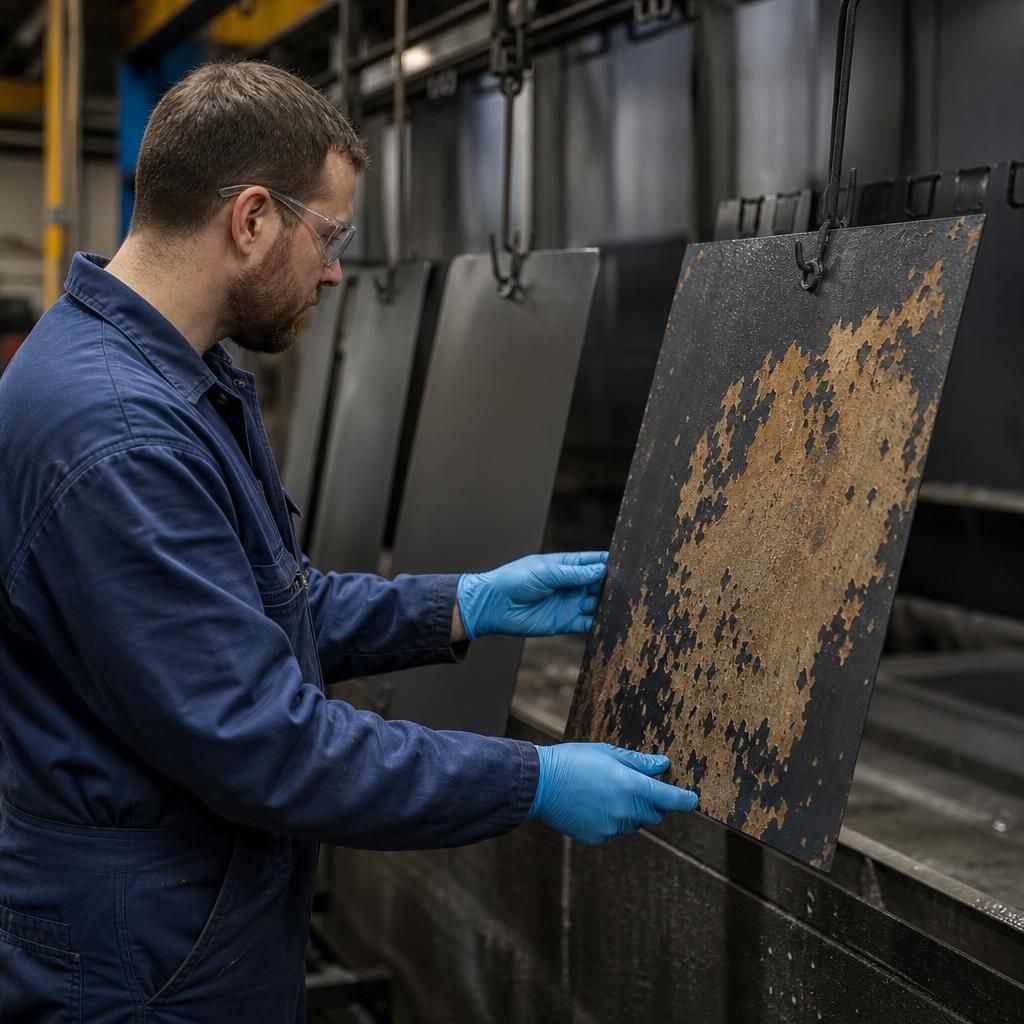
Previously coated metal requires separate assessment before it is accepted for powder coating preparation. The existing finish may be firmly bonded in some areas but loose, contaminated or chemically incompatible in others. It should not be assumed that a new powder coat will bond reliably over an unknown coating; the old finish may need to be removed so the substrate can be inspected and prepared consistently.
Stripping methods should be selected according to the underlying material. A process suitable for steel may damage aluminium, alter fine details or leave residues on zinc-coated components. Once the old coating has been removed, the exposed surface should be checked for corrosion, pitting and repairs before the final cleaning and pretreatment system is chosen.
Discuss Your Powder Coating Preparation Requirements
If you are unsure whether a particular metal or existing finish is suitable for powder coating preparation, discuss the component, alloy and coating requirements with our team. We can help identify the appropriate preparation approach before processing begins.