

What are the key cleaning methods for preparing metal surfaces before powder coating?
Key cleaning methods before powder coating include solvent or aqueous degreasing to remove oils, alkaline washing for heavier residues, and abrasive blasting to eliminate rust, mill scale and firmly bonded contamination. The chosen method should suit the metal and contaminant, leaving a clean, dry surface with an appropriate profile for powder adhesion.
Effective metal cleaning before powder coating is a controlled process that removes invisible residues as well as obvious dirt, while preserving a surface suitable for subsequent preparation. The best method depends on the substrate, the type and age of the contamination, the component’s geometry and the required finish. Cleaning should be followed by thorough rinsing where applicable, complete drying and inspection before coating begins.
Solvent wiping and vapour degreasing
Solvent cleaning is useful for localised oil, grease, cutting fluid and adhesive residues, particularly on small parts or areas that cannot easily be processed through a wash system. Clean, lint-free wipes should be used, with fresh solvent or a clean section of the wipe applied as the residue is lifted rather than redistributed. Vapour degreasing can provide more consistent coverage for compatible components, including recessed areas, but the solvent must be suitable for the metal and controlled so that it does not leave a film of its own.
Wiping alone is less reliable on heavily contaminated parts because it can spread oil across the surface. It is often better used as a targeted operation after bulk contamination has been removed, followed by a visual and, where appropriate, water-break inspection.
Aqueous spray and immersion cleaning
Water-based cleaning systems use heated solutions, agitation, spray pressure or immersion to loosen and carry away contaminants. Spray systems are suited to repeatable production work, while immersion tanks can accommodate shapes that are difficult to clean with a cloth. Agitation is particularly important inside recesses, holes and folded sections where stagnant solution may leave contamination behind.
The cleaning solution must be controlled rather than simply left in use indefinitely. Soil loading, concentration, temperature and contact time all affect performance. A weak or exhausted bath may fail to remove residues, whereas an excessively strong solution or prolonged exposure can attack sensitive metals. Components should be rinsed sufficiently to remove cleaner residues, as alkaline or detergent films can interfere with adhesion and contribute to surface defects.
Ultrasonic cleaning
Ultrasonic cleaning uses high-frequency sound waves to create microscopic bubbles in a liquid. Their collapse produces localised agitation that can reach grooves, blind holes, threads and intricate profiles more effectively than ordinary immersion. It is useful for smaller precision components with complex geometry, especially where manual wiping cannot reach every surface.
Ultrasonic cleaning is not a substitute for choosing the correct cleaning chemistry. The liquid must be compatible with the substrate and the equipment must be loaded so that sound energy can reach the parts. Entrapped air, unsuitable basket arrangements or heavily loaded tanks can reduce the effect. After processing, parts still require appropriate rinsing and drying.
Steam cleaning and hot-water washing
Steam or hot-water cleaning can soften and remove greasy deposits, loose dirt and some water-soluble residues without relying solely on organic solvents. It may be useful for larger fabrications and components that can tolerate heat and moisture. Drainage must be considered carefully: water trapped in seams, tubes, overlaps or blind holes can later emerge during heating and cause coating defects.
Hot-water methods are most effective when the removed contamination is prevented from redepositing. Run-off should be directed away from already cleaned areas, and parts should be dried promptly using clean, dry air or controlled heat. Flash rust can develop on susceptible steel if damp components are left untreated or exposed before the next preparation stage.
Manual and mechanical cleaning
Scrapers, brushes, pads and rotary tools can remove loose scale, weld spatter, burrs, dried deposits and other localised contamination. These methods are useful for spot correction and for preparing welds, edges and areas that need attention before a larger cleaning operation. The tools must be clean and appropriate to the substrate: an unsuitable wire brush can embed foreign particles or transfer residues between different metals.
Mechanical cleaning should be controlled to avoid rounding important edges, reducing dimensions or creating deep scratches that remain visible through the powder coating. It should also be followed by removal of dust, since a surface can appear clean while carrying fine abrasive or metallic particles.
Abrasive cleaning and surface profiling
Abrasive methods use a selected media and controlled air pressure or wheel action to remove firmly attached material and create a consistent texture. The abrasive, pressure and stand-off distance should be selected for the metal and the required profile. Excessive treatment can thin edges, distort lightweight parts or leave a profile that is too pronounced for the specified coating system.
After abrasive cleaning, dust must be removed from the surface and from holes, corners and internal features. Compressed air should be clean and free from oil and moisture. Abrasive residue, spent media or embedded particles can create inclusions, poor adhesion or visible surface marks, so inspection is required before coating.
Chemical descaling and pickling
Acidic cleaners or pickling solutions may be used where oxide scale, rust staining or heat-related surface contamination cannot be dealt with adequately by other methods. These treatments require tighter process control because their effect varies between mild steel, stainless steel, aluminium and galvanised materials. Over-treatment can etch the surface, alter dimensions or produce an unsuitable condition for the next stage.
Any chemical descaling process must be followed by the specified rinsing and neutralisation arrangements. Residual acid, salts or reaction products are unacceptable beneath a powder coating. This approach is therefore normally selected as part of a defined preparation system rather than applied as an improvised cleaning step.
Choosing a practical cleaning sequence
- Identify the substrate and map the likely contaminants, including oils, marking fluids, shop dust, corrosion products, weld residues and handling deposits.
- Remove loose material and heavy deposits without spreading them over previously clean areas.
- Use a compatible chemical, aqueous, ultrasonic, steam or abrasive method for the remaining contamination and the component’s geometry.
- Rinse or blow down as required to remove cleaning residues, loose particles and dissolved soil.
- Dry all surfaces, including joints, recesses, holes and internal cavities.
- Inspect under suitable lighting for staining, residue, dust, flash rust, water marks or areas that have been missed.
Cleanliness should be assessed by more than appearance. A uniform water film generally indicates that oily contamination has not caused obvious beading, while a clean wipe or suitable surface test can help identify residue that visual inspection misses. The exact test should match the material and process specification.
For batch work, the cleaning method should also be repeatable across every component. Part orientation, drainage, racking, solution maintenance and handling after cleaning can all affect the result. Clean gloves or suitable handling practices help prevent fingerprints and oils being transferred back onto the prepared surface. Where parts are collected for powder coating, the condition of the metal on arrival should be checked because storage, packaging and transport can introduce new contamination.
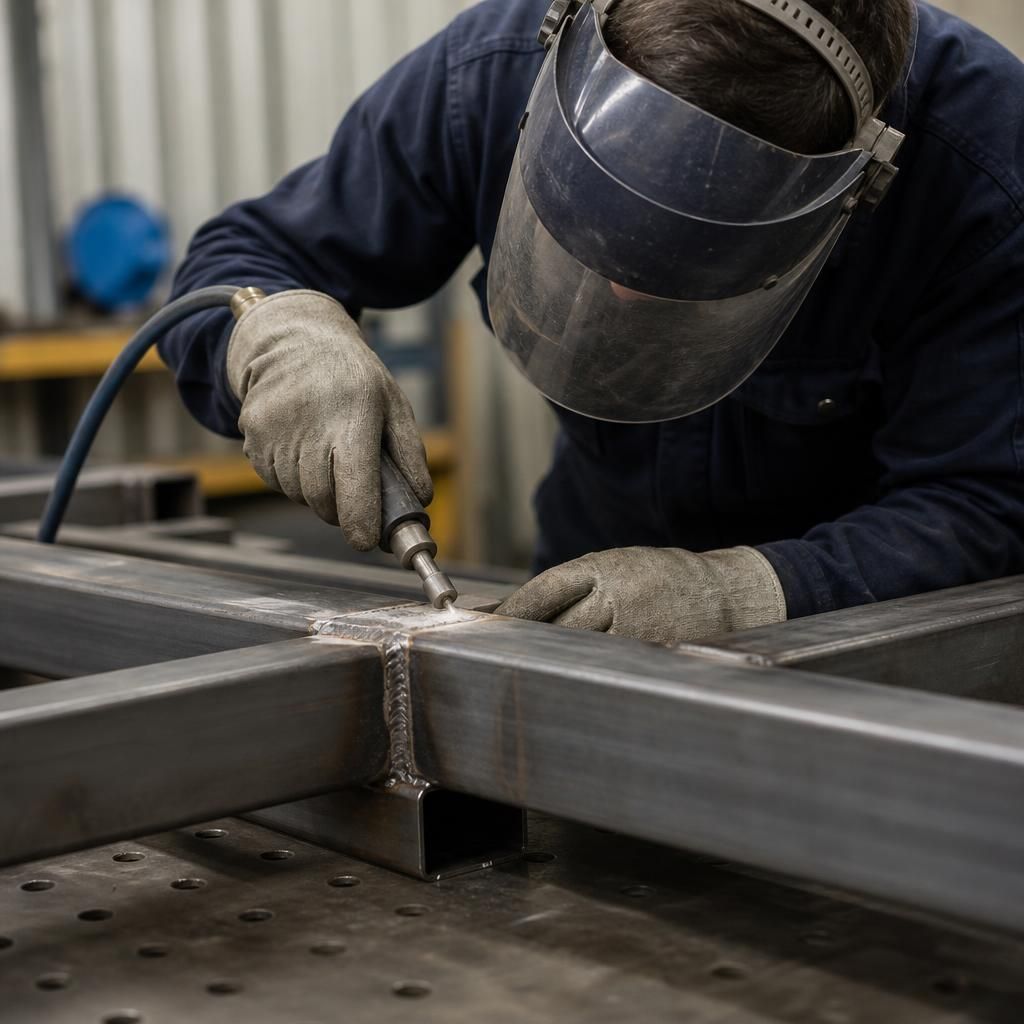
Welded assemblies often need targeted cleaning because weld zones can contain spatter, heat tint, anti-spatter residue and flux deposits that are not present on the surrounding metal. These contaminants may remain around the weld toe, in small crevices or beneath uneven deposits, so cleaning the broad faces alone is not sufficient.
Remove spatter mechanically with a suitable tool, then use a compatible degreasing or chemical cleaning method for any remaining film or heat-related residue. Take care not to smear contamination across the adjacent surface or damage the weld profile. After cleaning, inspect the welds and nearby crevices closely, as defects in these areas can become visible through the powder finish or affect coating adhesion.