

How does surface preparation improve the adhesion of powder coating on metal components?
Surface preparation improves powder coating adhesion by removing contaminants such as oil, grease, rust and scale that could prevent the coating from contacting the metal properly. It can also condition the surface to support stronger mechanical and chemical bonding, reducing the risk of peeling, blistering and premature corrosion.
Surface preparation improves powder coating adhesion by creating a clean, chemically compatible and suitably keyed interface between the metal and the cured coating. The powder must make continuous contact with the substrate during application and curing; any weak boundary layer, unstable oxide or poorly prepared area can become the point at which the finish separates.
Preparation affects adhesion in several distinct ways:
- It establishes a sound substrate. Metals may carry residues from fabrication, handling, storage or previous processing. Preparation removes or controls these layers so the coating bonds to the metal or to a deliberately applied conversion coating, rather than to a loosely attached residue.
- It creates a suitable surface profile. Controlled abrasion or blasting can produce microscopic irregularities into which the coating flows. This increases the effective contact area and gives the cured film a mechanical key. The profile must be appropriate to the coating system: excessive roughness may remain visible through a thin finish, while insufficient texture may provide little additional grip.
- It supports chemical bonding. On suitable substrates, a conversion treatment changes the surface chemistry and provides a more receptive base for the powder film. This can also help stabilise the interface beneath the coating, particularly where the component may later encounter moisture or corrosive conditions.
- It gives the film a consistent foundation. Variations in preparation can produce areas with different wetting, coverage and bonding behaviour. Consistency is therefore important for batch work, where parts need to perform similarly rather than having isolated areas of strong and weak adhesion.
The condition of the component before preparation also matters. Welds, heat-affected areas, sharp edges, seams, drilled holes and recesses can retain residues or behave differently from flat sheet. Weld spatter and loosely attached material may need to be removed, while sharp edges may require suitable treatment so that the coating is not excessively thin at the edge. Enclosed sections and joints should be considered carefully because trapped preparation chemicals or moisture can later cause defects beneath the film.
After preparation, the surface must remain suitable until powder application. Handling with contaminated gloves, contact with dirty supports, exposure to condensation or poor drying can undermine an otherwise effective process. Thorough rinsing and drying are particularly important where wet chemical stages are used. Residual moisture can interfere with application and may contribute to blistering or loss of adhesion during service.
Preparation also has to match the metal. Steel, galvanised steel, aluminium and other alloys do not develop identical oxide layers or respond in the same way to abrasion and chemical treatment. A process suitable for one substrate may be too aggressive, ineffective or chemically incompatible with another. The component’s intended environment, construction method and required finish should therefore be considered when selecting the preparation sequence.
Good preparation cannot compensate for every other process error. The powder type, film thickness, application settings and curing schedule must be compatible with the prepared substrate. If the coating is under-cured, over-cured or applied outside its specified conditions, the interface and the film itself may not achieve the intended performance. Adhesion testing, visual inspection and checks of preparation and cure records can help identify whether a problem originates at the substrate, within the coating or in the curing stage.
For manufacturers and fabricators, the practical result is a more reliable coating system: fewer local adhesion failures, better resistance to handling and service conditions, and a sounder base for corrosion protection. Powder-coating.co.uk provides surface preparation and powder coating for metal components for businesses across the Midlands and surrounding areas, with collection and delivery options for suitable projects.
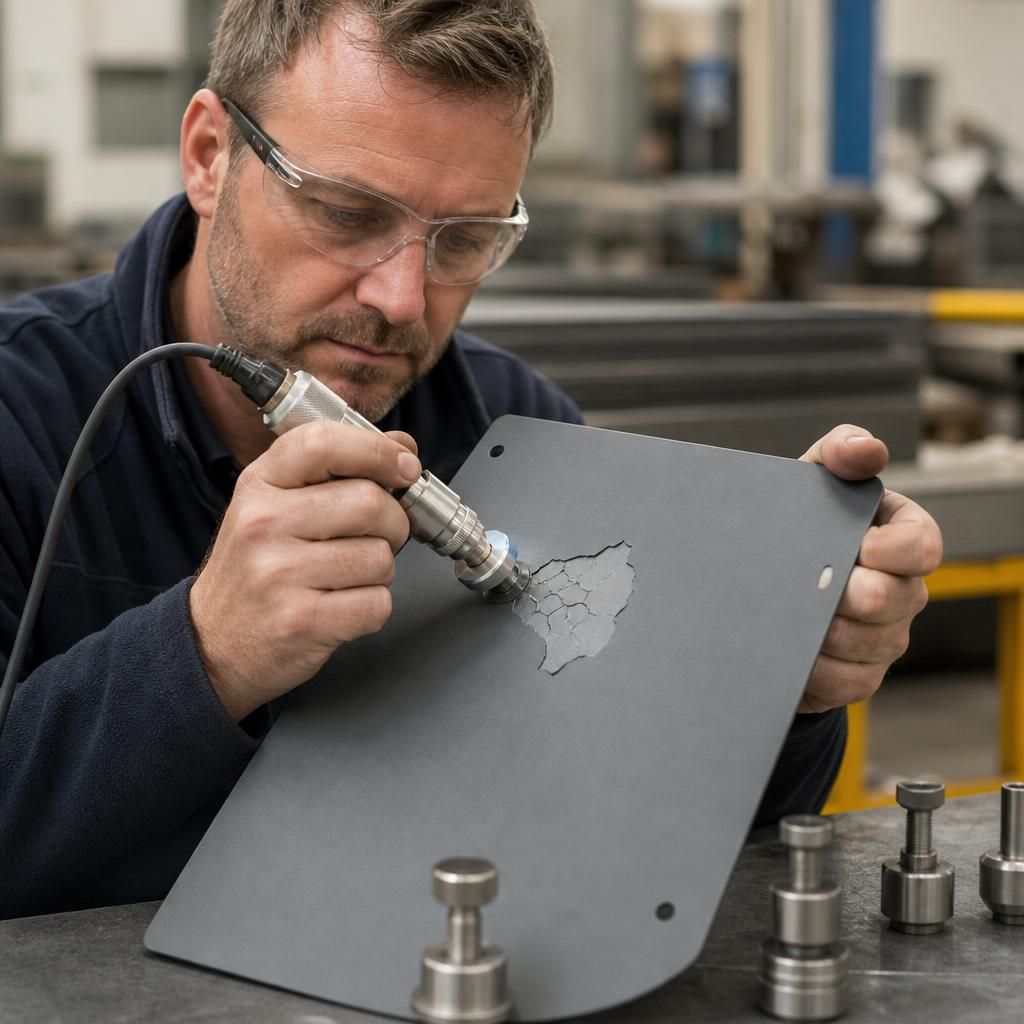
Adhesion testing can identify where a coating failure begins. If the powder film separates cleanly from the metal, the interface may be the weak point, indicating that cleaning, surface conditioning or handling before application requires review. If the coating tears within its own film while remaining attached to the substrate, the preparation has provided a stronger bond than the coating’s internal strength at that location.
This distinction is useful when investigating isolated defects on batches of components. It prevents every failure from being attributed to surface preparation and helps separate substrate-related problems from issues involving powder application, film formation or curing. Inspection should consider representative areas as well as visible defects, since adhesion can vary around welds, recesses, edges and other complex features.