

What types of primers are best suited for different metals in the powder coating process?
The best primer depends on the metal’s chemistry, surface condition and corrosion risk: epoxy or zinc-rich primers are commonly suited to steel, specialist epoxy primers support adhesion on aluminium, and zinc-compatible primers are used for galvanised surfaces. Primer selection should also account for the intended environment and compatibility with the powder topcoat.
Primer selection should match the substrate’s surface condition, expected corrosion exposure and the chemistry of the powder topcoat. In practical terms, zinc-phosphate or zinc-rich systems are generally used beneath coatings on carbon steel, adhesion-focused epoxy systems are often appropriate for aluminium and stainless steel, and specially formulated primers are needed for galvanised or zinc-coated surfaces.
Carbon and mild steel
Carbon steel is usually suited to epoxy primers, particularly where the finished component will encounter moisture, chemicals or changing temperatures. Epoxy provides a dense barrier and can give the topcoat a stable base when the steel has been correctly prepared. Zinc-phosphate formulations add corrosion-inhibiting properties and are commonly selected for general industrial components.
Zinc-rich primers can be considered for steel exposed to more demanding corrosion conditions. They contain metallic zinc that helps protect exposed areas when damage reaches the primer layer. Their use requires careful control of application, curing and topcoat compatibility; an unsuitable powder finish can reduce the intended protective performance. Zinc-rich products are therefore not automatically the best option for every steel component.
Cast iron
Cast iron generally benefits from a robust epoxy primer because its porous surface can retain oil, moisture and other contaminants. These substances may cause pinholing, bubbling or adhesion loss during curing. Thorough degreasing and abrasive preparation are especially important, and components should be checked for outgassing risks before a primer is chosen. A primer designed to tolerate the prepared cast-iron surface can help reduce defects, but it cannot compensate for contamination within the casting.
Aluminium
Aluminium forms a tenacious oxide layer that can interfere with adhesion, so the primer must be paired with suitable cleaning and surface activation. Epoxy adhesion primers are often used where a durable bond and corrosion barrier are required. The surface should be prepared without unnecessarily embedding abrasive residue, then coated within an appropriate process window to limit renewed oxidation or contamination.
Aluminium alloys vary considerably. Some contain copper, silicon or other elements that affect corrosion behaviour and surface response. For that reason, a primer proven on one aluminium component should not automatically be assumed suitable for every alloy. Trial panels or test pieces can help confirm adhesion and appearance before processing a production batch.
Galvanised and zinc-coated steel
Galvanised surfaces need a primer that is compatible with zinc and able to accommodate the characteristics of the coating beneath it. A bonding or epoxy primer formulated for galvanised steel is normally more suitable than a general-purpose steel primer. Preparation may include degreasing, controlled abrasion or sweep blasting, followed by removal of loose zinc residue and dust.
Fresh galvanised coatings can release trapped gases during powder curing, producing pinholes or blisters. The primer and curing schedule should therefore be selected with outgassing in mind. Excessively aggressive blasting can remove too much zinc, while insufficient preparation can leave a weak boundary between the primer and substrate.
Stainless steel
Stainless steel’s passive oxide layer makes adhesion more demanding than it is on ordinary carbon steel. A suitable epoxy adhesion primer can be used after controlled abrasion and thorough cleaning. The preparation method should create a consistent key without damaging the component or introducing iron contamination, which could create localised corrosion on the surface.
The grade and finish of stainless steel also matter. Smooth polished surfaces usually require more attention to mechanical keying than a pre-existing textured finish. Primer selection should be checked against the intended exposure, the topcoat and any requirements relating to chemical or food-contact environments.
Copper, brass and other non-ferrous metals
Copper and brass can oxidise or carry residues that reduce adhesion. An epoxy-based adhesion primer may be appropriate where the substrate has been cleaned and lightly abraded, but the formulation must be compatible with the metal and the curing temperature. Copper’s high thermal conductivity can also influence how quickly the component reaches the required coating temperature.
For unusual alloys, mixed-metal assemblies or components containing inserts, the most suitable approach is determined by the least compatible surface. A primer that bonds well to one metal may not provide the same result on another, and different thermal expansion rates can place additional stress on the coating system.
Factors to check before specifying a primer
- Surface preparation: confirm whether degreasing, abrasive blasting, chemical pretreatment or a combination is appropriate for the substrate.
- Corrosion exposure: consider humidity, salt, chemicals, outdoor use and the likelihood of mechanical damage.
- Topcoat compatibility: check that the primer will bond with the selected powder and that both products can be cured within a compatible schedule.
- Film thickness: excessive primer or total coating thickness can affect edge coverage, appearance, curing and dimensional tolerances.
- Outgassing: porous castings and zinc-coated materials may need a process designed to minimise trapped-gas defects.
- Testing: adhesion checks, visual inspection and corrosion testing on representative samples can validate the specification before full production.
The best primer is therefore the one that forms a reliable system with the specific metal, preparation method and topcoat. Product data should be reviewed alongside the component’s service conditions rather than selecting a primer solely because it is labelled for a broad metal category.
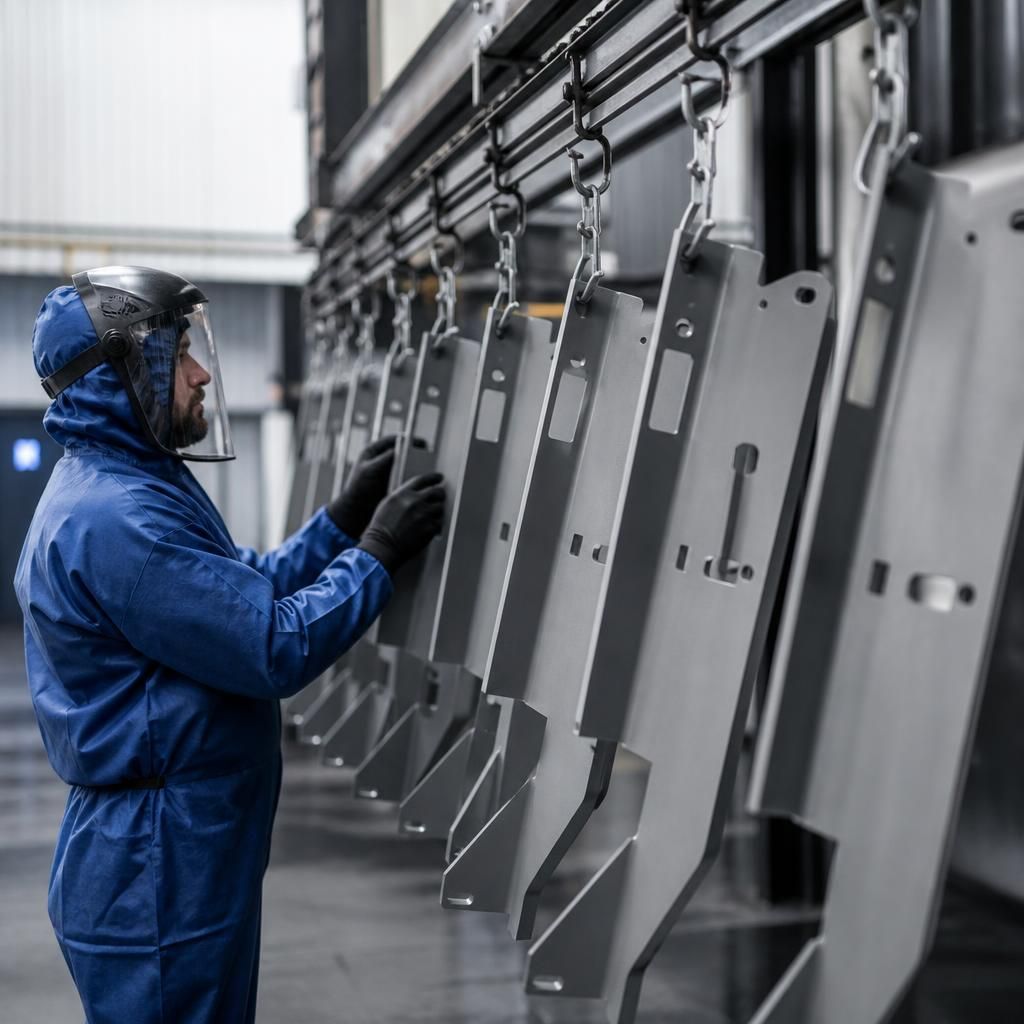
Primer choice should also account for the interval between primer application and the powder topcoat. Some systems require the topcoat to be applied while the primer is fully cured; others are designed for a controlled recoat window that promotes intercoat adhesion. Applying the topcoat outside the specified window can leave the layers poorly bonded even when the primer is suitable for the underlying metal.
For production work, the primer’s technical data should therefore be checked for recoat conditions, cure requirements and compatibility with the selected powder. This is particularly important when components are processed in separate stages or when the metal requires a primer with a different curing profile from the topcoat.