

How does the powder coating primer process improve corrosion resistance?
A primer improves corrosion resistance by forming an additional protective barrier between the metal and moisture, oxygen, salts and other corrosive contaminants. It also strengthens adhesion between the prepared metal surface and the powder topcoat, helping prevent defects such as peeling or underfilm corrosion that can expose the substrate.
The powder coating primer process improves corrosion resistance by controlling where corrosion can begin and by matching the coating system to the metal, service environment and component design. Its effectiveness depends on more than applying a primer: the substrate must be properly prepared, the primer must be applied evenly, and each layer must be cured within its specified conditions before the finished part is exposed to service.
Corrosion often starts at local weaknesses rather than across an intact coating. Edges, welds, corners, joints, recesses and areas with contamination can allow moisture and salts to reach the substrate. A correctly specified primer helps reduce the impact of these vulnerable areas by providing a consistent intermediate layer beneath the powder topcoat. This is particularly important for fabricated components with irregular profiles or for parts that will be exposed to outdoor, industrial, marine-influenced or chemically contaminated conditions.
The process improves protection in several connected stages:
- It removes corrosion-promoting contamination. Degreasing and other preparation steps remove oil, dirt, salts, oxides and residues that could otherwise remain beneath the coating. If these substances are trapped at the metal interface, they can attract moisture or interfere with the stability of the coating system.
- It creates a chemically suitable surface. Metal substrates vary in their surface condition and reactivity. Cleaning, abrasive preparation or chemical pretreatment can provide a more consistent foundation for the primer, while also reducing the risk of residual oxidation becoming a starting point for corrosion.
- It adds protection at the metal interface. Barrier-forming primers reduce the movement of water, oxygen and ions through the coating system. Some specialist primers can also offer sacrificial protection, where an active metal within the primer corrodes preferentially to the underlying steel. This approach must be selected carefully because the formulation needs to suit the substrate, topcoat and exposure conditions.
- It reduces the consequences of minor coating damage. Scratches, chips and small imperfections can expose the metal locally. A suitable primer can limit the ease with which corrosion spreads beneath the surrounding coating, although it cannot make a damaged coating immune to corrosion.
- It supports consistent film coverage. Correct application settings, grounded components and controlled powder deposition help the primer reach the intended areas. Particular attention is needed around sharp edges, holes and complex geometries, where coating build can be less uniform.
Primer selection is therefore a specification decision rather than a one-size-fits-all step. An epoxy-based powder primer may be selected where strong barrier properties and chemical resistance are important. A zinc-containing system may be considered where sacrificial protection is required for steel. Other formulations can be more appropriate for aluminium, galvanised material or components exposed to elevated temperatures. The choice should take account of the base metal, the expected moisture and chemical exposure, the design of the part and the chemistry of the powder topcoat.
Curing also has a direct effect on corrosion performance. The primer must reach the required melt and cure condition so that its particles flow together and develop the intended protective structure. Under-cured material may remain mechanically or chemically weaker, while excessive heat or an unsuitable curing cycle can affect the primer and the topcoat. Where a two-layer system is used, the interval and temperature between primer application and topcoat curing must be controlled so the layers work as one system rather than as incompatible films.
Quality checks help confirm that the intended protection has been achieved. Depending on the component and specification, checks may include visual examination for pinholes, craters, exposed metal, runs and thin areas; coating thickness assessment; cure verification; and testing of representative panels or parts. Weld zones, edges and recessed sections deserve particular inspection because they can be more susceptible to incomplete coverage and moisture retention.
Good component design supports the primer process. Drainage holes, accessible surfaces, rounded rather than excessively sharp edges and the avoidance of enclosed moisture traps can all reduce corrosion risk. Fabrication residues, weld spatter and heavy scale should be addressed before coating, as a primer cannot compensate for unstable rust, trapped contamination or a surface that is unsuitable for treatment.
In practical terms, primer provides the greatest corrosion benefit when it is specified as part of a complete coating system. Preparation, primer type, application, curing, topcoat compatibility, inspection and the component’s operating environment must be considered together. For industrial parts and batches, supplying accurate information about the metal, intended use, exposure and any existing treatment allows the coating process to be selected on a technical basis rather than relying on the topcoat alone.
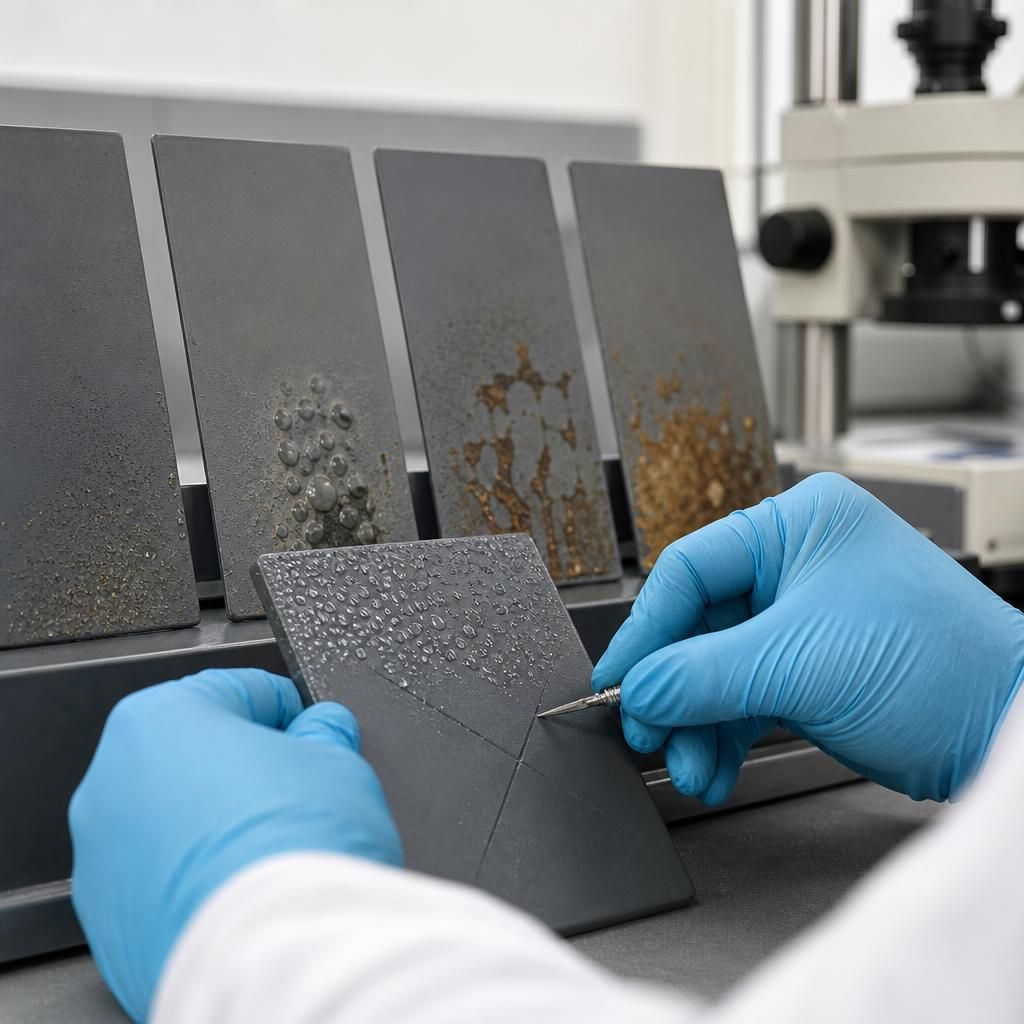
Corrosion resistance is best confirmed by assessing the complete primer-and-topcoat system, rather than judging the primer in isolation. The finished coating should be tested under conditions that represent the component’s intended exposure, because a formulation that performs well in a dry indoor application may not provide the same protection where moisture, salts or chemicals are present.
Testing can include controlled exposure of coated samples, inspection of scribed areas and adhesion checks after exposure. A scribe introduces a defined point of damage, allowing assessment of whether corrosion remains localised or travels beneath the surrounding coating. Inspection should also consider blistering, lifting, rust staining and loss of adhesion, as these symptoms can indicate weakness at the primer interface or between coating layers.
For production work, representative panels or spare components can help compare coating performance between batches and confirm that the specified system is suitable for the substrate and operating environment. The results should be interpreted alongside film thickness, cure verification and visual inspection, so corrosion resistance is evaluated as a property of the entire applied system.