

Why is achieving the correct powder coating thickness critical for preventing corrosion in steel components?
Correct powder coating thickness creates a continuous barrier that isolates steel from moisture, oxygen and corrosive contaminants, reducing the risk of rust initiation. If the coating is too thin, coverage may be inadequate; if it is too thick, curing and finish defects can undermine protection, so controlled thickness is essential for reliable corrosion resistance.
Correct powder coating thickness is critical because it determines whether the finished coating can provide a continuous, durable and mechanically resilient protective layer over the steel. Thickness must be controlled alongside surface preparation, coating selection and curing. A measured value within the specified range helps ensure that the coating performs consistently across faces, edges, recesses and other features of the component.
Steel corrosion begins when water, oxygen and contaminants reach the metal surface. Powder coating separates the steel from those agents, but the protection is only as reliable as the continuity and integrity of the film. Localised thin areas, missed edges, pinholes or damage can create points where corrosion starts. Once corrosion develops beneath the coating, it can spread laterally and cause lifting, blistering or flaking around the original defect.
Thickness also affects how well the coating withstands the conditions encountered during service. A film with adequate build is better able to tolerate ordinary abrasion, handling and minor impacts without exposing the substrate. This is particularly important for fabricated steelwork, brackets, frames, enclosures and components that are assembled, transported or subjected to repeated contact. The required build should therefore reflect the component’s environment and use rather than being selected as an arbitrary target.
Thickness is not uniform automatically. Powder can accumulate differently on broad faces, sharp corners, welds, holes, internal angles and recessed areas. The electrostatic application process may also produce variations according to the component’s shape and how it is positioned during coating. Edges are especially important because they may receive less coverage or experience greater mechanical wear. A suitable specification and a planned inspection regime should identify representative measurement points, including areas most likely to fall outside the required range.
Excessive build is not a substitute for proper preparation or application control. Over-application can affect appearance and may produce defects such as runs, uneven texture, orange peel, sagging or poor edge definition. It can also complicate curing because the heat must penetrate the full film and bring the coating system to its required cure condition. If the powder is not cured correctly, the apparent thickness alone does not confirm that the coating has achieved its intended chemical and mechanical properties.
Corrosion performance depends on the relationship between thickness and the rest of the finishing process:
- Surface preparation: removal of oil, rust, scale and other contaminants allows the coating to contact a suitable steel surface and develop dependable adhesion.
- Surface profile: an appropriate profile can provide a mechanical key, while an unsuitable or inconsistent profile may leave weak areas beneath an otherwise adequate film.
- Coating chemistry: different powder systems have different performance characteristics, so the specified thickness must be compatible with the chosen product and exposure conditions.
- Curing: the coating must receive the required heat exposure throughout the component, not merely reach a target thickness at the surface.
- Inspection: dry-film thickness readings, visual checks and, where appropriate, adhesion or other performance tests help identify process variation before components enter service.
Thickness control is particularly important at joints, weld zones and areas where water or debris could collect. These locations may face a higher corrosion risk because contaminants remain in contact with the coating for longer, while weld heat, grinding marks or geometric changes can affect preparation and application. Treating the component as a uniform flat panel can therefore give a misleading assessment of protection.
For a reliable specification, the required coating build should be agreed from the steel grade and condition, component geometry, handling requirements and expected exposure. The coating applicator can then establish an application and inspection method that checks the areas most relevant to the component’s corrosion risk. This approach is more dependable than relying on a single reading from an easily accessible face.
In practical terms, accurate thickness control reduces uncertainty in the finished coating. It helps confirm that the steel has received the intended level of barrier protection without introducing avoidable finish or curing defects. For manufacturers and fabricators, recording thickness results as part of quality control also provides evidence that the coating process was monitored consistently and that deviations can be investigated before they lead to premature corrosion.
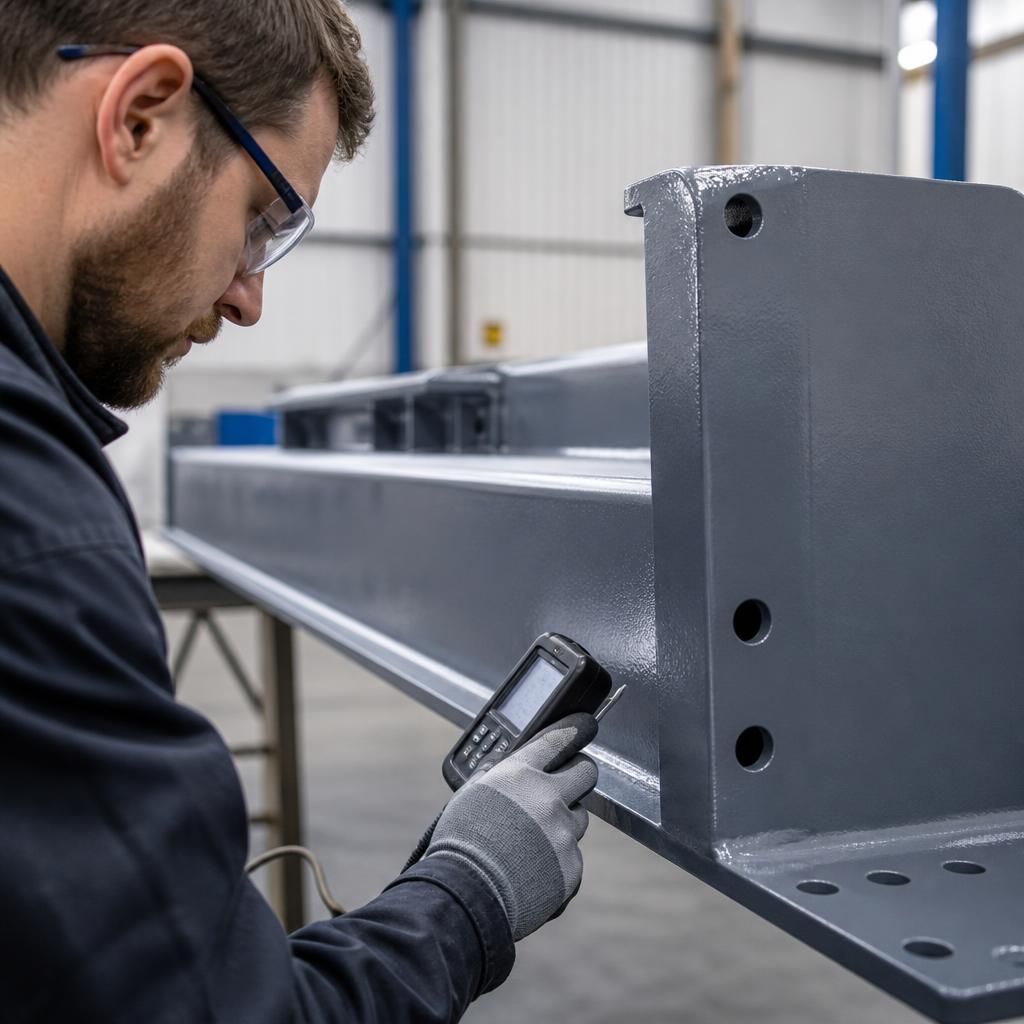
Powder coating thickness must be assessed in relation to the steel surface profile because surface roughness affects how much coating is available above the highest points. A nominally acceptable reading can conceal low areas where the film is thinner than intended, particularly if the substrate has been abrasive blasted or retains uneven weld and fabrication marks.
When the coating build does not adequately cover the profile, peaks may receive limited protection and valleys can hold contaminants or moisture. This can create local weaknesses even when the average thickness appears satisfactory. Specifying thickness alongside an appropriate surface profile therefore gives a more meaningful indication of corrosion protection than relying on an isolated measurement.
For this reason, preparation and application controls should be considered together. The steel surface needs a consistent condition, while thickness checks should account for the areas most affected by roughness and geometry. This helps distinguish genuine coating coverage from a reading that represents only the highest parts of the finished surface.
Discuss the correct powder coating thickness for your steel components
Discuss your steel components, service conditions and coating requirements with Powder-coatings.co.uk to establish a suitable thickness specification and inspection approach. Contact the team to explore the appropriate powder coating solution for your application.