

What role does the curing process play in achieving the desired powder coating thickness on steel components?
Curing does not determine the powder applied thickness; that is controlled during application. However, the curing cycle melts and flows the powder into a continuous film, so the correct time and temperature are essential for the specified thickness, uniform finish and performance on steel components.
Curing affects the final powder coating thickness by determining how the applied powder consolidates into a continuous, usable film. The specified dry film thickness must be achieved through controlled application, but the curing stage determines whether that layer develops the expected coverage, adhesion and finish on the steel component.
The steel temperature is more important than the oven air temperature. A curing schedule normally specifies how long the component must remain at a particular metal temperature. Thick sections, boxed fabrications and components with high thermal mass take longer to reach that temperature than small, thin parts. If the stated dwell time is measured before the steel has reached the required temperature, the coating may not receive the intended cure even though the oven display appears correct.
This is particularly important where one batch contains parts with different sizes or geometries. External faces may heat quickly, while recessed areas, joints and heavier sections lag behind. The result can be a coating that appears acceptable at one inspection point but has different film properties elsewhere. Oven profiling and checks on representative components help establish whether the entire part is receiving a suitable thermal cycle.
Insufficient curing can leave the film below its intended performance level. The powder may not fully consolidate, leaving reduced resistance to impact, chemicals, moisture or corrosion. Adhesion can also be affected, particularly if the steel was correctly prepared but the coating was not exposed to sufficient heat. A thickness reading alone cannot confirm that the coating has been properly cured; film build and cure state are separate aspects of quality control.
Excessive heat exposure can also be harmful. Depending on the powder formulation, over-curing may alter colour or gloss and can reduce the coating’s intended mechanical properties. The correct objective is therefore not simply to heat the component for as long as possible, but to follow the powder manufacturer’s specified cure window while accounting for the component’s material thickness, shape and loading arrangement.
The curing process also affects the way surface defects present themselves. Powder that has not flowed and consolidated correctly may leave an uneven appearance, pinholes or other discontinuities. These defects can make the effective protection less consistent even where an isolated thickness measurement falls within the specification. Excessive applied powder, meanwhile, cannot be corrected by curing; it may produce sagging, orange peel or poor edge definition rather than a sounder protective layer.
Reliable thickness control therefore links application checks with cure verification:
- confirm the required powder film build during or immediately after application;
- measure the temperature reached by the steel rather than relying only on the oven air reading;
- allow for differences between light and heavy sections, complex shapes and sheltered areas;
- inspect the cured film at agreed points, including edges and less accessible surfaces where practical;
- use a calibrated dry-film thickness gauge and record readings against the agreed specification; and
- investigate unusual readings alongside visual inspection, adhesion testing or other relevant quality checks.
For steel components, the most dependable result comes from treating thickness and curing as connected but separate controls. Application equipment establishes the amount of powder deposited, while the thermal cycle enables that deposit to become a stable coating with consistent coverage and performance. Component-specific profiling is especially valuable for batch work, where variation in part size or loading can otherwise produce inconsistent results.
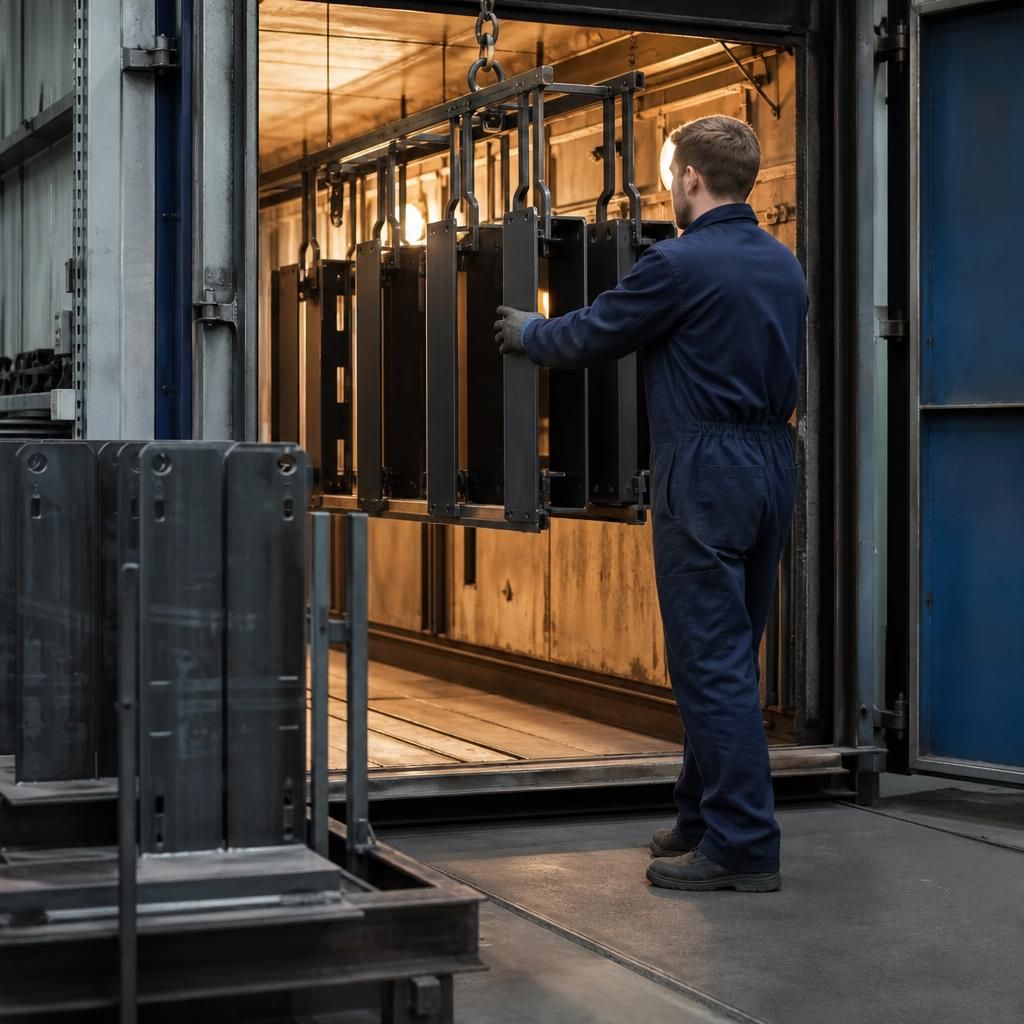
Oven loading can influence whether the applied powder reaches the intended cured state. Components placed close together, nested inside one another or positioned behind heavier fabrications may experience different heat transfer from parts exposed directly to the oven environment. The nominal curing schedule may therefore be suitable for one loading pattern but less reliable when the arrangement changes.
For repeat production, the loading arrangement used during cure validation should reflect normal working conditions. Changes to part spacing, orientation, batch composition or the position of heavy steel sections should prompt a review of the thermal cycle, particularly where consistent coating performance is required across the complete component.