

What role does cleaning play in metal finishing preparation for steel?
Cleaning removes oil, grease, dirt, rust residue and other contaminants from steel before finishing. This gives the powder coating a sound surface to bond to, helping prevent defects such as poor adhesion, blistering and premature corrosion.
Cleaning is the controlled removal of surface contamination and residues before steel is chemically or mechanically prepared for finishing. Its role is to make the substrate consistent, so subsequent treatment can act on the steel rather than on oil, handling marks, mill scale or processing debris.
Steel components can acquire contamination at several stages, including forming, machining, storage and handling. Cutting fluids, drawing compounds, fingerprints, adhesive residues, weld spatter, grinding dust and shop dirt may all remain on the surface. Some contaminants are visible, while others form a thin film that may only become apparent when the coating begins to wet the surface. Cleaning therefore needs to be selected according to the component’s manufacturing history, geometry and intended finish.
A typical preparation sequence may include:
- Initial inspection: identifying oils, corrosion products, scale, weld residues, burrs and areas that need additional mechanical preparation.
- Degreasing: using a suitable alkaline, aqueous or other approved cleaning process to dissolve or lift organic contamination.
- Rinsing: removing loosened soil and cleaning residues rather than allowing them to dry back onto the steel.
- Further surface preparation: using abrasive blasting, conversion treatment or another suitable process where scale, oxidation or a required surface profile must be addressed.
- Final inspection and drying: checking that the surface is clean, dry and free from residues before powder is applied.
Cleaning and surface profiling are related but not interchangeable. A blasting process can remove some contamination while also roughening the surface, but heavy oil or grease can interfere with abrasive action and spread across the steel. Conversely, a chemically clean surface may still require mechanical treatment to remove tightly bonded scale or provide the surface characteristics required by the coating system. The correct order is important: contaminants should be removed before preparation methods that could embed, redistribute or conceal them.
Rinsing and drying deserve particular attention. Cleaner residues, salts and rinse water left in seams, folds, hollow sections or fixing holes can affect later treatment and may contribute to defects during heating. Components should be arranged so liquid can drain from difficult areas, with trapped moisture removed before coating. Complex fabrications need especially careful inspection because internal corners and overlaps are more difficult to clean uniformly than accessible flat faces.
The cleaning method must also suit the steel itself. Excessively aggressive treatment can alter edges, damage delicate features or leave an unsuitable surface, while insufficient treatment may leave embedded contamination. Welded parts can require extra attention around heat-affected areas, where residues and oxide films may differ from those on the surrounding steel. Any existing coating, corrosion or mill scale should be assessed rather than assumed to respond identically to one cleaning process.
Cleanliness should be verified before the next stage, using visual checks and, where appropriate, tests for remaining residues or surface condition. Inspection should cover concealed faces, joints, recesses and handling points, not just the most visible areas. If contamination is found after preparation, the affected area should be cleaned again rather than relying on the powder coating to mask it.
For steel intended for powder coating, effective cleaning supports a predictable preparation sequence, consistent coating application and a more reliable finished surface. It does not replace correct profiling, chemical treatment, powder application or curing; instead, it provides the sound starting condition on which those stages depend.
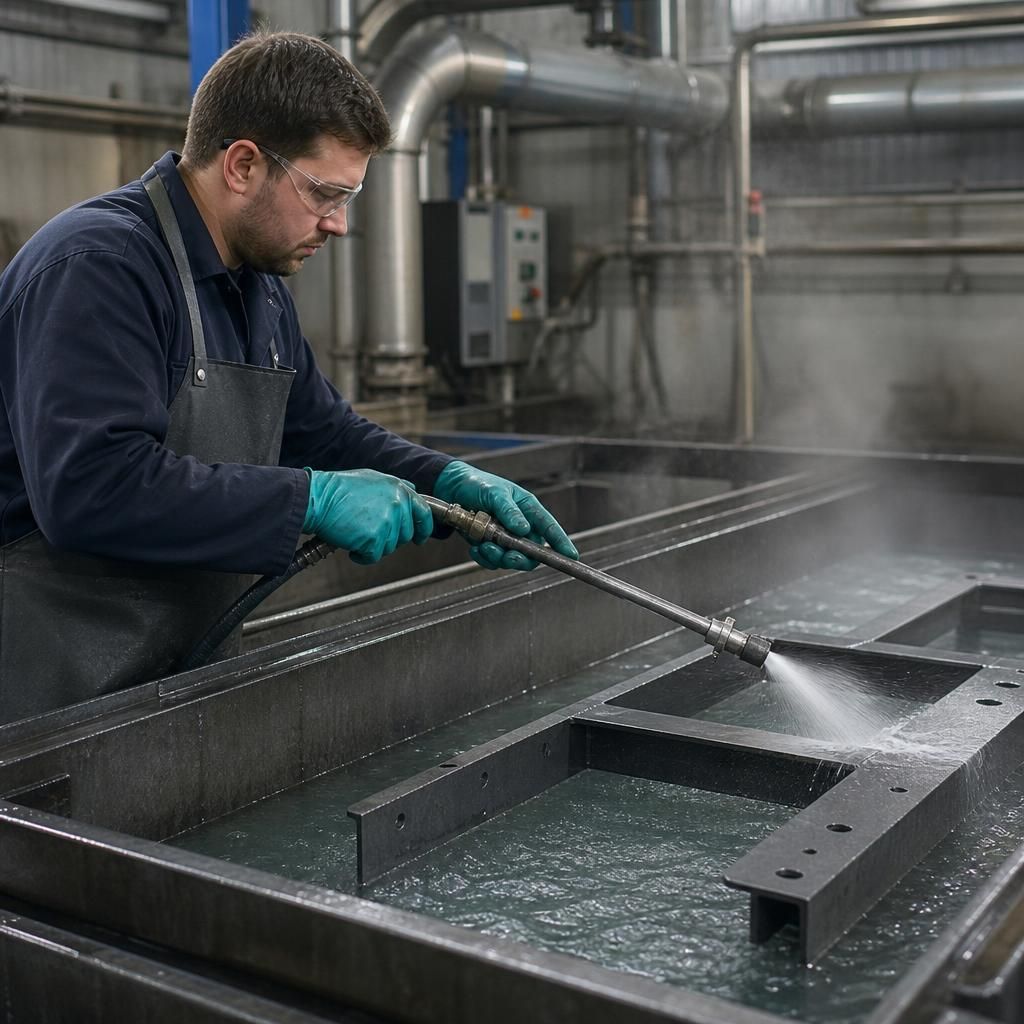
Cleaning also protects the consistency of the chemical treatment that follows. Oil, grease and cleaner residues can interfere with conversion coatings by preventing the treatment from contacting the steel evenly. This may produce areas with different surface chemistry, even when the component appears visually clean.
For this reason, cleaning is not simply a cosmetic step. It establishes a chemically suitable surface for pretreatment, helping the subsequent coating system form evenly across the steel. The cleaning process should therefore be checked for compatibility with the planned pretreatment, with residues removed before the next stage begins.