

How does surface preparation impact the longevity and performance of powder coatings on steel?
Surface preparation directly affects how well powder coating adheres to steel and how effectively it protects the substrate. Removing contaminants and creating a suitable surface profile helps prevent defects, under-film corrosion and premature coating failure, improving the finished component’s service life and performance.
Surface preparation has a direct effect on the durability, appearance and protective performance of powder-coated steel because it determines the condition of the substrate before the coating is applied. A well-prepared surface gives the coating a consistent foundation, whereas residues, corrosion, weld contamination or damaged areas can create localised defects that reduce service life.
The condition of the steel is the starting point. New steel may carry mill scale, oil, grease, drawing compounds, storage residues or light oxidation. Previously coated components can also have loose coating, rust, sealants or repair materials that are unsuitable beneath a new powder system. These conditions need to be identified before preparation begins, as the correct treatment depends on whether the steel is new, blasted, previously painted, galvanised or exposed to corrosion.
Preparation also has to account for the design of the component. Sharp edges, narrow gaps, folded sections, drilled holes and enclosed areas are more difficult to clean and coat consistently. Welds can contain spatter, flux residues, heat-tint effects and concentrated surface irregularities. If these features are left untreated, they may produce thin spots, pinholes, rough patches or visible variations in the finished film. Removing spatter, dressing unsuitable welds and ensuring that drainage holes and recesses are accessible can therefore improve both appearance and protection.
Cleaning establishes a chemically suitable surface. Degreasing and rinsing remove substances that can interfere with the preparation process or remain trapped beneath the powder. Cleaning must be thorough rather than limited to visibly dirty areas, because very small amounts of oil or residue can cause cratering, fisheyes, bubbling or poor wetting during curing. Rinsing quality and drying are equally important: cleaning chemicals or moisture left on the steel can introduce new defects instead of removing existing ones.
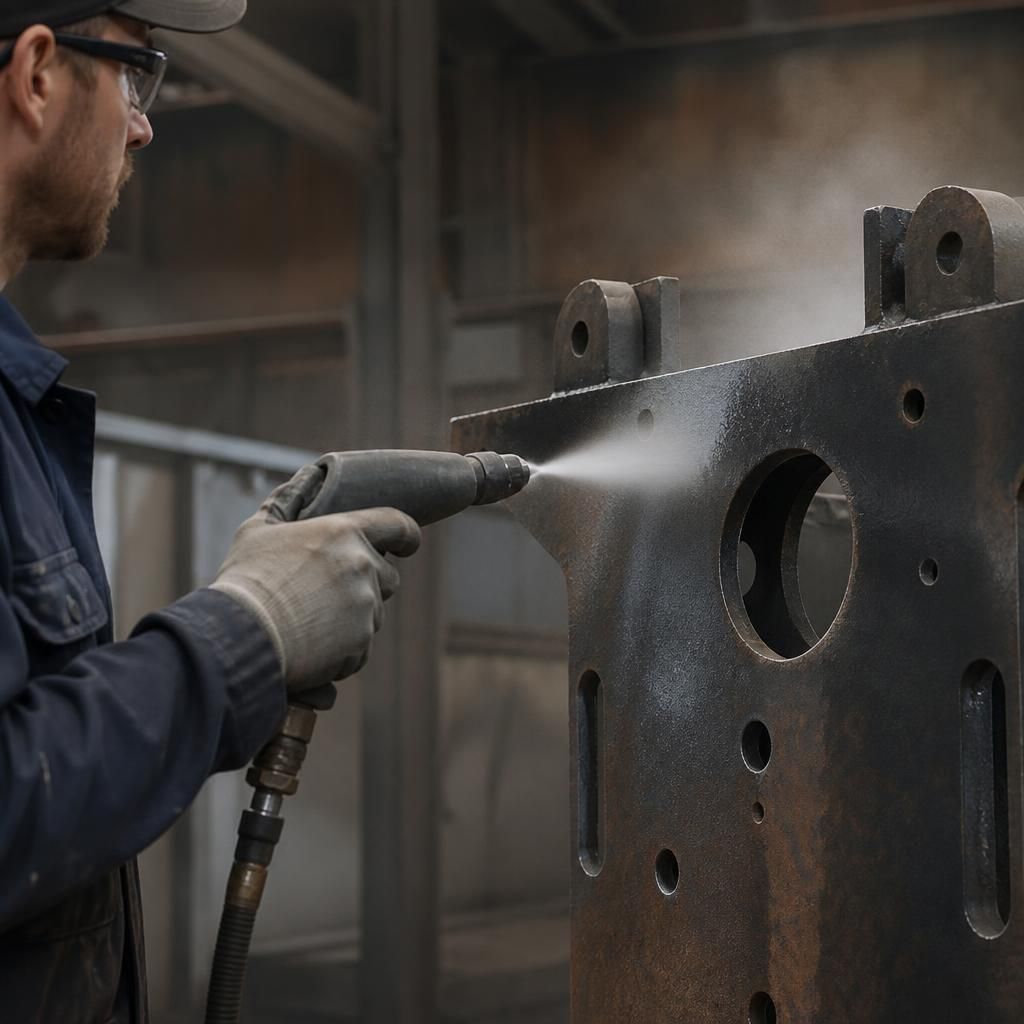
For many steel components, abrasive blasting is used to remove corrosion, scale and previous finishes while producing a suitably receptive surface. The choice of abrasive, pressure and technique needs to match the steel and the required finish. Excessive blasting can alter dimensions, round edges or distort thinner parts, while insufficient preparation can leave unstable material behind. After blasting, the steel should be handled and protected carefully so that it does not acquire fingerprints, oil, dust or flash rust before coating.
Chemical pre-treatment can add another layer of protection. Depending on the application and coating specification, a conversion treatment or other compatible pre-treatment may improve the interface between the steel and the powder film. Its value depends on correct chemical control, complete coverage, suitable rinsing and thorough drying. A treatment that is poorly controlled, incompatible with the powder system or allowed to dry unevenly may cause defects and reduce consistency.
Environmental exposure between preparation and coating is an important practical consideration. Prepared steel can begin to oxidise if it is exposed to moisture, condensation or contaminated handling conditions. The risk is greater where components are stored in a damp environment or moved between areas with different temperatures. Preparation should therefore be planned as part of the complete coating sequence, rather than treated as a separate task carried out long before application.
Surface preparation affects powder coating performance in several ways:
- Film uniformity: a stable, even substrate helps the powder melt and flow consistently, reducing visible roughness and local variations.
- Edge protection: properly treated edges are less likely to become weak points where the coating is thin or easily damaged.
- Resistance to moisture ingress: eliminating unstable material and residues reduces routes through which moisture can reach the steel.
- Resistance to mechanical damage: a sound interface helps the coating remain attached when components are handled, assembled or exposed to impact.
- Repeatability between batches: consistent preparation makes colour, texture and protective performance more predictable across production runs.
Inspection should take place before powder application, not only after curing. Checks may include visual examination, confirmation that oil and grease have been removed, assessment of remaining corrosion or scale, inspection of welds and edges, and verification that the prepared steel is dry and free from dust. For demanding work, the preparation method and acceptance criteria should be agreed against the component’s environment, handling requirements and coating specification.
The most effective preparation process is consequently the one matched to the steel, its fabrication condition and its intended use. A simple fabricated bracket may require a different sequence from a heavily corroded structural component or a steel part previously coated with an unknown material. When preparation is selected and controlled in this way, the powder coating starts with a stable substrate, reducing avoidable defects and supporting longer-lasting performance in service.
Surface preparation must be matched to the complete coating specification. The correct preparation for a sheltered indoor component may not provide the same level of performance on steel exposed to moisture, road contaminants or changing temperatures. The steel grade, fabrication condition, intended environment and selected powder system should therefore be considered together, rather than choosing a preparation method by appearance alone.
This approach also helps avoid compatibility problems between the prepared substrate and the coating system. A surface can look clean while still having a condition that is unsuitable for the specified powder, particularly where steel has been previously coated, repaired or subjected to different fabrication processes. Defining the preparation route, required surface condition and inspection checks as part of one specification gives the applicator clear acceptance criteria and makes performance more consistent across individual components and production batches.