

How do electrostatic coating techniques influence the consistency and efficiency of the powder coating process?
Electrostatic coating techniques charge powder particles so they are attracted to and distributed across the earthed metal component, promoting more even coverage and reducing overspray. Consistent gun settings, grounding, powder flow and part positioning help maintain repeatable film thickness and make powder application more efficient.
Electrostatic coating techniques influence powder coating by controlling how powder behaves between the spray gun and the metal surface. When the electrical conditions, powder characteristics and application method are matched to the component, the process becomes more repeatable, uses material more effectively and produces a more uniform cured film. The result depends on more than simply applying a charge: component geometry, powder formulation, surface condition and curing must all remain suitable for the coating system.
Different charging methods affect application behaviour. Corona guns transfer charge to powder particles through an electrode and are widely used because their settings can be adjusted for different components and coating requirements. Tribo systems charge the powder through friction as it passes through specially designed passages, which can be useful where a different particle distribution or reduced electrical field is required. The choice between these approaches affects how readily powder reaches recesses, how edges build up and how sensitive the application is to the component’s shape.
Component geometry is a major influence on consistency. Flat surfaces are generally straightforward to coat, whereas corners, narrow channels, boxed sections and recessed areas change the electrical field around the part. These areas can attract powder unevenly or restrict access for the spray pattern. This is commonly associated with the Faraday cage effect, in which charged powder is preferentially deposited around the outside of a recess rather than penetrating deeply into it. Application technique may therefore need to account for gun angle, approach sequence and the accessibility of the surface.
Electrical conditions also have to be controlled carefully. Excessive charge or an unsuitable voltage can contribute to back-ionisation, where an intense electrical field disrupts the powder layer and creates a rough or uneven appearance. Insufficient charge may reduce deposition on the component and increase material falling away from the intended surface. The appropriate balance depends on the powder, the metal, the part geometry and the equipment, so a setting that works for one job cannot automatically be transferred to another.
Powder condition affects both repeatability and transfer efficiency. Moisture, contamination, agglomeration and changes in particle size can alter how powder charges, flows and deposits. Reclaimed powder may also behave differently from unused powder if it has been exposed to contamination or mixed with another product. Keeping powder types segregated, maintaining suitable storage conditions and checking the feed system helps prevent changes in application behaviour between batches. Any recovery system must also be managed so that collected material is suitable for reuse rather than becoming a source of variation.
Electrostatic application can improve material efficiency because powder that does not initially deposit on the component may be captured by a recovery system. However, recovery does not eliminate the need for process control. Excessive overspray, unsuitable spray patterns, poor access to recesses or unstable powder feed can increase waste and create additional handling or rework. Efficient application is therefore measured by the proportion of usable powder deposited correctly, not simply by the amount collected after spraying.
The preparation and condition of the metal remain fundamental. Oil, dust, corrosion products and residual pretreatment chemicals can interfere with electrical contact or prevent the deposited film from bonding properly. The component must be suitably clean and dry, and the metal must provide a reliable path for charge dissipation. Masking, racking and contact points should also be planned so that the areas requiring coating remain accessible and the electrical connection is maintained throughout application.
Film consistency is assessed after application and curing rather than by appearance alone. Coating thickness checks can identify thin areas, excessive build-up and variation between parts. Visual inspection may reveal defects such as uneven texture, pinholes or roughness, but it does not always show whether the coating has reached the required thickness. Where a component has critical edges, recesses or dimensional tolerances, measurements should be taken at representative locations rather than only on the easiest flat surface.
Curing completes the process and can expose inconsistencies that were not obvious in the powder state. The coating must receive the appropriate combination of oven temperature and time for the particular powder system and metal thickness. Parts with different thermal mass may reach curing temperature at different rates, even when they share the same oven load. Poor curing can reduce the finish’s functional performance, while excessive heat or an unsuitable cycle can affect colour, texture or appearance.
For repeat production, the main controls are:
- using a consistent powder material and keeping different products properly separated;
- maintaining stable powder feed and suitable charging conditions;
- adapting the application method to flat areas, edges and recessed geometry;
- preserving clean electrical contact between the component and the earthed support;
- checking coating thickness at relevant points on the part;
- verifying that the curing cycle suits the powder and component construction; and
- recording adjustments and inspection findings so that repeat batches can be compared.
In practice, electrostatic coating is most consistent when it is treated as an integrated process rather than a single gun setting. Charging method, powder condition, component design, surface preparation, application access, recovery and curing all influence the final result. Controlling these factors reduces variation between parts and helps industrial coaters select an application method that is appropriate for the required finish, geometry and production volume.
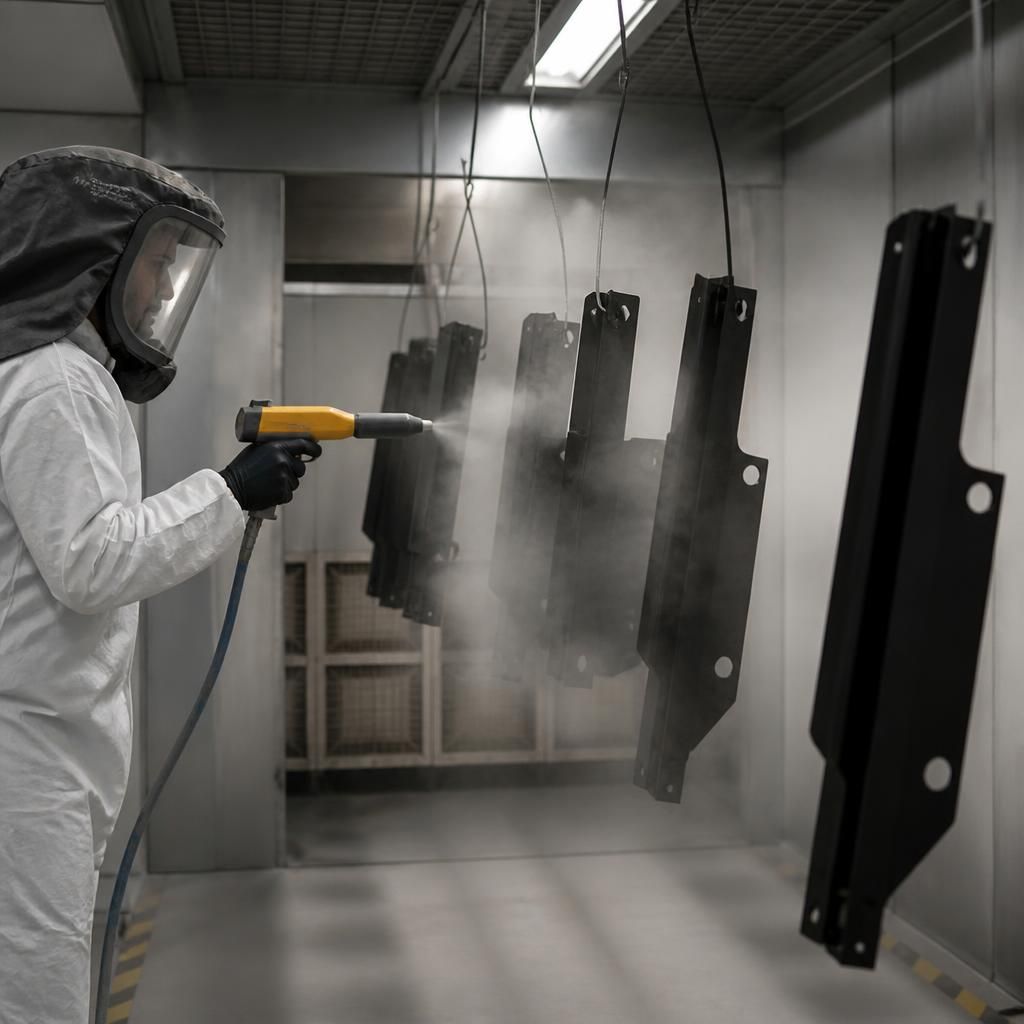
Spray-booth airflow influences electrostatic coating by controlling the movement of the charged powder cloud between the gun and the component. If airflow is too strong, powder can be diverted before it reaches the metal, causing uneven deposition and additional overspray. If it is poorly balanced, powder may linger around the part or settle on equipment, increasing contamination and recovery demands.
Consistent booth conditions therefore support repeatable application. Air movement should allow the spray pattern to remain stable while carrying excess powder towards the recovery equipment. The booth, extraction system and spray settings need to work together, particularly when coating components with open sections, edges or complex profiles. Monitoring changes in airflow can help distinguish an application problem from an issue with charging, powder feed or component positioning.