

What methods ensure effective removal of oxides and contaminants during electrostatic coating preparation?
Effective electrostatic coating preparation combines degreasing to remove oils, alkaline or chemical cleaning for embedded contaminants, and abrasive blasting or mechanical abrasion to eliminate oxides and scale. Thorough rinsing, complete drying and visual inspection are then essential to prevent residues or remaining corrosion from reducing powder adhesion.
Effective removal of oxides and contaminants requires more than making a metal surface look clean. The preparation method must remove the particular soil or corrosion product present, avoid damaging the substrate, and leave a chemically stable surface that will not interfere with electrostatic powder deposition or subsequent adhesion. The correct approach therefore depends on the metal type, the condition of the component, its geometry and the required coating performance.
Identify the contamination before choosing the treatment
Different residues require different removal mechanisms. Oils, greases and machining fluids can form a film that prevents cleaning solutions from contacting the metal. Fingerprints and handling residues may be less visible but can still create local adhesion defects. Welding can introduce heat tint, oxide scale, spatter and residue from fabrication processes, while storage may result in surface rust, mill scale or deposited salts. Dust and abrasive particles can also remain in holes, seams and corners after mechanical preparation.
A visual assessment should distinguish loose contamination from firmly bonded oxide. It should also consider whether the substrate is steel, galvanised steel, aluminium or another alloy. A treatment that is suitable for robust carbon steel may mark aluminium, remove protective zinc unnecessarily or create an unsuitable surface profile on a thin component.
Control mechanical oxide removal
Where corrosion or scale is firmly attached, mechanical preparation must be controlled rather than applied indiscriminately. Abrasive selection, impact energy and working direction affect the resulting profile and the amount of embedded media. Excessive treatment can round sharp details, distort thin sections, expose unwanted substrate or leave a surface that is too rough for the intended finish. Insufficient treatment may leave islands of oxide around welds, edges, fasteners and recessed areas.
For complex fabrications, particular attention is needed at lap joints, internal corners, drain holes and weld toes. These areas can retain corrosion products even when the broad faces appear uniform. Abrasive residue should be removed afterwards, since loose particles can become inclusions or interfere with the electrostatic application.
Use chemical cleaning for residues that mechanical methods cannot reliably remove
Chemical cleaning is useful where contaminants are thin, widespread or lodged in areas that are difficult to reach mechanically. The process needs suitable concentration, contact time, temperature and agitation to work consistently. If the treatment is too mild, contamination remains beneath the powder. If it is too aggressive, it may attack the substrate, alter the surface chemistry or create staining.
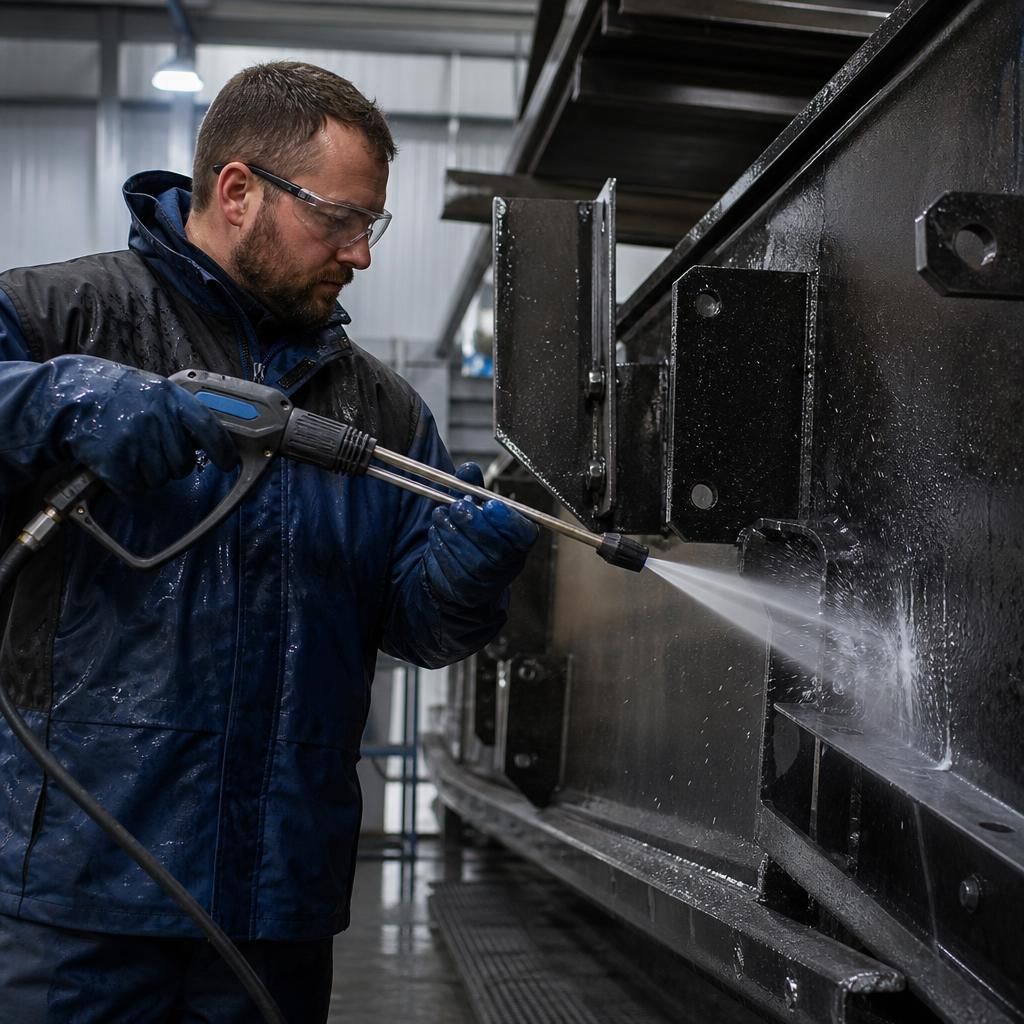
After chemical treatment, all reaction products and cleaning residues must be removed. Inadequate rinsing can leave alkaline, acidic or detergent residues that attract moisture and contribute to loss of adhesion. Rinse quality is especially important on folded parts, hollow sections and components with blind recesses, where liquid can collect and later emerge during heating.
Prevent recontamination after cleaning
A prepared surface can quickly be compromised by contact with unclean gloves, dirty fixtures, workshop dust, cutting fluids or condensation. Components should therefore be handled by suitable clean equipment and protected from further exposure between preparation stages. Storage and transfer arrangements should prevent cleaned faces from touching contaminated benches or packaging.
Steel also requires control of the interval between oxide removal and coating. If moisture reaches freshly prepared steel, flash rust can develop before powder is applied. This is particularly relevant where temperature changes cause condensation. The surface should remain dry and be checked again if there is any doubt about its condition.
Verify cleanliness rather than relying only on appearance
Inspection should combine visual assessment with practical checks appropriate to the substrate and specification. Examine bright areas under suitable lighting, looking for remaining scale, staining, powdery corrosion, oil marks, abrasive particles and water trapped in joints. A surface that appears clean but shows localised wetting, residue or inconsistent appearance may need further treatment.
Where coating performance is critical, cleanliness testing can help identify invisible or low-level contamination. Tests may assess residual oils, dust, soluble salts or surface chemistry. The selected test should reflect the likely contamination source and the coating specification. Records of preparation conditions, inspection results and any rework provide useful evidence that the surface was suitable before powder application.
Match the final preparation to the coating system
Oxide and contaminant removal is one stage within a wider preparation system. The final surface condition must be compatible with any subsequent conversion coating, primer or powder formulation. Over-cleaning can be as inappropriate as under-cleaning if it removes a beneficial surface condition or leaves the substrate vulnerable before the next stage.
For B2B components, the most reliable process is a defined sequence with agreed acceptance criteria: identify the substrate and contamination, select the least aggressive effective treatment, remove residues, dry difficult features thoroughly, inspect the result and protect the surface until coating. This approach makes preparation repeatable across batches while allowing adjustments for geometry, corrosion severity and material sensitivity.
Oxide removal also supports the electrical part of electrostatic coating. Rust, mill scale and some firmly bonded residues are less conductive than the underlying metal, so they can interfere with charge dissipation and contribute to uneven powder deposition. This is particularly important around welds, edges and repaired areas, where surface condition may vary across the same component.
The objective is not to make every surface highly rough. It is to expose sound, conductive substrate consistently while retaining a controlled profile suitable for the specified coating system. After preparation, the component should be free from loose oxide and positioned so that clean contact points provide a dependable path to earth during powder application.