

What are the critical drying conditions required to prevent defects before the final powder application in electrostatic coating?
Before final powder application, the pre-treated metal must be completely dry, with no trapped water, solvent or cleaner residue in joints, recesses and seams. Controlled substrate temperature, low condensation risk and clean, consistent airflow are essential so moisture and vapours have fully evaporated without allowing the surface to recontaminate before spraying.
The critical drying conditions are the correct time and temperature for the pre-treatment chemistry, sufficient and evenly distributed airflow, effective drainage from the component, and verification that the surface is suitable for powder application. Drying is not simply a matter of leaving metal exposed to air; it is a controlled process that must remove process moisture and volatile residues without damaging the conversion coating or allowing the part to become contaminated again.
Use the drying cycle specified for the pre-treatment system. Rinsed components, iron-phosphated or zinc-phosphated parts, and surfaces treated with specialist chemical products can have different drying requirements. Excessive heat can alter a conversion layer, bake residues onto the substrate or affect dimensional stability. Insufficient heat or time can leave moisture in the surface profile and create defects during the powder oven cycle. The coating system supplier’s technical instructions should therefore determine the drying temperature, exposure time and permitted substrate temperature.
Air movement must reach the whole component. A hot chamber or drying zone may not produce an evenly dry part if air circulation is poor. Brackets, folded sections, box sections, mesh, flanges and closely spaced components can shield one another from the airflow. Drying equipment should provide consistent circulation rather than relying solely on radiant heat, with loading patterns that prevent cold or stagnant areas.
Component orientation is equally important. Parts should be positioned so liquid can drain from holes, channels, overlaps and underside features instead of collecting there. Drainage holes need to remain unobstructed, and complex fabrications may require a deliberate orientation change between processing stages. If a design retains rinse water, drying controls alone may not resolve the problem; the part may need additional drainage provision or a revised pre-treatment and handling method.
Drying must preserve the prepared surface. The support used during drying should not introduce oil, dust, fibres or other contaminants. Contact points should be kept to the minimum needed for safe handling, particularly where the powder will later be applied. Components should also be protected from contact with dirty gloves, unclean racks, condensate from equipment and other sources of recontamination after drying.
Inspection should be based on the component’s geometry rather than only its most accessible face. Before powder application, the operator should check:
- recesses, seams, joints and enclosed features for retained process liquid;
- drainage holes and channels for blockage;
- the surface for visible staining, tide marks, water spotting or chemical residue;
- racks and contact points for contamination transferred during handling; and
- the consistency of the drying result across different areas of the load.
Where the process is safety- or quality-critical, drying controls should be recorded as part of the pre-treatment process. Useful checks include oven or dryer temperature, line speed or exposure time, loading arrangement and inspection findings. Periodic checks should also consider whether airflow has changed because of blocked filters, altered fan performance or a different component mix.
Drying conditions should be assessed alongside the powder application sequence. A part that has been dried correctly can still become unsuitable if it is stored in a dusty area, handled excessively or exposed to conditions that produce surface contamination before spraying. The interval between drying and application should therefore be controlled by the coating process, with prepared components transferred using clean handling methods.
For batch work, representative parts should include the most difficult geometries, not only flat or open pieces. A small flat panel may dry satisfactorily while a fabricated assembly with enclosed corners retains process liquid. Validating the drying arrangement against the most demanding component helps identify risks such as localised bubbling, pinholing, poor adhesion or corrosion developing beneath the powder film.
In practical terms, an effective pre-application drying process combines chemistry-specific settings, even airflow, correct component positioning, clean handling and documented inspection. These controls establish a consistent surface for electrostatic powder deposition and reduce the likelihood that retained process liquid or drying-related contamination will become a defect during subsequent heating.
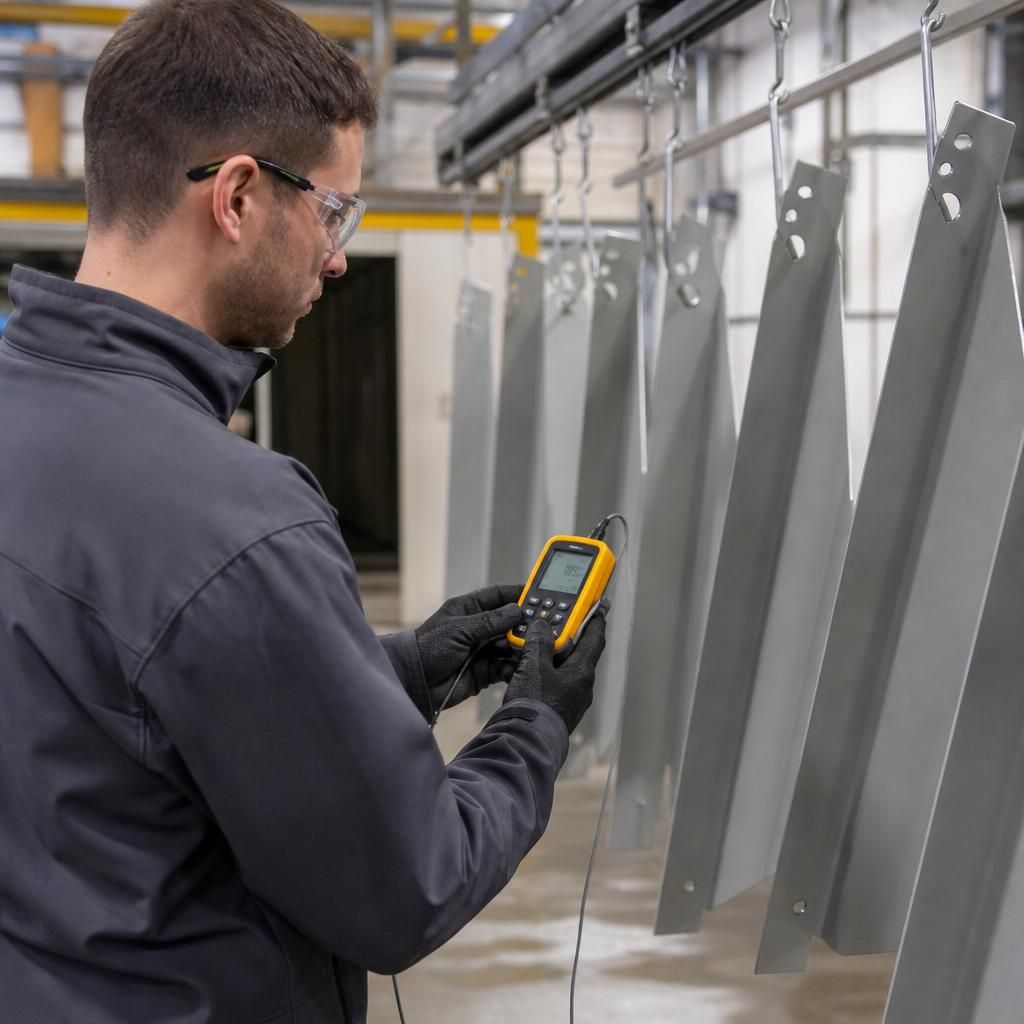
A critical final check is confirming that the metal temperature remains above the dew point before powder application. The dew point is the temperature at which moisture from the surrounding air can condense on the substrate. A component may appear dry yet develop an invisible film of moisture if it has cooled in humid conditions, particularly after leaving a heated drying stage or when moved into a cooler spray area.
Measure or assess the relationship between substrate temperature, air temperature and relative humidity at the point of application. If the metal is close to the dew point, allow it to reach a suitable stable temperature before spraying. This check is especially important when components have substantial thermal mass or when environmental conditions change during production. Preventing condensation protects the prepared surface from flash rusting, moisture entrapment and adhesion defects beneath the powder film.