

What are the best practices for applying primers to ensure optimal powder coating adhesion in electrostatic applications?
For optimal powder coating adhesion in electrostatic applications, select a primer compatible with the metal substrate and powder system, then apply it evenly to a correctly prepared, contaminant-free surface. Control film thickness, allow the primer to dry or cure according to its technical data, and confirm that the recoating window is met before applying the powder.
A primer is an intermediate coating applied between the prepared metal substrate and the powder topcoat. Its purpose is to provide a stable bonding layer, improve corrosion protection and help the finished system remain intact where the substrate or service conditions place greater demands on the coating. Good results depend on treating the primer as part of a complete coating system rather than as a separate product applied simply to increase film build.
Establish whether a primer is necessary. Priming is particularly useful where the component will face moisture, salts, chemicals, abrasion or difficult atmospheric conditions, or where the substrate contains areas that are more vulnerable to corrosion. It can also be appropriate for steel, castings, repaired surfaces and complex fabrications where a single powder layer may not provide the required protection. On relatively low-risk work, an additional primer may add process complexity without a corresponding benefit, so the coating specification should identify the required level of protection before production begins.
Prepare the substrate to a consistent standard. A primer cannot compensate for oil, grease, cutting fluid, dust, loose oxide, mill scale or previous coating residue. Preparation should produce a chemically clean and suitably keyed surface, with particular attention to welds, seams, recesses and edges. Weld spatter and sharp projections should be removed because they can interrupt the primer film or create weak points in the topcoat. Any abrasive residue must also be removed before priming. The preparation method should reflect the metal type and its condition; over-aggressive treatment can distort thin sections, while insufficient treatment may leave corrosion products beneath the coating.
Control the condition of the workpiece. Metal should be dry and free from condensation before primer application. Components brought from a colder area into a warmer one can develop an invisible moisture film, particularly on enclosed sections and heavy fabrications. Surface temperature, ambient temperature and humidity should be checked where the coating system requires environmental control. The work area should be kept clean enough to prevent airborne dust settling on wet primer, and prepared parts should not be handled with contaminated gloves or placed on dirty supports.
Use the primer as a controlled system layer. Mixing, induction time, thinning, agitation and pot life are relevant to liquid primers, while powder primers require correct storage, handling and application settings. These details should be taken from the product’s technical data rather than estimated on the shop floor. Materials beyond their usable life, incorrectly mixed components or poorly dispersed solids can produce soft areas, pinholes, cratering and inconsistent adhesion. Containers and equipment should also be checked for contamination from incompatible coatings or cleaning products.
Pay attention to difficult geometries. Corners, returns, folded edges, holes and recessed sections do not receive coating in the same way as open faces. Electrostatic effects can reduce deposition in recesses and create heavier build on prominent edges. Gun angle, component rotation and access should therefore be considered when priming, rather than relying on a single pass from one direction. Edges should be free from burrs and sharpness, and drainage or vent holes should remain clear where they are required for later processing.
Allow the primer to become a sound foundation. Before the powder topcoat is applied, the primer should be sufficiently stable for handling and free from visible defects. Depending on the system, this may involve drying, flash-off or a defined cure. Applying powder over solvent that has not escaped can cause bubbling, pinholing or loss of intercoat adhesion during the final bake. Conversely, an over-cured or contaminated primer may provide a poorer key for the next layer. The permitted interval between primer application and powder coating should be controlled, especially where dust, moisture or handling could affect the surface.
Maintain electrical control during electrostatic work. The component, hooks, racks and relevant equipment need a reliable earth path so that the powder can be attracted to the workpiece and deposited consistently. Poor contact caused by overspray, oxide or coating build-up on hooks can contribute to uneven deposition, particularly around corners and isolated parts. Contact points should be positioned deliberately and kept suitable for repeated use. The primer itself must also be considered in the system design: an insulating layer can affect the electrical behaviour of subsequent powder application if it is too thick, unsuitable or applied before the process has stabilised.
Inspect before releasing the part for topcoating. Useful checks include visual examination for runs, dry spray, pinholes, craters, bare patches, inclusions and edge pull-back. Where the specification requires it, primer coverage and cured film properties can be assessed using an appropriate inspection method. Test panels or representative components are valuable when introducing a new substrate, geometry or coating combination because they can reveal defects before a full batch is processed. Any failure should be traced to preparation, contamination, application, drying, curing or handling rather than hidden beneath the powder layer.
- Record the substrate condition and preparation route.
- Confirm that the primer material has been stored, mixed and used in accordance with its technical information.
- Check environmental conditions and the condition of the primed surface before powder application.
- Inspect hooks, racks and contact points to maintain consistent electrostatic behaviour.
- Keep batch records so that recurring defects can be linked to a specific preparation or application stage.
The most dependable approach is therefore a documented sequence: assess the service requirement, prepare and inspect the metal, apply the primer under controlled conditions, allow the specified drying or cure to occur, and verify the primed surface before electrostatic powder application. This process gives the topcoat a clean, stable foundation and makes adhesion problems easier to prevent and diagnose.
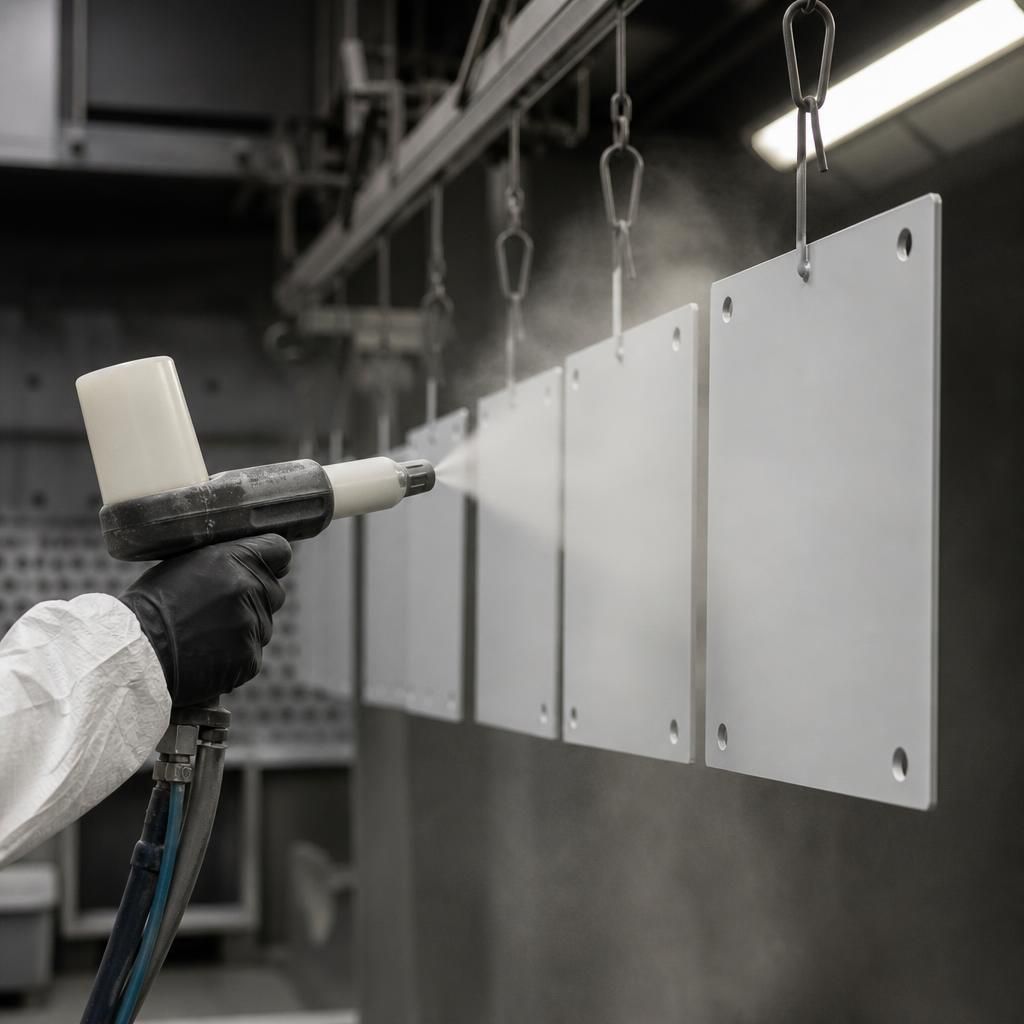
Primer adhesion in an electrostatic powder coating system depends on two separate interfaces: the bond between the primer and the metal, and the bond between the primer and the powder topcoat. A coating can appear sound at one interface while failing at the other, so adhesion problems should be diagnosed by identifying which layer has separated.
If the primer lifts from the metal, investigate substrate preparation, remaining oxides, contamination or unsuitable primer chemistry. If the powder separates from the primer, examine intercoat compatibility, primer surface condition and whether the permitted recoating interval was exceeded. A primer that has become contaminated, excessively hardened or chemically unsuitable for the topcoat may require removal and reprocessing rather than simply receiving another powder layer.
For new combinations of substrate, primer and powder, adhesion should be assessed on a representative test piece using the inspection method specified for the coating system. Examine both the separation pattern and the exposed surface: this helps distinguish a substrate-to-primer failure from a primer-to-topcoat failure and supports a more accurate process correction.