

What role does shot blasting play in preparing steel surfaces for powder coating?
Shot blasting prepares steel for powder coating by using abrasive media to remove rust, mill scale, old coatings and other surface contamination. It also creates a controlled anchor profile, helping the powder coating bond securely to the steel and form a more consistent finish.
Shot blasting is a mechanical preparation stage that conditions steel before powder coating. Its role is to produce a sound, suitably textured surface that can accept the coating system consistently, while also revealing defects or areas that need further treatment before coating begins.
In a typical process, the steel is placed in a blast cabinet, room or automated line, where abrasive media is propelled against the surface using compressed air or a blast wheel. The operator controls the media type, size, pressure, travel speed and coverage so that the treatment matches the component rather than removing material indiscriminately.
Although the term is often used generally, shot blasting normally refers to spherical metallic media. This produces a different surface character from angular grit, which cuts more sharply into the steel. The appropriate method depends on the steel grade, component thickness, geometry, required coating system and intended service conditions. A preparation specification should therefore identify the required degree of cleaning and surface profile instead of relying on the word “blasted” alone.
The process contributes to powder coating preparation in several important ways:
- It exposes a consistent steel substrate. Coating performance depends on the powder contacting sound steel rather than loosely attached residues or unstable surface layers.
- It improves uniformity across complex components. Carefully controlled blasting can treat visible faces, edges, recesses and fabricated areas more evenly than manual abrasion alone, although concealed or narrow sections still require inspection.
- It helps identify fabrication issues. Once the surface has been prepared, weld spatter, sharp edges, pits, laminations and other imperfections are easier to assess. These may need grinding, filling or fabrication correction before powder is applied.
- It provides a controllable surface texture. The resulting profile gives the coating a mechanical key, but the depth must be appropriate for the powder system and the thickness of the coating. An excessively coarse profile can remain visible through a thin finish or demand more coating material to cover it.
Preparation should normally begin with an assessment of the incoming steel. Oil, grease and other heavy contamination can interfere with blasting by clogging or contaminating the abrasive, so degreasing or another suitable cleaning step may be necessary first. Blasting is not a substitute for removing every type of contamination. Some substances can be spread across the surface rather than eliminated, which can later cause poor wetting, pinholes or localised coating defects.
Blasting parameters also need to suit the component. Excessive impact can distort thin sheet, damage delicate edges, alter dimensions or embed abrasive particles. Insufficient coverage may leave untreated patches, especially around welds, corners, holes and changes in section. Operators should also consider how the component is suspended and rotated, because areas hidden by hooks, supports or adjacent parts may not receive the same treatment as exposed faces.
After blasting, the steel should be checked before it moves to the powder coating stage. Useful checks include:
- visual examination for remaining residues, oxidation, scale or unprepared areas;
- confirmation that welds, edges, holes and recesses have received suitable treatment;
- assessment of the surface profile using an appropriate comparison or measurement method;
- inspection for visible dust or loose abrasive, followed by suitable removal;
- verification that the component is dry and has not been handled in a way that transfers oil or salts back onto the surface.
Timing after blasting is important because freshly prepared steel can begin to oxidise when exposed to moisture. The interval before coating should be controlled according to the working environment and the condition of the steel. If the surface develops visible oxidation, condensation or new contamination, it may require further preparation rather than proceeding directly to powder application.
Shot blasting does not correct every surface problem. Deep corrosion pits, embedded contamination, poor weld finishing and damaged steel may remain after treatment. Nor can a powder coating reliably conceal sharp burrs, poor fabrication or significant irregularities. Surface preparation therefore works best as part of a sequence: inspect the steel, clean it where required, blast using controlled parameters, remove dust, carry out any necessary repairs and then apply the agreed pretreatment and powder coating system.
For manufacturers and fabricators, the main benefit of a controlled blasting stage is process consistency. It gives the coating team a defined substrate to work from and makes surface condition easier to verify before powder is applied. Powder-coating projects involving steel components can be assessed as part of a wider preparation plan, with collection and delivery options for businesses across the Midlands and surrounding areas.
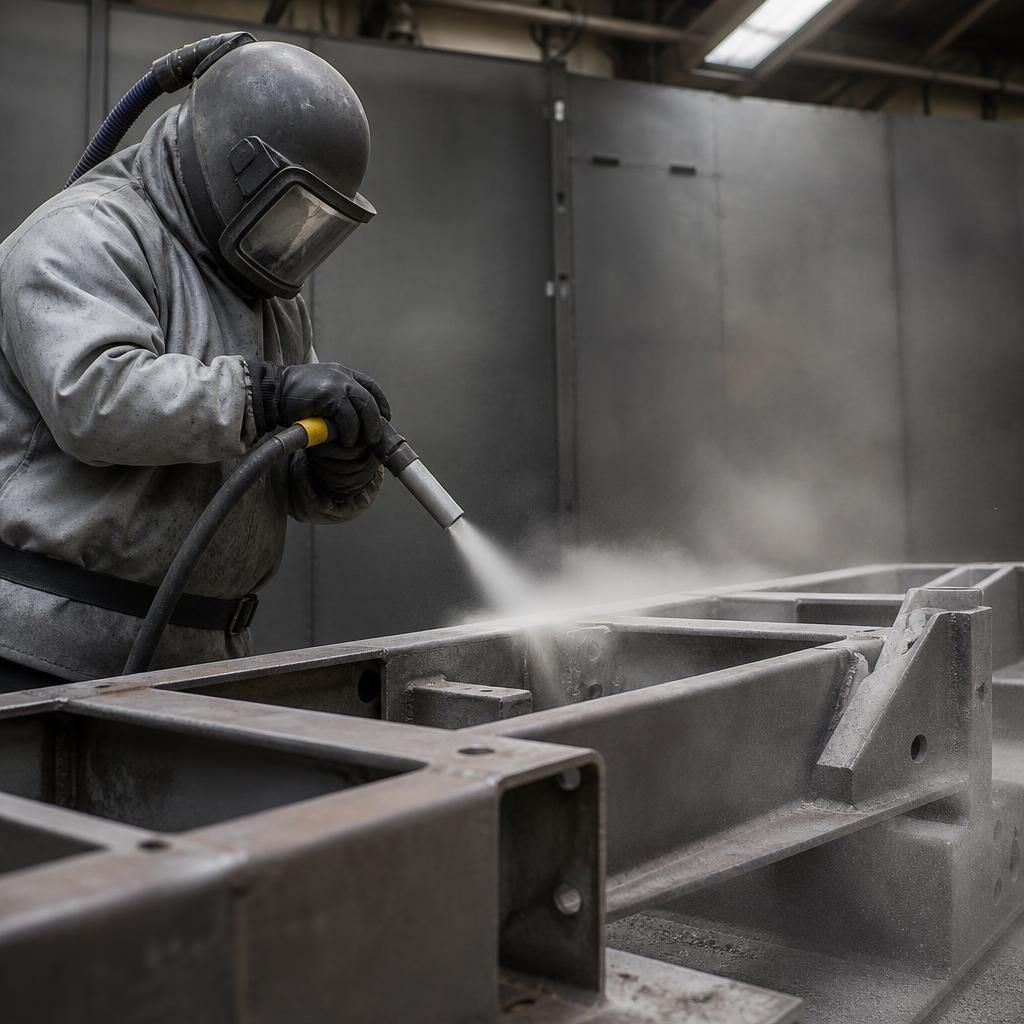
Shot blasting is particularly useful where steel carries tightly bonded mill scale, rust or an existing coating that ordinary degreasing cannot remove. Liquid cleaners can lift oil and grease, but they do not provide the same mechanical action against hard, adherent layers. By removing these barriers, blasting exposes the steel so that subsequent pretreatment can contact the substrate rather than treating an unstable surface above it.
This is important on fabricated components where different areas may have different histories: one section may be covered by mill scale, another by weld discolouration and another by an older coating. A controlled blast produces a more uniform starting condition across those areas. The prepared steel must still be inspected for residual salts, dust and embedded contamination, because blasting alone does not make every surface chemically clean or suitable for coating.