

What are the best practices for maintaining component surface integrity during the pretreatment process?
Maintaining component surface integrity during pretreatment requires controlled cleaning, suitable chemical selection, thorough rinsing and complete drying without altering the metal surface. Components should be inspected before and after treatment, handled with clean equipment, and protected from recontamination so the powder coating bonds to a clean, sound substrate.
Maintaining component surface integrity during pretreatment means preserving the substrate’s geometry, dimensional accuracy, metallurgical condition and key functional surfaces while preparing it for powder coating. The best practice is to control the complete process around the component’s material, design and end use, rather than treating every part as suitable for an identical pretreatment cycle.
Assess the component before defining the process. Review the substrate type, thickness, fabrication method and areas with tight tolerances before production begins. Aluminium, mild steel, galvanised steel and previously treated surfaces can respond differently to pretreatment chemicals and process temperatures. Welded zones, cast areas, machined faces and heat-affected regions may also have different surface characteristics. A documented review helps identify where the process could affect dimensions, appearance or performance.
Protect critical features. Threads, bores, bearing seats, sliding faces, electrical contact points and close-tolerance mating surfaces may need suitable masking or process-specific protection. This prevents unwanted build-up, chemical attack or coating deposits from interfering with assembly. Masking materials must remain stable during the pretreatment and curing stages, and their placement should be defined consistently so that protected areas remain usable without creating uncoated boundaries in locations that require corrosion protection.
Address fabrication defects before pretreatment. Burrs, sharp projections, weld spatter, embedded abrasives and poorly blended welds can remain visible through the finished coating or create local weaknesses. Sharp edges are particularly important because powder tends to form a thinner film at an edge than on a broad flat surface. Removing avoidable projections and specifying suitable edge preparation gives the coating a more uniform foundation. This is a fabrication-quality issue as well as a pretreatment issue, so responsibility should be agreed between the component manufacturer and the coating provider.
Design for drainage and process access. Hollow sections, folded returns, box sections and overlapping joints can retain process liquid. If liquid remains trapped, it may later drain onto the prepared surface, cause staining or contribute to corrosion beneath the coating. Components should therefore include suitable drain and vent openings where their design permits. Parts should also be presented so that recessed areas, internal faces and joints are exposed to the process rather than shielded by their own geometry.
Use fixturing that supports the part without deforming it. The loading arrangement should distribute the component’s weight and avoid concentrated pressure on thin sections, unsupported panels or delicate edges. Contact points need to be selected with the finished component and its functional surfaces in mind. Poor support can cause distortion, imprinting or movement during processing. For repeat batches, a defined fixture layout improves consistency and reduces the risk that changing the hanging position will expose some areas less effectively than others.
Control mechanical handling between stages. Surface integrity can be lost through impact, abrasion or contact with unsuitable racks even when the chemical process itself is correctly controlled. Parts should not be dragged across hard supports or stacked in a way that causes rubbing at edges and corners. Dedicated racks, separators or soft contact materials can be used where the component’s shape makes damage likely. Heavy parts require lifting methods that prevent flexing, twisting or localised loading.
Prevent dimensional change and substrate attack. Pretreatment should be strong enough to provide the required surface condition but not so aggressive that it etches the substrate excessively, alters sharp features or changes the appearance of machined areas. Process controls should include the variables relevant to the selected system, such as solution concentration, temperature, contact time and bath condition. These controls should be linked to the substrate and component specification rather than managed only by nominal equipment settings.
Separate incompatible materials where necessary. Assemblies containing dissimilar metals can require particular attention because contact between different substrates in a conductive process environment may encourage galvanic effects. Where practical, components should be processed separately or with an approved method for managing the dissimilar materials. Any existing plating, anodising or other surface treatment should be declared before processing, as it can influence how the substrate reacts and whether the existing layer should remain.
Define acceptance criteria for the prepared surface. Visual inspection alone may not be sufficient for critical components. The specification can identify acceptable limits for staining, etching, edge condition, masked areas, dimensional change and visible handling marks. For production work, representative test pieces or witness samples may help confirm that the selected cycle is not adversely affecting the substrate. These checks are especially useful when a component design, material source or fabrication method changes.
Keep process records traceable. Recording the component specification, loading arrangement, pretreatment route, relevant bath controls and inspection results makes it easier to identify the cause of any later coating defect. Traceability is particularly valuable for batch production, where a small change in material, welding practice or fixture design can affect the prepared surface. If a problem occurs, records allow the process to be reviewed systematically rather than relying on appearance alone.
For B2B projects, the most reliable approach is to agree the component requirements before production coating begins. Drawings should identify surfaces that must remain free from coating, areas where masking is permitted, drainage requirements, edge expectations and any dimensional limits. Sharing this information with a specialist powder coating provider enables the pretreatment process, fixturing and inspection method to be matched to the component instead of applying a generic cycle that may compromise its functional surfaces.
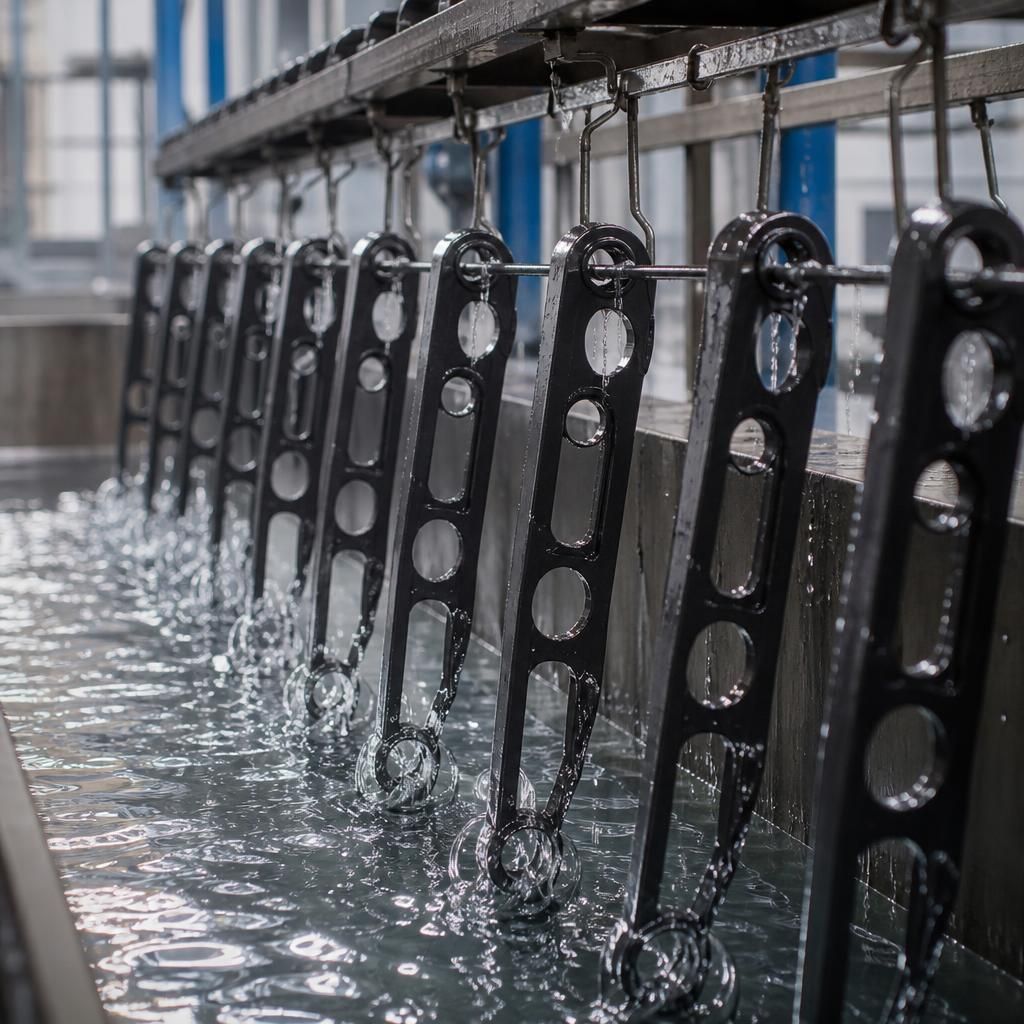
Rinse control is essential for preserving surface integrity because chemical carryover can leave residues, staining or localised deposits on the component. Each rinse stage should remove the solution from the preceding process, with attention given to recesses, joints and internal sections where liquid may be retained. Rinse water condition should be monitored as part of the pretreatment process, particularly when components require a clean, residue-free surface for consistent powder coating adhesion.
Parts should be positioned to allow rinse liquid to drain rather than flow back across prepared areas. Where a final rinse is used, its condition and renewal requirements should be defined in the process specification. This helps prevent contaminants from being transferred back onto the substrate immediately before drying and coating.
Discuss Your Pretreatment Surface Integrity Requirements
Discuss your component drawings, critical surfaces and acceptance criteria with a specialist powder coating provider before the pretreatment route is agreed. This helps establish a process that protects surface integrity throughout preparation.