

What specific pre-treatment processes are essential for ensuring optimal powder coating adhesion and longevity?
Essential pre-treatment processes include thorough cleaning and degreasing, controlled rinsing, chemical conversion treatment and complete drying before powder application. These steps remove contaminants, prepare the metal surface for stronger adhesion and help protect the finished coating against corrosion, moisture and premature breakdown.
Optimal powder coating adhesion and longevity depend on more than applying chemicals to a metal surface. The essential pre-treatment system must match the substrate, remove or neutralise surface defects, control each process stage and prevent recontamination before the powder is applied.
- Initial inspection and substrate assessment: The metal should be checked for rust, mill scale, weld spatter, sharp edges, existing coatings, corrosion products and surface damage. Different materials, including mild steel, galvanised steel and aluminium, require different preparation methods. Identifying the substrate and its condition prevents an unsuitable treatment from being applied.
- Mechanical surface preparation where required: Abrasive blasting, light abrasion or other suitable mechanical methods may be needed to remove tightly bonded scale, corrosion or previous coatings that chemical treatment alone cannot address. This can also create a controlled surface profile for the powder film to key into. Excessively aggressive preparation should be avoided because it can distort components, expose vulnerable areas or leave an inconsistent profile.
- Controlled chemical treatment: The treatment chemistry must be appropriate for the metal and the required level of corrosion protection. Process control includes maintaining the correct chemical strength, temperature, contact time and application coverage. If these variables drift, the conversion layer may be incomplete or uneven, reducing the consistency of the bond beneath the powder film.
- Rinse-stage management: Rinsing is not simply a final wash. Each stage should prevent residues from one tank being carried into the next, while the water condition should be monitored for contamination and unwanted deposits. Poorly controlled rinsing can leave salts or chemical residues on the surface, which may contribute to blistering, under-film corrosion or adhesion failure.
- Complete and even drying: Moisture trapped in seams, box sections, folded edges, welds and recesses can interfere with powder application and later cause defects. Components should therefore be dried consistently, with particular attention to areas that drain poorly. Handling should take place only when the prepared surface is dry and suitable for the next stage.
- Edge, weld and joint preparation: Sharp edges can receive a thinner powder film than broad flat areas, while welds may contain spatter, flux residues or porosity. Removing sharp projections, smoothing unsuitable weld contamination and checking difficult geometries helps the coating cover the component more uniformly and reduces points where corrosion can begin.
- Protection of contact and functional areas: Threads, bearing seats, earth points, machined faces and close-tolerance interfaces may need masking or suitable plugs before treatment and coating. This is essential where powder build-up could affect assembly, electrical continuity or the operation of moving parts. Masking materials must also withstand the process without transferring contamination.
- Clean handling between preparation and coating: Prepared metal can be compromised by fingerprints, dirty gloves, workshop dust, silicone, oil or contact with contaminated racks. Clean handling equipment and appropriate support points reduce the risk of recontamination. Components should be arranged so that prepared surfaces are not rubbed together or exposed unnecessarily before powder application.
- Process verification: A robust pre-treatment process includes checks on chemical condition, equipment performance, drainage, surface appearance and drying. Visual inspection can identify staining, water marks, missed areas or flash rust, while adhesion and finished-coating checks can help investigate recurring defects. Records of process conditions are useful when a batch contains varied substrates or complex components.
The most suitable combination depends on the metal, its previous condition, component geometry, intended service environment and the performance required from the finished coating. A dedicated pre-treatment plant can apply these stages in a controlled sequence, but plant capability alone does not replace substrate assessment and process monitoring. Preparation should be agreed with the coating requirements before production begins, particularly for parts exposed to moisture, chemicals, road salts, abrasion or outdoor conditions.
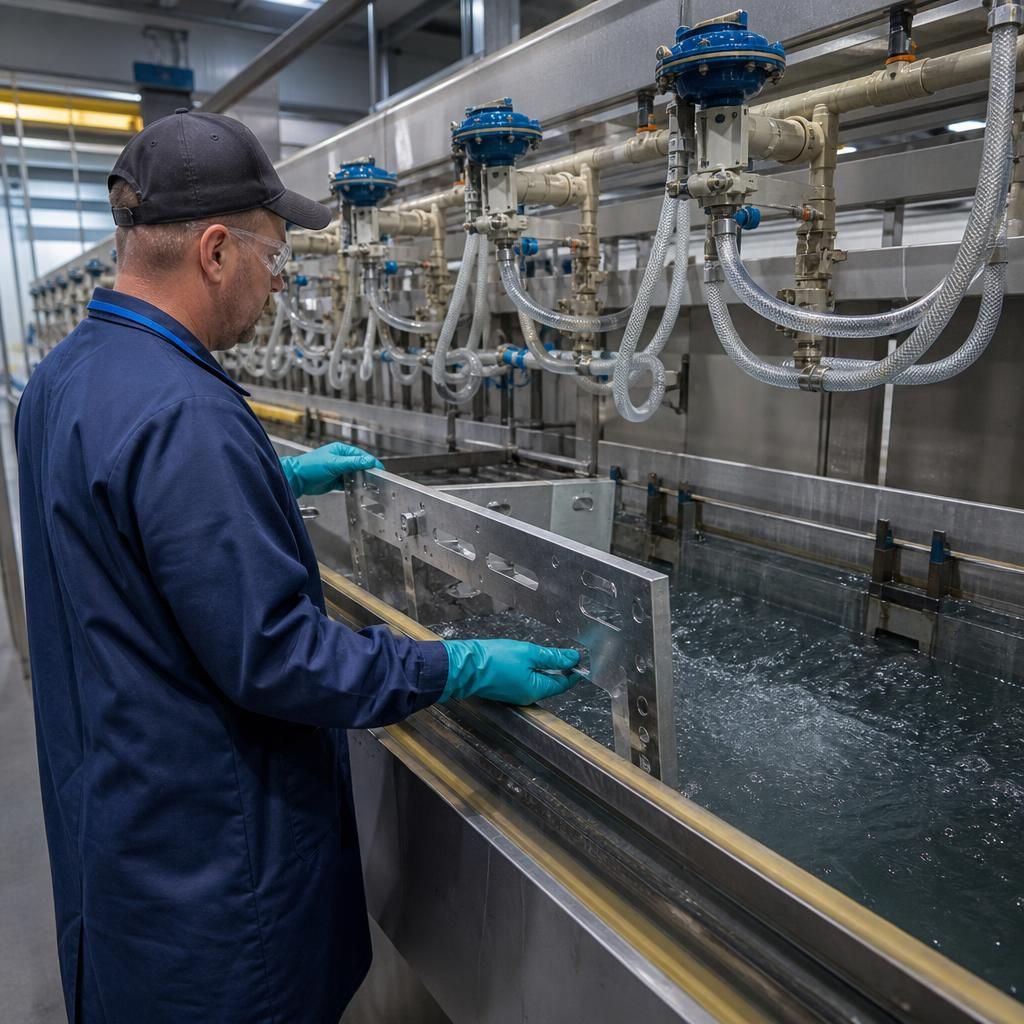
Pre-treatment must be selected for the substrate rather than applied as a universal recipe. Aluminium may require deoxidising or desmutting after cleaning to remove oxide residues and alloying particles that can interfere with the conversion layer. Galvanised steel needs a treatment that prepares the zinc surface without unnecessarily attacking it, particularly where white rust, passivation residues or storage contamination are present.
These substrate-specific stages help create a chemically suitable surface for the powder system. Using an unsuitable treatment can leave an unstable interface beneath the coating, even when the finished film appears uniform. The correct process should therefore be established from the metal type, its previous surface condition and the protection required in service.
Discuss Your Powder Coating Pre-Treatment Requirements
Discuss your metal components, substrate requirements and intended service conditions with the powder coating team to establish a suitable pre-treatment specification. This helps ensure the preparation process is aligned with the coating system and final application.