

What role does metal surface condition play in the effectiveness of pre treatment plant powder coating?
Metal surface condition directly affects how well pre-treatment plant powder coating adheres and protects the component. Removing contaminants, corrosion and residues, while addressing surface defects and achieving a suitable surface profile, helps create a consistent, durable finish.
Metal surface condition is a process variable that determines whether a pre-treatment plant can prepare a component consistently for powder coating. The condition of the substrate affects the chemical reactions during pre-treatment, the way the part dries, the uniformity of the finished film and the risk of defects developing after the coating has been cured.
The metal itself influences the treatment required. Mild steel, galvanised steel, aluminium and other alloys do not respond identically to cleaning and conversion stages. Their surface chemistry, oxide layers and reactivity vary, so a treatment suitable for one substrate may be ineffective or unnecessarily aggressive for another. Correct identification of the base metal allows the pre-treatment sequence and chemical conditions to be selected more appropriately.
Galvanised components, for example, have a zinc surface that needs controlled preparation without unnecessarily attacking the protective layer beneath the powder coating. Aluminium naturally forms an oxide film, while steel can present mill scale or manufacturing residues that alter how the treatment reacts. Mixed-metal assemblies can therefore require particularly careful assessment, since different areas may behave differently as they pass through the same plant.
Manufacturing methods also affect the result. Pressing, cutting, machining, welding and forming can leave local variations across a component. Welded areas may have heat-affected zones, weld spatter or altered surface chemistry, while machined sections can retain lubricant films or have a different texture from the surrounding metal. Cut edges and drilled holes may also behave differently during chemical treatment and drying. These variations can lead to differences in coating appearance or performance if they are not considered before processing.
Component design is relevant as well. Recesses, overlaps, folded sections and enclosed spaces can retain process liquid, making drainage and rinsing more difficult. Poor drainage may leave chemical residue on the surface, encourage staining or interfere with curing. Drain holes, suitable hanging points and access for rinsing help the pre-treatment plant treat and dry the part more evenly. Where a design cannot be changed, the processing method and racking arrangement may need to account for these features.
Moisture and storage history should be assessed before treatment. Parts that have been stored in damp conditions, exposed to condensation or handled repeatedly may require a different preparation approach from newly manufactured, well-protected components. Moisture trapped in seams or cavities can cause problems during heating, including vapour release and local coating disruption. A dry, stable substrate gives the plant more predictable conditions than metal whose condition has changed during storage or transport.
Surface temperature can affect chemical reaction rates and drying behaviour. If components enter the process at substantially different temperatures, treatment may be less consistent between batches or across different sections of a large part. The plant operator must therefore consider the material, component mass, shape and previous storage conditions when establishing suitable process controls.
Existing finishes require particular care. Previously painted, plated or treated metal cannot automatically be processed in the same way as untreated substrate. Residual layers may prevent the pre-treatment chemicals from reaching the base metal, and incompatible or poorly bonded old coatings can remain a weak point beneath the new finish. The condition of any existing layer needs to be established before deciding whether it can be retained, removed or treated as a separate preparation issue.
Inspection before processing helps identify conditions that a standard plant cycle cannot correct. A suitable assessment may consider:
- the base metal and any surface conversion or plating already present;
- the age and storage history of the components;
- the presence of moisture in joints, cavities or folded sections;
- variations caused by welding, machining, forming or cutting;
- the geometry of the part and its ability to drain and dry; and
- any existing coating whose condition could affect the new system.
This assessment helps determine whether additional preparation, a different chemical sequence, altered racking or a specific handling method is needed. It also supports more accurate identification of the likely cause if a finished part shows blistering, staining, uneven colour, pinholes or poor coverage. Not every coating fault originates in the powder or curing stage; some are linked to the condition or history of the metal before it entered the plant.
For batch and large-component work, consistency between parts is especially important. If one group contains freshly fabricated steel and another contains weathered or previously treated material, processing both groups identically may produce different results. Separating materials by substrate and condition allows the pre-treatment route to be reviewed rather than assuming that a single cycle is suitable for every component.
In practical terms, good surface-condition control gives the pre-treatment plant a stable starting point. It enables the treatment stages, rinsing, drying and subsequent powder application to work as a coordinated system. The more accurately the condition of the metal is understood before processing, the easier it is to select an appropriate route and produce a finish that is consistent with the component’s material, design and intended use.
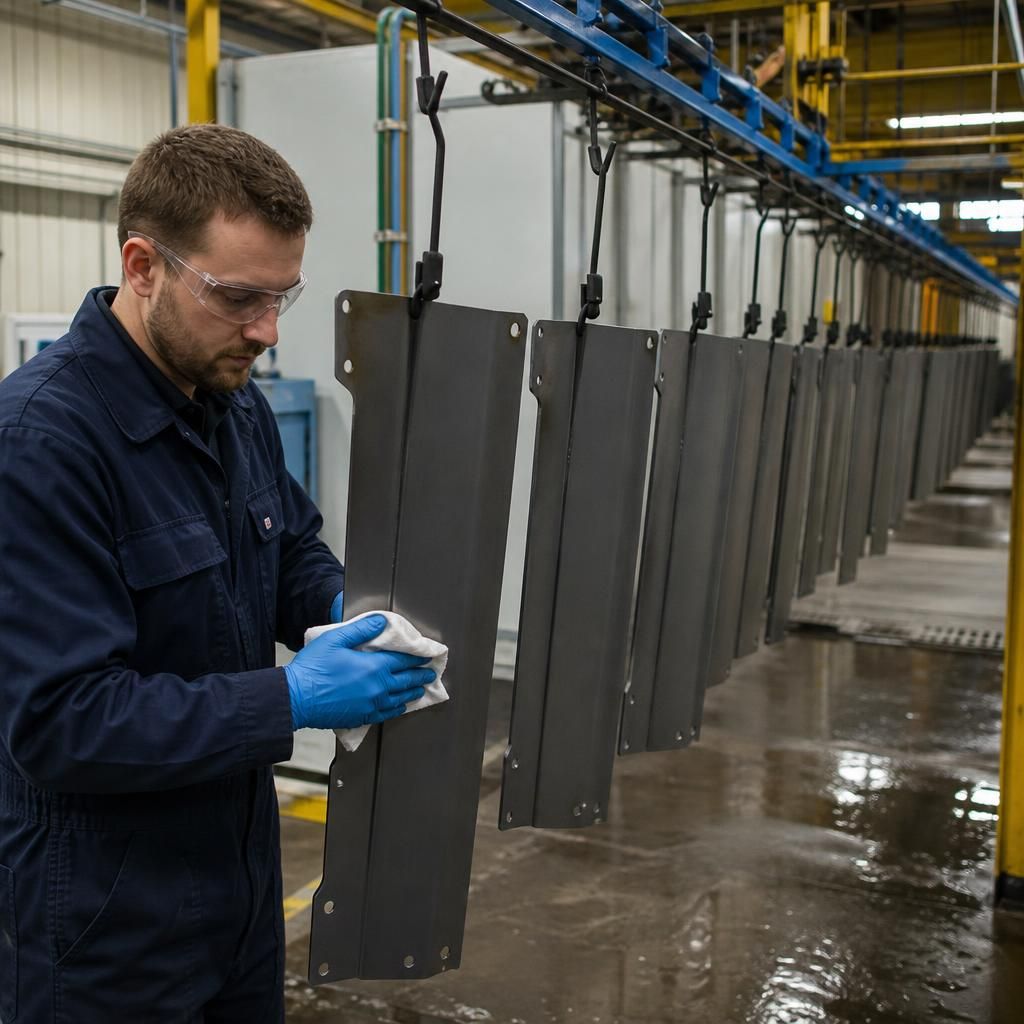
Metal surface condition must also be controlled after pre-treatment, immediately before powder application. Bare steel can develop flash rust if it remains damp after rinsing, while retained solution or handling contamination can leave marks and interfere with the next coating stage. These changes may occur even when the component appeared suitable when it entered the plant.
A final check should therefore confirm that the treated surface is clean, dry and free from visible oxidation, water marks or residues. Any unexpected change should be investigated before powder is applied, rather than covered by the coating. This links the condition of the metal at the start of the process with the condition presented to the powder, helping prevent adhesion and appearance problems caused during the transition between treatment and coating.
Discuss your metal surface condition and powder coating requirements
Discuss your component drawings, substrate details and production requirements with the powder-coating.co.uk team to determine how metal surface condition should be assessed before processing. This helps establish whether any additional preparation or handling considerations are needed for your parts.