

How does the choice of pre treatment chemicals influence the performance and longevity of powder coated surfaces?
The choice of pre-treatment chemicals affects how effectively a metal surface is cleaned, conditioned and prepared for powder coating. Correctly selected and controlled chemistry promotes adhesion and corrosion resistance, while unsuitable or poorly controlled chemicals can contribute to coating defects, peeling and premature failure.
The pre-treatment chemistry determines the condition of the surface that the powder coating must bond to. Different chemicals remove different contaminants and create different surface characteristics, so the correct selection depends on the base metal, its previous condition, the environment in which the finished part will be used and the powder system being applied. A process that is suitable for clean mild steel may be unsuitable for aluminium or galvanised components.
Cleaning chemistry is the first consideration. Alkaline cleaners are commonly used to remove oils, grease, handling residues and some workshop contamination. Their strength, temperature and contact time must be matched to the substrate. If the cleaner is too mild, residues can remain beneath the coating. If it is too aggressive, it may attack the metal, alter the surface profile or leave a difficult-to-remove film. Acidic cleaners may be selected where mineral deposits, oxidation or particular forms of surface contamination need to be treated, but they also require careful control to avoid excessive etching.
The condition of the incoming metal influences chemical choice. New steel, laser-cut parts, fabricated assemblies and previously stored components may carry different levels of mill scale, weld contamination, oil or corrosion. Aluminium can be affected by alkaline solutions more readily than steel, while galvanised surfaces need treatment that removes contamination without unnecessarily attacking the zinc layer. Chemical selection therefore forms part of the process specification rather than being an interchangeable cleaning step.
Conversion chemistry affects the interface between the metal and the powder film. After cleaning, a conversion treatment can modify the surface so that it provides a more stable base for coating. Traditional phosphate systems can create a fine, adherent conversion layer, while newer low-residue technologies may use alternative chemistries based on the substrate and performance requirements. The purpose is not simply to add another layer; it is to reduce the surface’s susceptibility to underfilm corrosion and support a consistent bond between the metal and the cured powder.
The selected conversion treatment must be compatible with the metal. Iron phosphate, zinc phosphate and non-phosphate systems do not produce the same surface or require identical operating conditions. A treatment designed for one substrate may give poor coverage, excessive residue or an unsuitable reaction on another. Where a component contains more than one metal, the process may need to balance the requirements of each exposed surface.
Rinse and sealing chemistry can be just as important as the primary treatment. Rinses remove spent cleaner, loose reaction products and surplus treatment chemicals. If rinsing is inadequate, soluble residues can remain on the component and contribute to blistering, staining or inconsistent powder application. A final rinse or seal may be used to reduce residual contamination and improve the stability of the treated surface before drying. Water quality matters because dissolved salts and high conductivity can leave deposits that interfere with coating performance.
In practical terms, the chemical product is only one part of the result. The process plant must keep the working baths within their specified operating range. Important controls can include:
- Concentration: insufficient active chemistry may leave contamination or produce an incomplete conversion layer, while excessive concentration can increase attack on the substrate or create residues.
- pH: changes in acidity or alkalinity alter how effectively the bath cleans and reacts with the metal.
- Temperature: chemical reactions commonly depend on temperature, but excessive heat can accelerate attack, evaporation or bath deterioration.
- Contact time and spray pressure: these determine whether the treatment reaches the complete surface, including edges, joints and recessed areas.
- Bath contamination: accumulated oil, metal fines and reaction products can reduce the effectiveness of a treatment and transfer contamination to later stages.
- Rinse condition: contaminated rinse water can put removed material back onto the component rather than leaving a clean surface.
These variables explain why two components treated with the same named chemical can produce different coating results. Poor dosing, blocked spray nozzles, uneven coverage or excessive carry-over between stages can create localised differences across one batch. Edges, welds, folds and cavities are particularly important because they may retain processing solution or receive less consistent spray contact.
The effect on service life is usually seen at weak points in the coating system. A sound chemical treatment helps limit the pathways through which moisture and salts can reach the metal. If the treatment is incomplete, corrosion may begin beneath a small coating defect and spread outwards. If residues remain, the powder may blister or detach locally. In either case, the visible failure can occur well after production, even though the underlying cause was an uncontrolled pre-treatment stage.
Chemical selection should also take account of the intended service environment. Components exposed to outdoor moisture, road salt, industrial pollutants or frequent washing generally require more demanding surface preparation than parts used in a dry indoor setting. The required level of treatment may also depend on the geometry of the component, the powder formulation, film thickness and whether edges or concealed areas are difficult to coat uniformly.
Verification is needed to confirm that the chemistry is doing its intended job. Routine checks can include bath analysis, pH and conductivity monitoring, visual inspection after treatment, checks for water break on the cleaned surface and examination of the conversion layer where appropriate. Finished parts may also be assessed for coating adhesion, curing and resistance to relevant exposure conditions. These checks help distinguish a chemistry problem from a powder application or curing problem.
For a batch coating process, the most reliable approach is to define the substrate and expected service conditions before choosing the chemical sequence, then maintain the agreed operating controls throughout production. Specialist powder coating facilities can use this information to select a suitable combination of cleaner, conversion treatment, rinses and drying conditions for fabricated and manufactured metal components. The result is not determined by the chemical name alone; it depends on compatibility, control and consistent coverage from the first treatment stage through to powder curing.
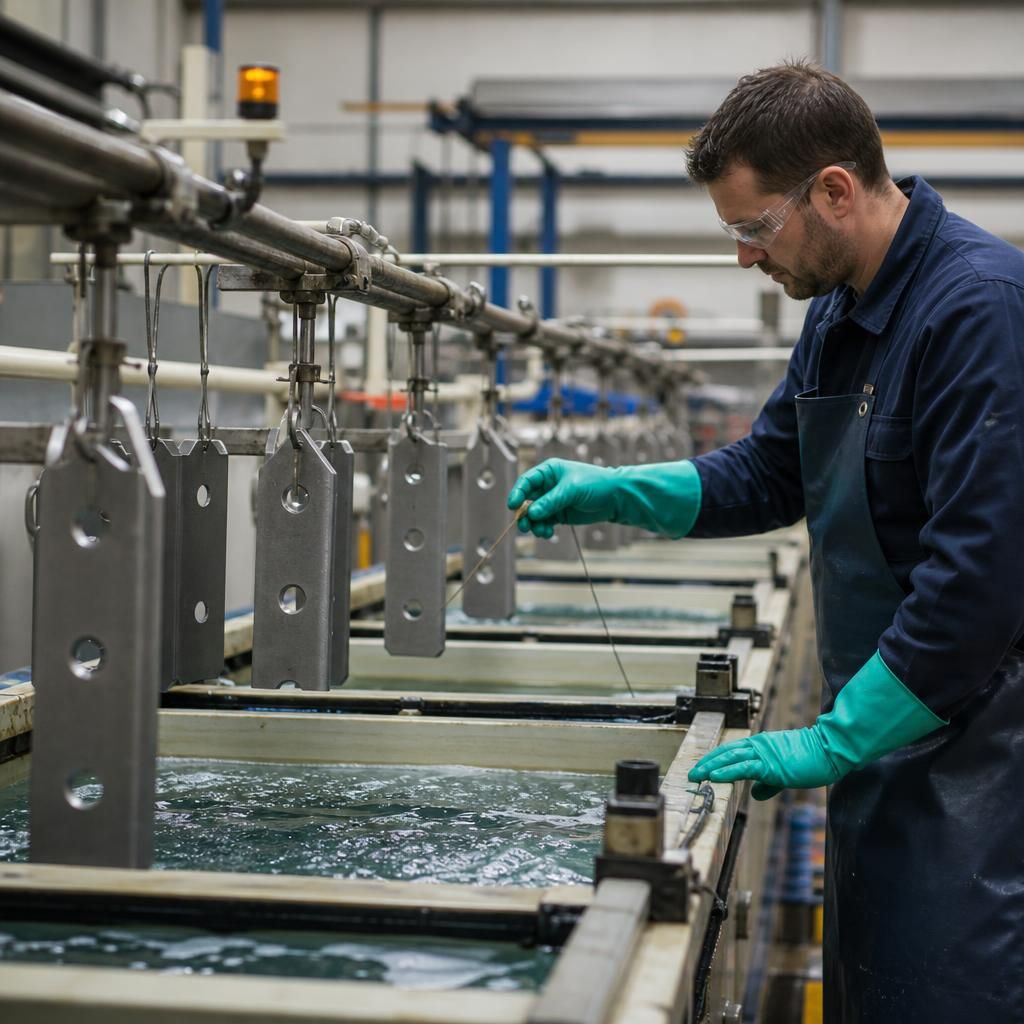
Pre-treatment chemistry affects two separate aspects of powder coating performance: immediate adhesion and long-term corrosion protection. A coating may appear well bonded after application yet still offer limited durability if the chemical treatment has not created a stable interface between the metal and the powder film.
This distinction is important when assessing treated components. Adhesion checks help identify an obvious bonding problem, while corrosion-focused evaluation shows how well the complete system resists moisture reaching the substrate. Chemical selection should therefore reflect the component’s expected exposure, not simply whether the powder initially adheres to the surface.