

What are the risks of incorrect powder curing temperatures?
Incorrect powder curing temperatures can prevent the coating from developing its intended properties, causing poor adhesion, reduced hardness, brittleness, colour or gloss variation and increased corrosion risk. Under-curing leaves the film inadequately bonded, while excessive heat can degrade the powder or damage the substrate.
Incorrect powder curing temperatures can compromise the coating’s chemical structure and create defects that may not be apparent immediately after the part leaves the oven. The principal risks are incomplete cross-linking, thermal degradation, surface defects, inconsistent appearance and premature loss of service performance. The correct cure must therefore be assessed against the powder manufacturer’s specified time and temperature, using the temperature of the metal component rather than relying only on the oven’s displayed air temperature.
Under-curing and incomplete cross-linking
Powder coating becomes a continuous film when its resin and curing agent react under controlled heat. If the component does not reach the required metal temperature, or does not remain at that temperature for long enough, the reaction may remain incomplete. The film can then have lower resistance to solvents, chemicals, moisture and mechanical handling than the powder specification indicates.
This can create practical problems during assembly and service. Fasteners, clips or adjacent components may mark the surface, cleaning agents may soften or attack it, and edges or handling points may show damage sooner than expected. A coating can look acceptable while still failing performance tests because visual appearance alone does not confirm that the cross-linking reaction is complete.
Over-curing and thermal degradation
Excessive heat or prolonged exposure can damage the coating system rather than improve it. The resin may begin to degrade, causing changes in surface chemistry and reducing the properties the coating was designed to provide. This is particularly relevant where parts are thin, have already reached temperature, or remain in the oven after the required cure has been achieved.
Overheating can also affect the substrate, pre-treatment layer or any material attached to the component. Heat-sensitive inserts, seals, adhesives and masking materials may distort, discolour or lose their intended function. The risk is greater when the oven programme is based on a general dwell time without accounting for the component’s thickness, shape and thermal mass.
Surface and appearance defects
An incorrect thermal profile can contribute to visible defects such as blistering, pinholing, cratering, orange peel, uneven flow and localised gloss variation. These problems may result from the powder flowing before the substrate has reached the required temperature, from gases escaping from the component during heating, or from the film remaining exposed to heat after its optimum cure has been reached.
Components with deep recesses, boxed sections, folded returns or heavy welded areas can heat at different rates. A single part may therefore contain regions that have experienced different cure conditions. The outside may appear satisfactory while sheltered or thermally dense areas show a different texture, flow pattern or level of cure.
Loss of functional protection
When the cured film does not develop its specified properties, its ability to act as a barrier can be reduced. Water, salts, industrial contaminants and cleaning chemicals may reach vulnerable areas more readily, particularly where the film has been weakened at edges, around fixings or at handling damage. Incorrect curing can also reduce confidence in the coating’s resistance to abrasion and repeated contact.
For fabricated assemblies, the consequences can extend beyond appearance. A coating that is too soft, insufficiently resistant or locally degraded may require remedial work, disrupt assembly, or lead to rejection when the finished component is inspected against a project or customer specification.
Why oven readings can be misleading
The temperature shown by an oven controller normally represents the air temperature at a sensor location. It does not necessarily show the temperature reached by every part in the load. Metal thickness, section geometry, loading density, airflow, entry temperature and contact with racks all influence heat transfer.
For this reason, a programme that is suitable for a light bracket may not be suitable for a heavy fabricated frame. If the same settings are used without checking the component’s thermal response, some areas may be exposed for too little time while others receive excessive heat. Poorly positioned or inaccurate sensors can add to this uncertainty by allowing the displayed reading to differ from the actual process conditions.
How the risk is controlled
- Check the powder technical data for its specified cure schedule and any permitted cure window.
- Measure the metal temperature at representative points on the component, especially on heavy sections, corners, recesses and areas known to heat slowly.
- Use a temperature profiling system when validating a new part, changing the load configuration or investigating inconsistent results.
- Allow for the time required for the metal itself to reach cure temperature; oven air temperature alone is not a reliable measure of cure.
- Keep loading patterns, rack positions and airflow conditions consistent where repeatability is important.
- Investigate changes in gloss, texture, colour, adhesion, solvent resistance or handling behaviour rather than assuming they are cosmetic issues.
- Verify oven sensors and controls as part of a documented calibration and maintenance process.
Testing should reflect the coating’s intended service rather than relying on appearance alone. Depending on the specification, this may include adhesion assessment, solvent resistance, impact or flexibility checks, hardness evaluation and corrosion-related testing. Results should be considered alongside the recorded temperature profile so that a defect can be linked to a process condition, a substrate issue, contamination or another stage of production.
In practice, correct curing is a controlled relationship between powder formulation, component temperature and exposure time. Treating the oven set point as the only relevant variable can conceal under-heated or overheated areas. A verified profile, suitable loading method and consistent monitoring provide a more dependable basis for determining whether the finished coating has received the intended thermal treatment.
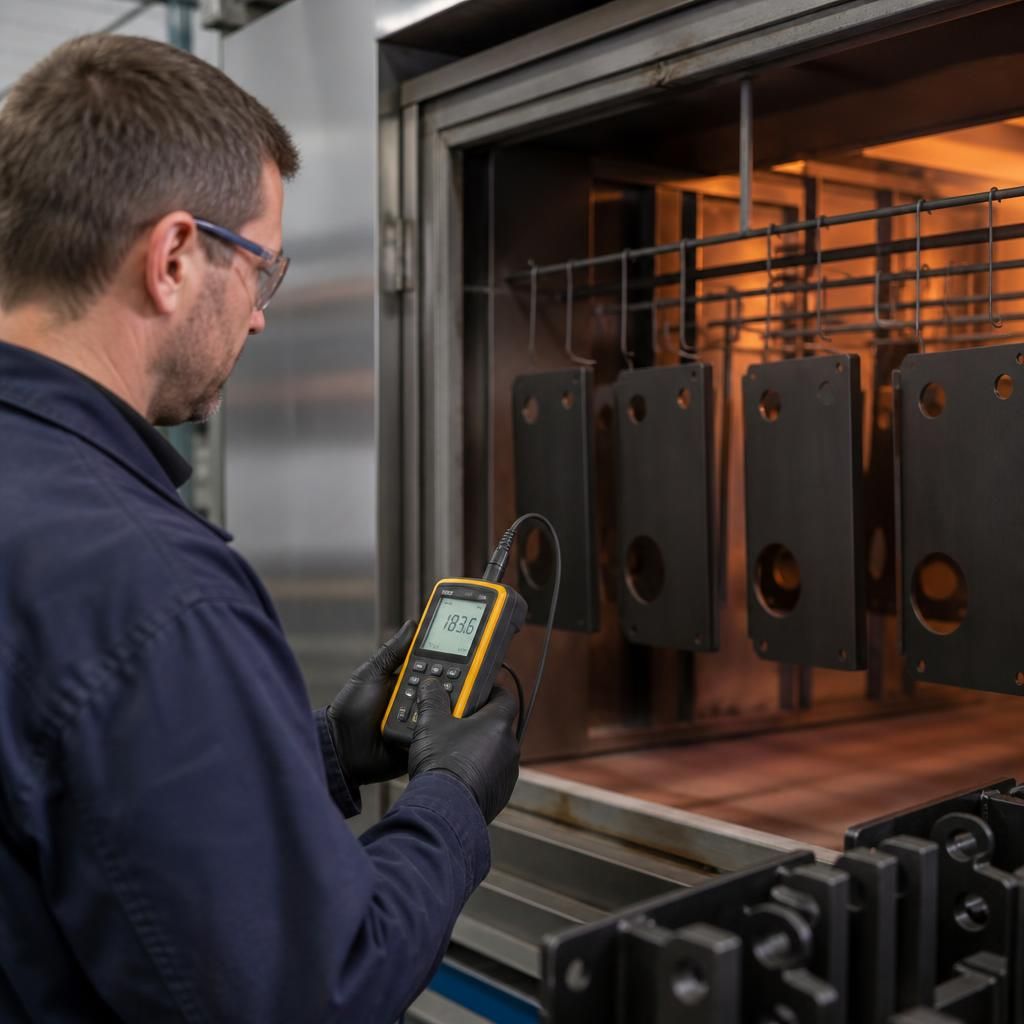
A cure schedule validated for one combination of powder, substrate, film thickness and component design cannot automatically be transferred to another job. Changing the metal gauge, surface mass, coating build, rack arrangement or load density can alter how heat reaches the part and therefore change the actual cure received by the film.
This creates a particular risk when a new component is processed using familiar oven settings. The displayed programme may be unchanged while the coating experiences a different thermal cycle. Cure conditions should therefore be rechecked whenever the powder system, part design or loading arrangement changes, with the findings recorded alongside the relevant batch or production run.