

How can precision control of curing oven variables improve the overall quality and consistency of powder coatings?
Precision control of curing oven temperature, time, airflow and loading conditions helps the powder film reach its intended cure consistently across every component. This improves adhesion, hardness, appearance and durability while reducing variation between batches and areas of the same part.
Precision control of curing oven variables means measuring, setting and maintaining the conditions that bring the powder film to its specified cure without exposing different parts of the load to materially different thermal histories. The most reliable approach controls the temperature reached by the metal itself, verifies the time spent at that temperature and confirms that air movement, loading and equipment condition are not introducing avoidable variation.
Part temperature is more significant than the oven display. An oven controller may show the target air temperature while a thick steel bracket, a hollow section or a densely packed batch is still heating. Conversely, a thin component can reach curing temperature quickly and receive excessive heat if the process is judged only by the chamber reading. Temperature probes, data loggers and representative thermal profiling show how the workpiece heats, holds and cools throughout the cycle. This identifies the slowest-heating areas and supports a cure schedule based on actual component conditions rather than assumptions.
Control limits should be established for each type of work. Components with different thicknesses, shapes, materials or hanging arrangements do not necessarily need identical settings. A validated process window can define acceptable conditions for a particular product family, including the minimum thermal exposure needed for complete cross-linking and the upper limit beyond which the coating or substrate may be affected. Keeping production within that window reduces reliance on operator judgement and makes repeat batches easier to compare.
Thermal profiling reveals variation that routine checks can miss. A profile should include several points on a representative load, especially heavy sections, corners, recesses and areas furthest from the main air path. Reviewing these traces can reveal slow heat-up, cold spots, overshoot, unstable control or excessive differences between the front and rear of the load. The result is useful process evidence: it helps distinguish a coating-material issue from an oven or loading issue before large quantities of work are affected.
Airflow requires control as well as circulation. Recirculated air must reach all relevant surfaces without creating strong localised heating. Blocked ducts, damaged fans, poor seals and incorrectly positioned work can disrupt the intended pattern. A load that shields another component may create a cooler zone, while a gap between parts may allow more direct hot-air exposure. Regular checks of fans, ducting, filters, seals and circulation patterns help preserve the conditions established during process validation.
Loading arrangements are part of the process specification. Consistent spacing, orientation and hanging points make heat transfer more predictable. Components should not touch where contact could obstruct coating or insulate the metal, and hollow or enclosed sections may need particular attention because trapped air can delay heating. Recording an approved loading method for repeat products prevents a change in rack density or component presentation from silently altering the cure cycle.
Accurate instruments support meaningful decisions. Controllers, sensors, timers and recording equipment should be checked against suitable reference instruments at defined intervals. Calibration is not simply an administrative exercise: a small measurement error can cause an operator to accept a cycle that has not reached the intended condition or to extend a cycle unnecessarily. Sensor position also matters, because a probe placed in a convenient air location may not represent the temperature experienced by the workpiece.
Powder film thickness and substrate condition also affect the result. A thicker deposited film may require different heat transfer behaviour from a light film, while a large metal mass takes longer to reach the required condition than a small component. Variations in pretreatment, surface contamination, moisture or substrate composition can create defects that are then incorrectly attributed to the oven. Oven control therefore works best when it is combined with checks on preparation, application and film build.
Consistent records make process drift easier to detect. Useful records can include the product or load identity, powder specification, application conditions, profile results, instrument checks and any deviations from the approved method. Comparing these records with inspection findings can expose gradual changes, such as increasing heat-up time, recurring defects in one oven zone or variation linked to a particular loading pattern. Corrective action can then target the actual cause rather than treating every defect by adjusting the set point.
In practice, precision control is a complete verification system rather than a single adjustment to the thermostat. It combines representative profiling, suitable operating limits, controlled loading, maintained airflow, reliable instruments and documented checks. This makes the curing stage more repeatable and provides technical evidence that each batch has experienced conditions appropriate to the coating and the component.
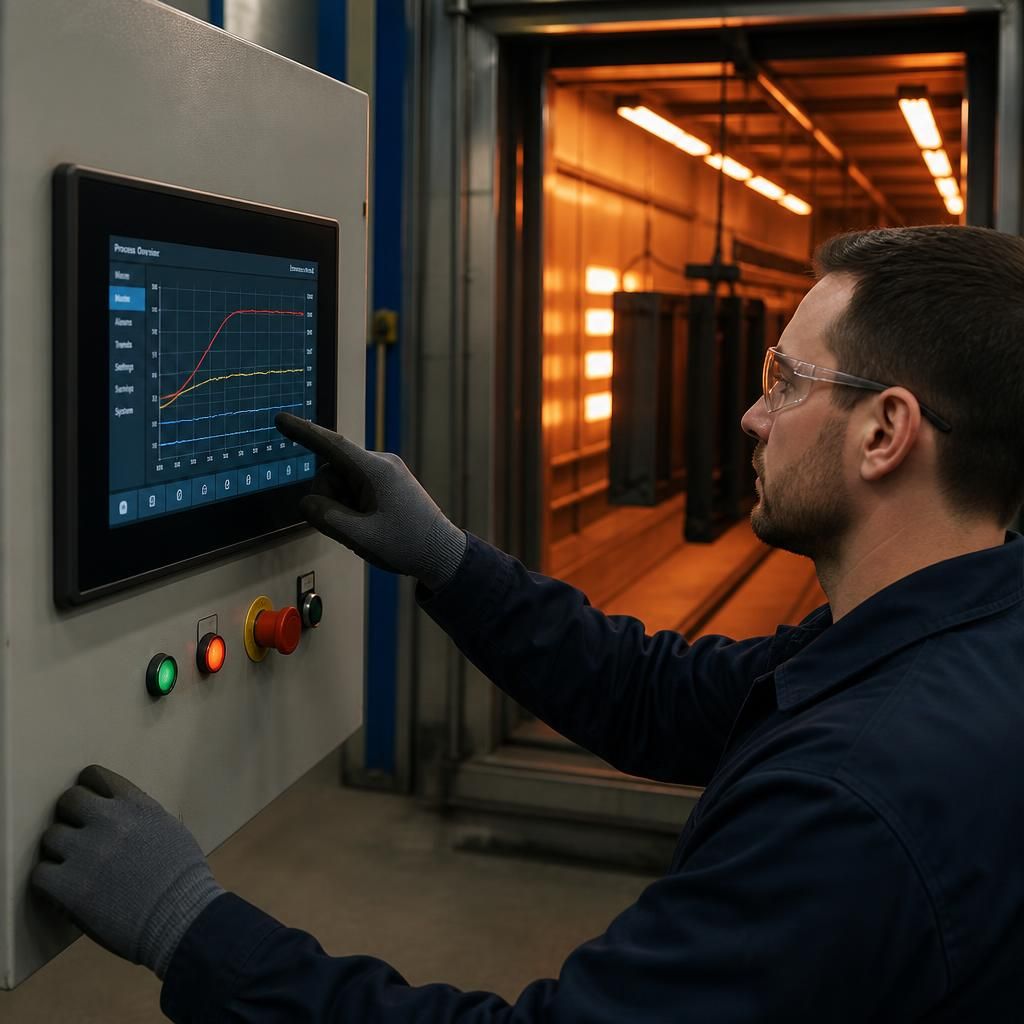
Closed-loop control helps prevent curing conditions from drifting away from the validated process window. The controller continuously compares measured temperature with the selected set point and adjusts heating output to limit fluctuations. A separate high-temperature safety limit can protect the load if the primary control system fails, while alarms can highlight slow recovery, excessive overshoot or unexpected temperature loss.
This distinction matters because a display showing the correct temperature does not necessarily mean the oven is controlling it effectively. A system that repeatedly overshoots may expose thin components or sensitive coatings to unnecessary heat, whereas unstable heating can leave the process short of the required cure. Reviewing controller trends and responding to alarms therefore supports more consistent coating quality than relying on a single end-of-cycle reading.