

What role does surface clean pretreatment play in ensuring compliance with industry standards and regulations for powder coating applications?
Surface-clean pretreatment supports compliance in powder coating by providing a controlled, repeatable foundation for coating adhesion, corrosion resistance and consistent finish quality. Removing oils, dirt, rust and other residues, while applying the appropriate preparation for the metal substrate, helps demonstrate that the coating process meets relevant quality and regulatory requirements.
Surface-clean pretreatment supports compliance by making the condition of the metal and the preparation process measurable, repeatable and suitable for the coating specification. It is not simply a cosmetic cleaning stage: it provides evidence that contaminants, corrosion products and unsuitable residues have been controlled before powder is applied, helping the finished work satisfy the relevant project, quality and regulatory requirements.
Compliance requirements vary according to the substrate, service environment, coating system and end use. A component intended for an internal dry environment may require a different preparation regime from steelwork exposed to moisture, industrial pollution or road salts. The specification should therefore identify the required cleanliness, surface condition, pretreatment chemistry, coating thickness and performance tests rather than treating every metal part in the same way.
- Surface condition: the metal should be assessed for oil, grease, mill scale, rust, welding residues, dust, marking products and other substances that could interfere with coating performance.
- Preparation standard: where the contract calls for a recognised cleanliness grade, the prepared surface can be assessed against the relevant standard, such as the ISO 8501 series for visual evaluation of steel preparation.
- Substrate suitability: steel, galvanised steel, aluminium and other metals can react differently to cleaning and conversion treatments. The selected process must avoid damaging the substrate while producing a surface suitable for the specified powder system.
- Corrosion protection: the pretreatment must be compatible with the corrosion category, exposure conditions and expected service life stated in the project requirements. Standards such as BS EN ISO 12944 may be relevant to protective paint and corrosion-protection specifications, depending on the application.
Process control is central to demonstrating conformity. A controlled pretreatment line or defined manual process should specify the cleaning stages, chemical concentrations where applicable, operating temperatures, contact times, rinsing arrangements and drying conditions. These variables affect whether contaminants are removed and whether the surface is left with residues that could impair adhesion or accelerate corrosion. Monitoring and recording the relevant parameters creates a traceable link between the incoming component, its preparation and the subsequent powder-coating stage.
Rinsing and drying deserve particular attention. Cleaning chemicals, salts and process residues left on the part can create defects beneath the powder or cause premature coating failure. Parts should be inspected after preparation for visible contamination, flash rust, trapped moisture and areas that have not been adequately treated. Hollow sections, joints, folded edges, welds and recesses may need specific handling because they can retain fluids or remain difficult to clean.
For projects governed by a recognised powder-coating quality scheme or a customer specification, pretreatment is considered alongside the complete coating system. Evidence may include:
- the identified substrate and incoming condition;
- the preparation method and any required cleanliness grade;
- chemical or process checks carried out during pretreatment;
- inspection records confirming that parts were clean and dry before coating;
- powder identification and batch traceability where required by the specification;
- coating thickness measurements and visual inspection after curing; and
- adhesion, cure or corrosion-performance testing where the contract calls for it.
These records do not replace physical control of the process. A completed form cannot demonstrate compliance if the cleaning equipment is poorly maintained, the treatment solution is outside its operating range or the prepared parts are handled in a way that reintroduces contamination. Good practice therefore combines documented procedures with equipment checks, operator controls, inspection points and corrective action when a result falls outside the agreed requirement.
Regulatory compliance also extends to the chemicals and waste associated with pretreatment. Cleaning and conversion products must be selected, stored, handled and disposed of in accordance with applicable UK health, safety and environmental obligations. Risk assessments, safety data, suitable personal protective equipment, controlled chemical storage and appropriate waste arrangements help manage exposure and prevent uncontrolled discharge. The exact obligations depend on the products and process used, so they should be confirmed against current legislation and the site’s environmental controls.
For a B2B coating project, the most reliable approach is to agree the preparation and evidence requirements before production begins. The drawing, purchase order or coating specification should define the substrate, exposure class, finish, testing expectations and any named standard or approval scheme. Where the specification is unclear, the intended use and likely contaminants should be established before selecting the pretreatment route. This prevents a generic cleaning process from being applied to a component that requires a more controlled corrosion-protection system.
Surface-clean pretreatment therefore contributes to compliance in three connected ways: it prepares a technically suitable surface, it controls risks that can undermine the coating system, and it creates records that show how the required preparation was achieved. Final compliance remains dependent on the complete specification, including application, curing, inspection and testing, but pretreatment is the point at which the condition of the metal is brought under controlled process conditions.
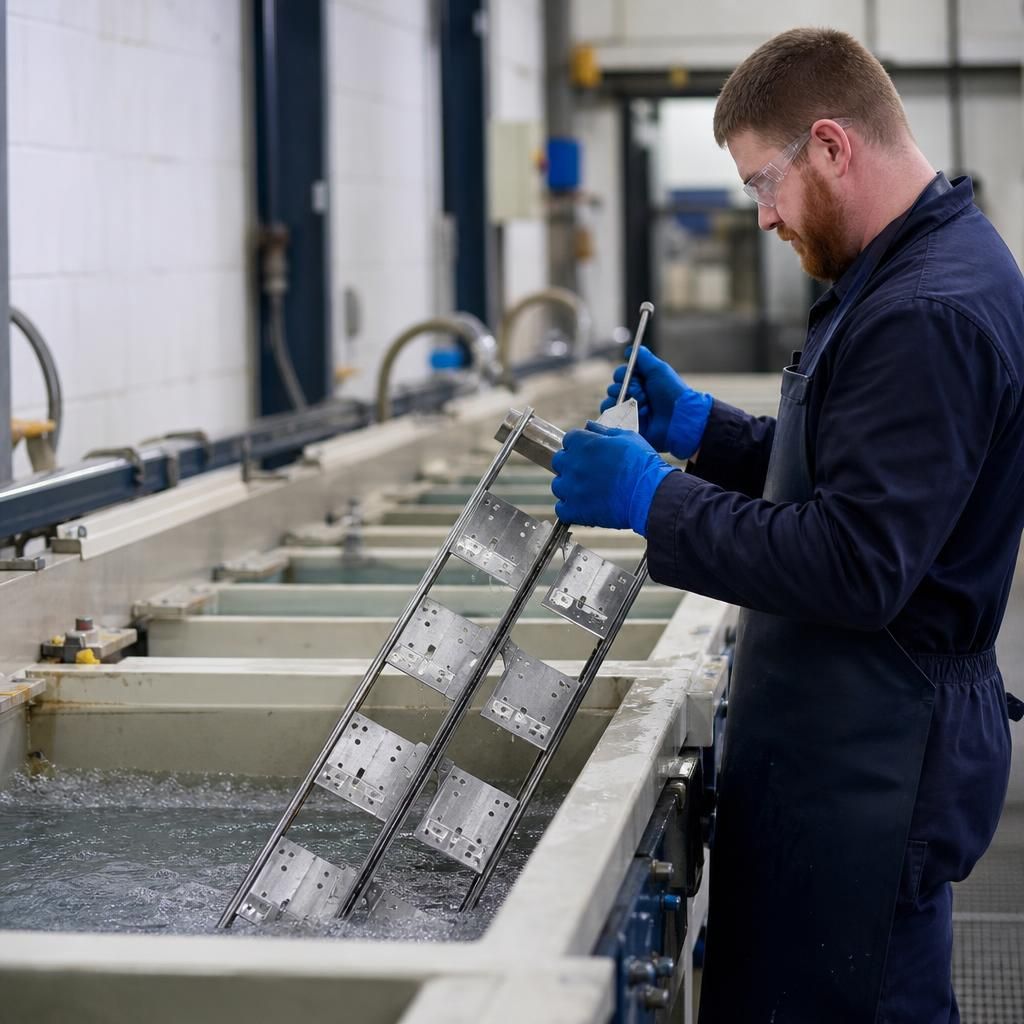
Surface-clean pretreatment supports compliance by preventing cross-contamination between different metals and treatment stages. Steel, galvanised steel and aluminium may require different cleaning or conversion conditions, so processing them through an unsuitable sequence can leave residues, cause surface attack or reduce coating adhesion. Separating substrates where necessary and controlling carry-over between process stages helps keep the prepared surface consistent with the specified coating system.
This is particularly important where components contain mixed-metal assemblies, welds, threaded areas or concealed faces. These features can retain cleaning solution or introduce contaminants during handling, creating localised weaknesses that may not be obvious in a final visual inspection. A suitable pretreatment method, careful drainage and handling with clean equipment reduce the risk of isolated non-conforming areas and support a more defensible assessment against the project specification.