

How does the choice of cleaning methods in surface pretreatment impact the final powder coating finish?
The cleaning method selected during surface pretreatment directly affects powder coating adhesion, appearance and durability. Effective removal of oils, rust, scale and other residues, without damaging or contaminating the metal, creates a suitably clean and active surface for an even, firmly bonded finish.
The cleaning method used in surface pretreatment determines the condition of the metal immediately before powder application. It influences surface profile, chemical activity, dimensional accuracy and the risk of defects such as pinholes, craters, blistering, poor coverage and premature corrosion. The most suitable method depends on the substrate, the type and severity of contamination, the component’s geometry and the performance required from the finished coating.
Aqueous alkaline cleaning is commonly used for removing oil, grease, machining residues and handling marks. The solution breaks down or emulsifies organic contamination so it can be rinsed away. If concentration, temperature, contact time or rinsing is poorly controlled, residues may remain on the metal. Those residues can interfere with coating wetting and create localised adhesion problems. Excessively aggressive cleaning can also attack sensitive substrates or alter the appearance of the surface.
Acidic cleaning and pickling are used where mineral deposits, oxide layers or light rust need to be removed. These methods can expose fresher metal, but they require careful control because over-treatment may etch the surface, cause dimensional change or leave an acidic film. Thorough rinsing and drying are therefore essential. Any retained chemical residue can react beneath the powder film or contribute to blistering and corrosion.
Solvent cleaning can be useful for targeted removal of oils, waxes and similar contaminants, particularly before a broader pretreatment stage. It does not necessarily remove rust, scale or inorganic residues, so it may be insufficient as the sole method for heavily contaminated parts. The solvent must also be fully removed; otherwise, evaporation during curing can contribute to pinholes, bubbles or local disruption of the finish.
Abrasive blasting combines contaminant removal with mechanical preparation. It can eliminate mill scale, corrosion products and tightly bonded residues while creating a controlled surface profile that gives the cured powder a suitable mechanical key. The abrasive, pressure, angle and duration must be matched to the metal. Excessive blasting may round edges, distort thin sections, embed abrasive particles or produce a profile that is too pronounced for the coating thickness. Inadequate removal, meanwhile, can leave unstable material beneath the powder.
Mechanical methods such as wire brushing, sanding or grinding may be appropriate for localised defects, weld areas and difficult-to-reach sections. They can be useful for preparation and repair work, but they may produce an inconsistent texture if applied unevenly. Grinding can also smear soft metal across the surface, while worn tools can transfer contamination. These methods should be followed by an appropriate cleaning step rather than treated as proof that the surface is ready for coating.
For some metal systems, a chemical conversion treatment follows cleaning. This is not simply another way to remove contamination: it modifies the surface to improve the interface between the metal and the powder coating and can support corrosion resistance. Its effectiveness depends on correct substrate selection, solution control, coverage, rinsing and drying. A conversion layer that is too heavy, incomplete or contaminated may reduce rather than improve coating performance.
The choice of method also has to account for component design:
- Deep recesses, internal channels and boxed sections may retain cleaning solution or rinse water, leading to staining, residue or corrosion beneath the coating.
- Welds can contain heat scale, spatter, flux and residues that need more focused preparation than adjacent sheet or bar.
- Sharp edges and corners may receive less powder during application, so aggressive preparation should not create unnecessarily severe edge profiles.
- Thin sections can distort under abrasive or thermal stress, whereas heavy sections may require more substantial treatment to remove bonded scale.
- Mixed-metal assemblies need a process that does not damage one substrate while preparing another.
Surface condition between stages is as important as the initial cleaning method. Rinsing must remove loosened material and chemical residues, and the final rinse quality should be suitable for the process being used. Components should then be dried completely, particularly around joints, folds, holes and enclosed areas. Contact with dirty racks, unclean gloves or contaminated handling equipment can reintroduce oils and particles after cleaning, undoing the preparation already carried out.
Cleaning methods can also affect the visual appearance of the final finish. A uniform blasted or chemically prepared surface generally gives more consistent powder wetting and appearance. Variations in texture, residual stains or localised oxidation can show through as differences in gloss, texture or colour perception, even when the same powder has been applied. A surface that is chemically clean but excessively rough may produce a different appearance from one prepared with a finer, more controlled profile.
Selection should therefore be based on a defined process sequence rather than on the strongest available treatment. A typical assessment considers the substrate, contaminant type, component geometry, required corrosion protection, desired appearance and the powder system’s application requirements. Test panels or representative components can help confirm that the selected method removes the relevant contamination without damaging the metal or creating an unsuitable profile.
Before powder is applied, the prepared surface should be checked for visible residue, oxidation, water marks, embedded abrasive, excessive roughness and areas that have been missed. Where necessary, process checks can include solution condition, rinse quality, drying effectiveness and surface-profile assessment. These controls link the cleaning stage to the final finish: the coating cannot compensate for a chemically or mechanically unsuitable surface, while a correctly chosen and controlled method gives the powder a consistent foundation for curing and service.
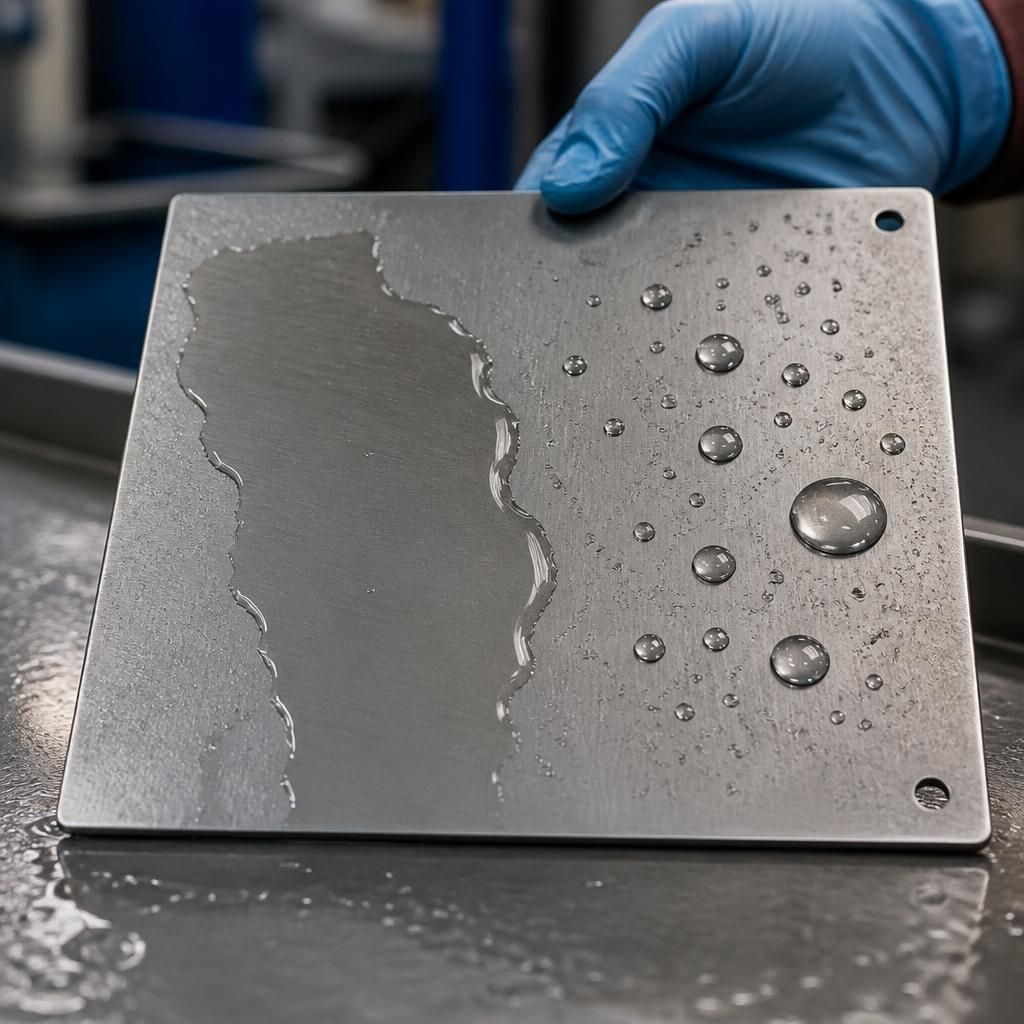
A clean-looking surface is not necessarily ready for powder coating. A water-break test can help identify residual oils: when a clean, properly rinsed surface is wetted, water should form a continuous film rather than retract into beads or separate patches. This provides a useful indication that greasy contamination has been removed, although it does not confirm the absence of salts, abrasive particles, oxide residues or trapped moisture.
For more demanding components, this visual check should be supported by process controls such as rinse-water monitoring, inspection under suitable lighting and checks of difficult areas including welds, folds and recesses. Combining these checks with the correct cleaning method reduces the risk of applying powder over contamination that may not be visible but can later affect adhesion or appearance.
Discuss the right pretreatment method for your powder coating project
Discuss your component’s substrate, contamination and required finish with our powder coating team to identify a suitable pretreatment approach. We can advise on preparation requirements for projects requiring collection and delivery across the Midlands and surrounding areas.