

What specific advantages do chemical pretreatments offer in terms of corrosion resistance and finish quality?
Chemical pretreatments improve corrosion resistance by removing contaminants and creating a conversion layer that helps protect the metal beneath the powder coating. They also promote more consistent adhesion and coverage, producing a cleaner, more uniform finish with fewer surface defects.
Chemical pretreatments improve powder-coated metal in two distinct ways: they increase the substrate’s resistance to corrosion beneath and around the coating, and they create more controlled conditions for achieving the intended appearance. Their value comes from the chemical modification of the metal surface, rather than from the powder film alone.
Corrosion resistance benefits
- Reduced underfilm corrosion: If moisture or corrosive contaminants reach a small weakness in the coating, an appropriate pretreatment can slow the spread of corrosion between the metal and the powder film. This helps limit blistering, lifting and progressive coating failure.
- Protection at exposed edges and imperfections: Cut edges, drilled holes, joints and minor coating discontinuities are particularly vulnerable because they expose the substrate. A suitable conversion treatment can provide additional protection in these areas, although it cannot compensate for badly damaged or inadequately coated metal.
- Improved resistance to humidity and salt exposure: Pretreatment chemistry can be selected to suit the expected environment. This is important for components used outdoors, in damp locations or where airborne salts and industrial pollutants may be present.
- More stable performance over time: By slowing the electrochemical reactions that cause rust and other forms of substrate attack, pretreatment helps the complete coating system retain its protective function for longer. The actual result depends on the metal, coating specification, film thickness, curing and service conditions.
The chemistry must match the substrate. Steel, galvanised steel and aluminium do not react in the same way, so a treatment that is appropriate for one may be ineffective or damaging on another. The required level of protection also depends on whether the component will remain indoors, face regular condensation, or be exposed to weathering and industrial contamination.
Finish-quality benefits
- More predictable surface appearance: A chemically prepared substrate gives the powder film a more stable base, helping the finished part meet the intended requirements for colour, gloss and texture.
- Lower risk of localised coating faults: Residues, oxides and processing films can interfere with the coating process. Properly controlled treatment and rinsing reduce the likelihood of pinholes, craters, fisheyes, staining and other visible irregularities.
- Better consistency between batches: When concentration, temperature, contact time and rinsing are controlled, components can present a more repeatable surface to the powder application stage. This is especially important where separate parts must match after assembly.
- Improved edge and profile definition: Effective pretreatment helps the powder film behave more consistently across flat faces, bends, recesses and fabricated details. It does not eliminate the normal limitations of powder application, but it supports a more even visual result.
Finish quality is also influenced by the condition of the incoming metal. Oil, welding residue, mill scale, rust, fingerprints and previous coatings may require different preparation steps before the chemical stage. Pretreatment cannot reliably correct deep pitting, rough welds or poorly prepared edges; those defects may remain visible through the powder coating.
How the advantage is maintained in practice
The performance of a pretreatment depends as much on process control as on the chosen chemical. The treatment must be applied for the specified contact time, at the correct concentration and temperature, followed by suitable rinsing and drying. Poor rinsing can leave residues that affect colour or adhesion, while insufficient treatment can leave reactive contamination on the metal. Excessive treatment may also attack the substrate or create an unsuitable surface.
Quality checks should therefore consider the complete process rather than judging the chemical in isolation. Useful checks include visual inspection after preparation, monitoring bath condition, confirming that parts are fully rinsed and dry, and examining coated samples for appearance and corrosion-related failure. Where the end use is demanding, testing should reflect the actual substrate, powder system and service environment.
Chemical pretreatment is not a substitute for correct powder selection, sound fabrication or proper curing. Its specific advantage is that it strengthens the interface between those stages: the metal is placed in a more stable condition before coating, the finished surface is less likely to show preparation-related defects, and the completed system has better protection against moisture and corrosive attack. The most suitable treatment is therefore the one selected for the metal type, required appearance and conditions the component will encounter.
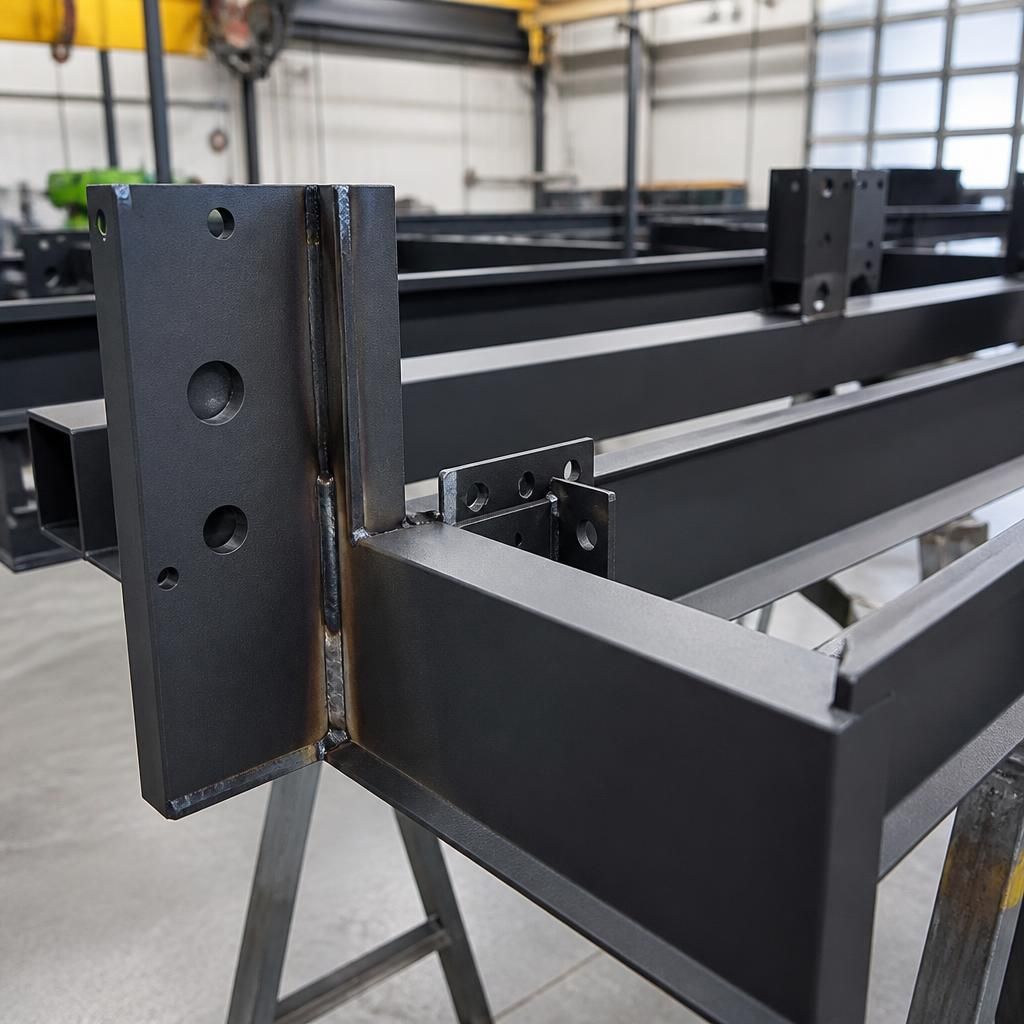
Chemical pretreatment can help prevent substrate-related staining from becoming visible through or around the powder coating. This is particularly relevant where fabricated components contain different surface conditions, such as clean metal alongside weld-affected areas or previously oxidised sections. By conditioning the surface before powder application, the treatment reduces variation in how the substrate interacts with the coating system, supporting a more consistent finished appearance across the complete part.
Discuss the Right Chemical Pretreatment for Your Components
Discuss your metal substrate, intended service environment and finish requirements with our team to identify a suitable chemical pretreatment approach for your components. We can advise on the preparation considerations before powder coating.