

What are the environmental considerations when selecting pretreatment chemicals for powder coating?
Selecting pretreatment chemicals for powder coating involves balancing cleaning and corrosion-performance requirements with environmental impact. Consider hazardous substance content, wastewater treatment needs, chemical consumption, energy and water use, waste generation, and whether a lower-impact formulation can prepare the specific metal substrate effectively.
Environmental selection of powder coating pretreatment chemicals should be based on the complete lifecycle of the process, not simply on whether a product is described as “eco-friendly”. The most suitable option is one that meets the required corrosion and adhesion performance for the substrate while reducing regulatory risk, resource demand, replacement work and environmental impacts across preparation, application and disposal.
Assess the full lifecycle rather than one environmental claim
A chemical may have a favourable profile in one area but create a different burden elsewhere. For example, a formulation with a lower-hazard classification may require additional process stages, closer control or more frequent replacement if it is poorly matched to the metal or coating specification. Conversely, a treatment that produces a consistent, durable surface can reduce the need for stripping, recoating and transporting rejected components.
When comparing products, consider:
- the raw materials and substances used in the formulation;
- the manufacturing, storage and transport requirements associated with the product;
- the process conditions needed to achieve the required pretreatment;
- the useful working life of the treatment system;
- the likely frequency of rejects, rework or recoating; and
- the arrangements required for residues, spent solutions and packaging at the end of use.
This broader assessment is more meaningful than selecting a product based on a single label, such as phosphate-free or chromium-free, without checking how it performs in the intended production process.
Check substrate compatibility and service requirements
Environmental performance depends partly on choosing a treatment that is appropriate for the metal. Aluminium, galvanised steel, mild steel and mixed-metal assemblies can respond differently to cleaning and conversion stages. A treatment that is unsuitable for the substrate may cause uneven conversion, flash corrosion, poor powder adhesion or premature coating failure.
The environmental consequence is not limited to the pretreatment bath. Defective parts may need additional cleaning, stripping and processing before they can be coated again. In some cases, a component may be scrapped rather than recovered. Selecting a chemistry that reliably prepares the specified metal and supports the required service life can therefore reduce avoidable material use and repeat processing.
Consider durability as an environmental factor
A coating system that remains properly bonded and resists corrosion for its intended application can reduce the environmental impacts associated with maintenance and replacement. This does not mean that the most aggressive pretreatment is automatically the most sustainable. The objective is to establish the least burdensome treatment that provides the necessary surface condition for the powder coating and the component’s operating environment.
Performance should be assessed against the actual specification, including exposure conditions, appearance requirements, edge coverage, joint areas and the expected handling of the finished component. Laboratory or production trials may be appropriate where a proposed lower-impact chemistry has not previously been used with the metal, powder system or line configuration.
Review process integration
The environmental profile of a chemical is also affected by how it fits into the existing pretreatment line. A formulation that can be introduced without unnecessary changes to tanks, dosing equipment or process stages may avoid additional installation materials and disruption. It is also important to establish whether the chemistry is compatible with the plant’s control systems and the powder coating specification.
Useful questions for a technical review include:
- Can the chemical operate within the existing line design and substrate range?
- Does it require a different temperature, contact time or application method?
- Will it remain stable under the expected production conditions?
- Can operators monitor the relevant control parameters consistently?
- Will changing chemistry affect the quality of subsequent rinsing, drying or powder application?
- Does the supplier provide clear instructions for commissioning, testing and decommissioning the process?
These questions help identify indirect impacts that may not appear on a product data sheet.
Use reliable environmental and technical documentation
Environmental claims should be supported by current safety data, technical data and relevant compliance information. Documentation should identify the product’s classification, handling requirements, operating parameters and disposal considerations without relying solely on broad terms such as “green”, “clean” or “sustainable”.
Where available, request information about the formulation’s restricted substances, packaging, storage stability and any independently assessed environmental declarations. The information should be specific enough to compare alternatives on a like-for-like basis. A product cannot be assessed properly if its environmental claim is not matched by transparent technical evidence.
It is also sensible to confirm whether the supplier’s recommendations apply to the exact substrate and coating system being considered. Generic guidance may not account for a particular alloy, galvanised surface, fabrication oil or required corrosion-performance class.
Account for compliance and future change
Environmental selection should include present and foreseeable regulatory requirements. Restrictions on certain substances, classification rules and waste controls can change, creating additional obligations for storage, treatment, records or disposal. A formulation with a clear compliance position and well-maintained documentation may reduce the risk of having to change the process at short notice.
This is particularly relevant for businesses coating parts for regulated supply chains. The end customer may require evidence about restricted substances, material declarations or the environmental controls applied during manufacture. Keeping records of the selected chemistry, process specification, monitoring results and waste arrangements supports that due diligence.
Compare alternatives using a documented decision matrix
A practical comparison should give environmental factors an appropriate weighting alongside technical performance. One option may have a lower-impact formulation, while another may offer better reliability on a difficult substrate. The final decision should reflect the complete application rather than a single attribute.
A decision matrix can assess:
- substrate compatibility and required corrosion performance;
- adhesion and finish consistency after powder application;
- operating complexity and process-control requirements;
- regulatory documentation and restricted-substance status;
- lifecycle implications of rejects, maintenance and recoating;
- supplier support for trials, monitoring and end-of-use arrangements; and
- the environmental evidence available for making a defensible comparison.
For industrial powder coating, the environmentally preferable pretreatment is usually the one that delivers the required technical result with the least overall burden across its lifecycle. That assessment should be confirmed through controlled trials and reviewed whenever the substrate, powder system, production method or applicable requirements change.
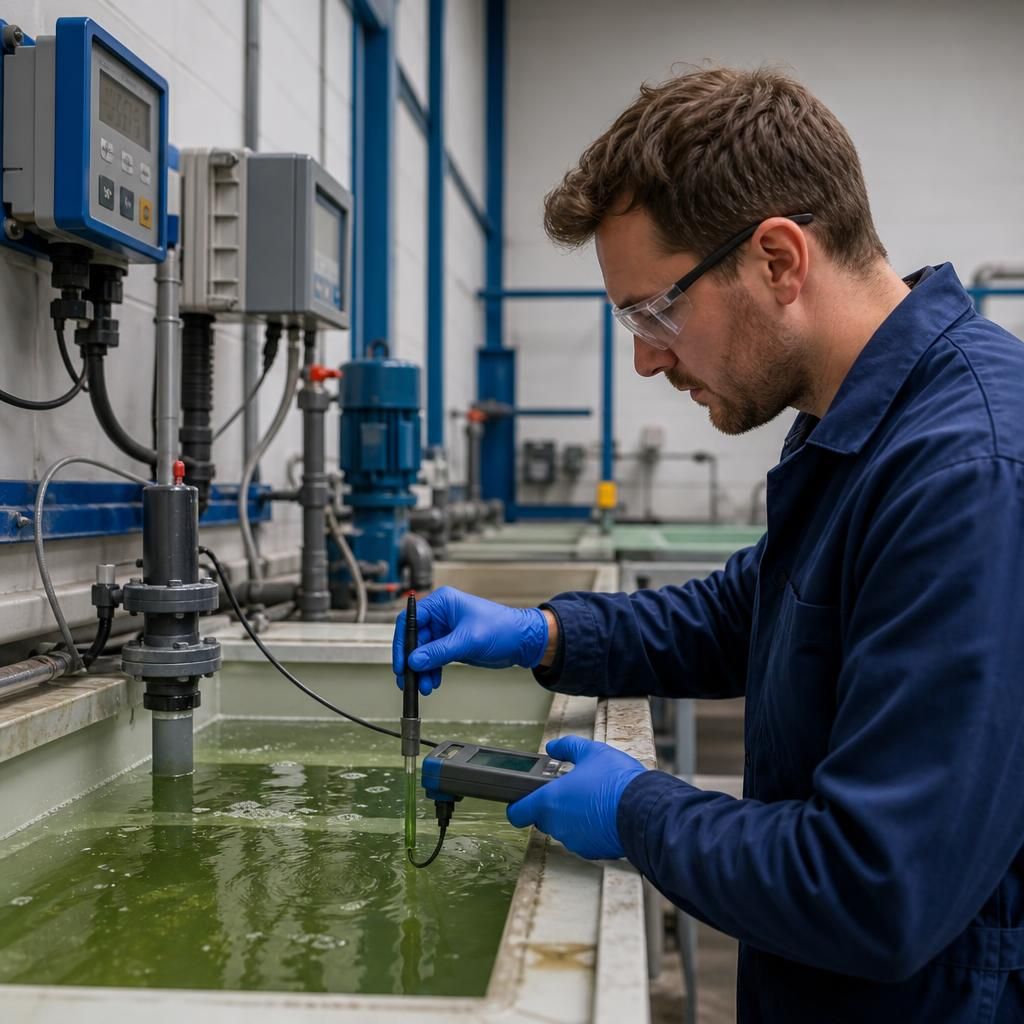
Chemical dosing and bath control are important environmental considerations because excess concentration can increase chemical consumption and the load placed on wastewater treatment, while an exhausted or poorly controlled bath can lead to defective parts and repeat processing. The aim is to maintain the lowest effective operating condition for the specified substrate and coating system.
Ask how the pretreatment process is monitored and whether control can be based on measurable parameters such as pH, conductivity, concentration or temperature. Regular checks can help identify contamination, chemical drag-out and gradual bath deterioration before they result in unnecessary replenishment or disposal. Where suitable for the process, staged rinsing, controlled drainage and recovery of usable solution may further reduce losses. Any changes should be validated against adhesion and corrosion requirements rather than made solely to reduce chemical use.